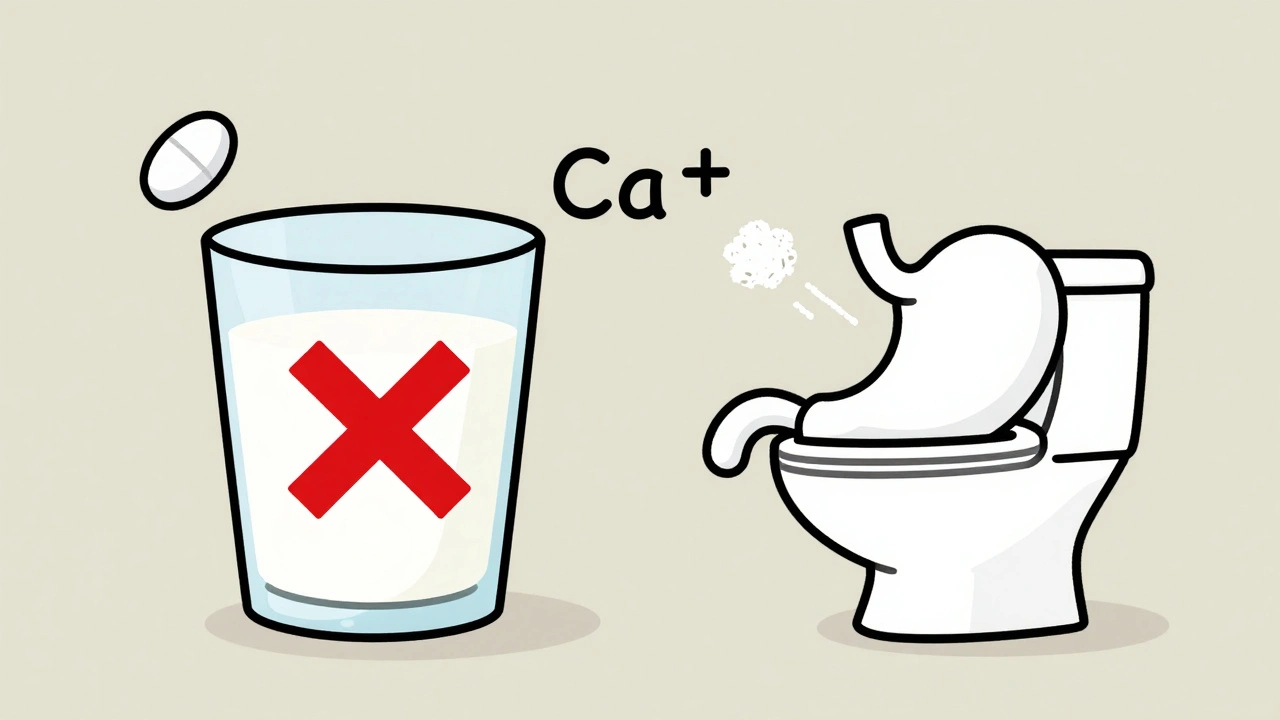
When you’re sick and your doctor prescribes an antibiotic, you want it to work. But what if the very thing you eat with it - like a glass of milk, a bowl of yogurt, or even a calcium-fortified orange juice - is quietly stopping that medicine from doing its job? This isn’t a myth. It’s chemistry. And it’s happening more often than you think.
Why Dairy Stops Antibiotics from Working
The problem isn’t that dairy is bad for you. It’s that it contains calcium - and calcium binds tightly to certain antibiotics in your stomach. When this happens, the two form a solid, chalky compound called a chelate. This compound can’t be absorbed into your bloodstream. Instead, it passes right through your gut and out of your body. The antibiotic? It never reaches the infection. This isn’t new. Scientists first noticed it in the 1960s with tetracycline. Back then, patients were told to avoid milk. But many didn’t understand why. Today, we know the exact mechanism: calcium ions (Ca++) latch onto antibiotic molecules like magnets, blocking their path into the blood. The result? You might be taking your full dose, but your body only gets 10% of it.Which Antibiotics Are Affected?
Not all antibiotics react this way. Penicillin, amoxicillin, azithromycin - these are mostly fine with dairy. But two major classes are at high risk:- Tetracyclines: This includes tetracycline, doxycycline, and minocycline. These are often used for acne, Lyme disease, and respiratory infections. Tetracycline itself can lose up to 90% of its absorption when taken with milk. Doxycycline is a bit less sensitive, but still affected - especially if you’re eating a big bowl of cheese or drinking a smoothie right after your pill.
- Fluoroquinolones: Ciprofloxacin (Cipro), levofloxacin (Levaquin), and moxifloxacin (Avelox) fall here. These are common for UTIs, sinus infections, and pneumonia. Studies show milk can slash ciprofloxacin absorption by 70%. Yogurt? Up to 92%. That’s not a small drop - that’s treatment failure territory.
Even non-dairy products can cause the same problem. Calcium-fortified almond milk, soy milk, or orange juice? Same issue. Some people think plant-based means safe. It doesn’t. If it has added calcium, it’s just as risky as cow’s milk.
How Long Should You Wait?
Timing isn’t optional. It’s the difference between healing and relapse.For tetracyclines, the rule is simple: take the pill at least one hour before eating dairy - or wait two hours after your last bite of cheese or yogurt. That’s the minimum. Some experts recommend three hours, especially if you’re on a high dose or treating a serious infection.
For fluoroquinolones, the window is wider. Take ciprofloxacin or levofloxacin two hours before dairy. But after? Wait four to six hours. Why the longer wait? These drugs stay in your stomach longer, and calcium keeps binding. A 2022 study found that even a small serving of yogurt six hours after a dose still lowered absorption by 30%.
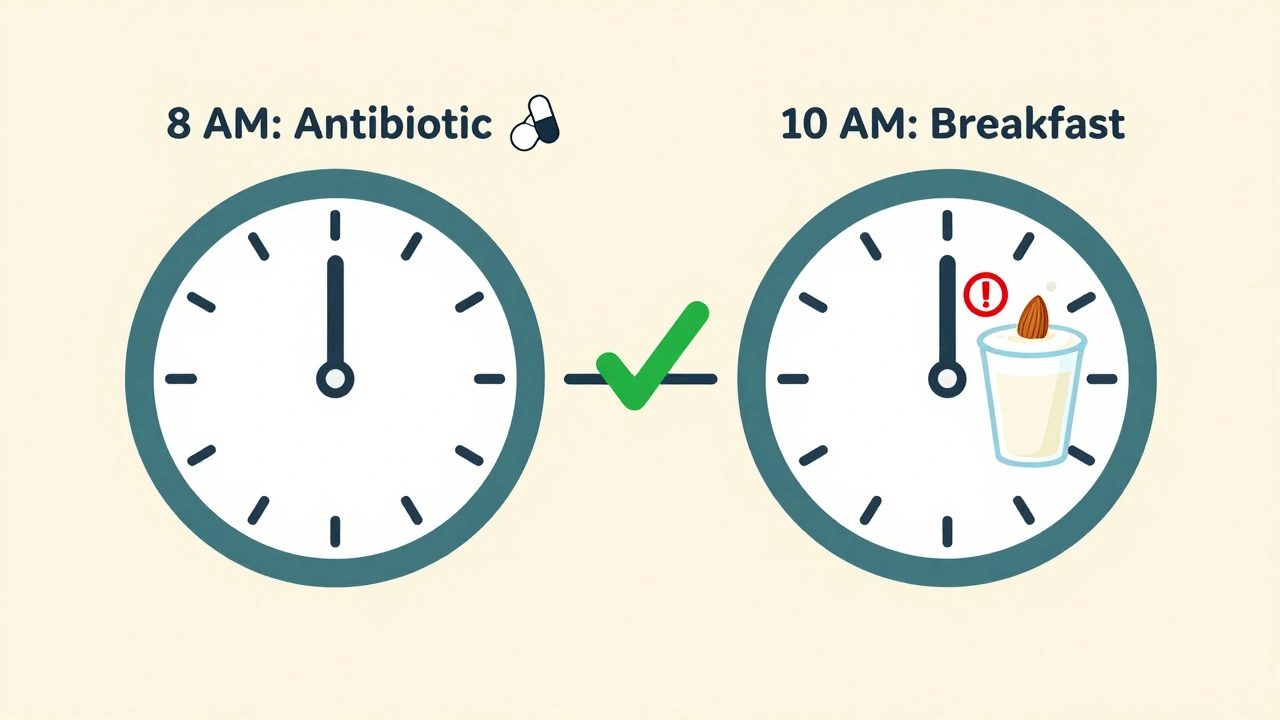
Here’s a real-world example: If you take doxycycline at 8 a.m., don’t have your cereal with milk until 10 a.m. If you take ciprofloxacin at 8 p.m., skip your bedtime yogurt until 2 a.m. - or better yet, save it for breakfast the next day.
What Happens If You Ignore the Rules?
You might not feel sick right away. But here’s what’s really going on:- Your infection doesn’t clear. Symptoms linger. You think the antibiotic didn’t work - but it never even got to the battlefield.
- You might end up back at the doctor, needing a stronger, more expensive antibiotic - or even an IV.
- Worse, you’re helping bacteria become resistant. When antibiotics don’t kill all the bugs, the survivors learn to fight back. That’s how superbugs grow.
A 2023 study in the Journal of Antimicrobial Chemotherapy found that 22% of recurring UTIs were linked to dairy timing mistakes. One patient in Johns Hopkins Hospital’s clinic had three UTIs in six months. She took ciprofloxacin every time - and always ate yogurt with it. When she changed her routine, the infections stopped.
What About Calcium Supplements?
Same problem. Calcium pills, antacids with calcium, even multivitamins with added calcium - all can bind to tetracyclines and fluoroquinolones. If you take a calcium supplement, don’t take your antibiotic within two hours before or four hours after. Some people take their calcium at night and their antibiotic in the morning. That’s a smart fix.And don’t forget: some iron supplements and antacids with aluminum or magnesium also cause this. Always check the label. If it says “contains calcium,” “fortified,” or “antacid,” treat it like dairy.
How to Make This Easier
You don’t have to live on a strict diet. Just plan ahead.- Take your antibiotic first thing in the morning - on an empty stomach - before coffee or breakfast.
- Have dairy with lunch or dinner, not at the same time as your pill.
- If you’re on a twice-daily schedule, take one dose in the morning and the other at bedtime. That naturally separates it from meals.
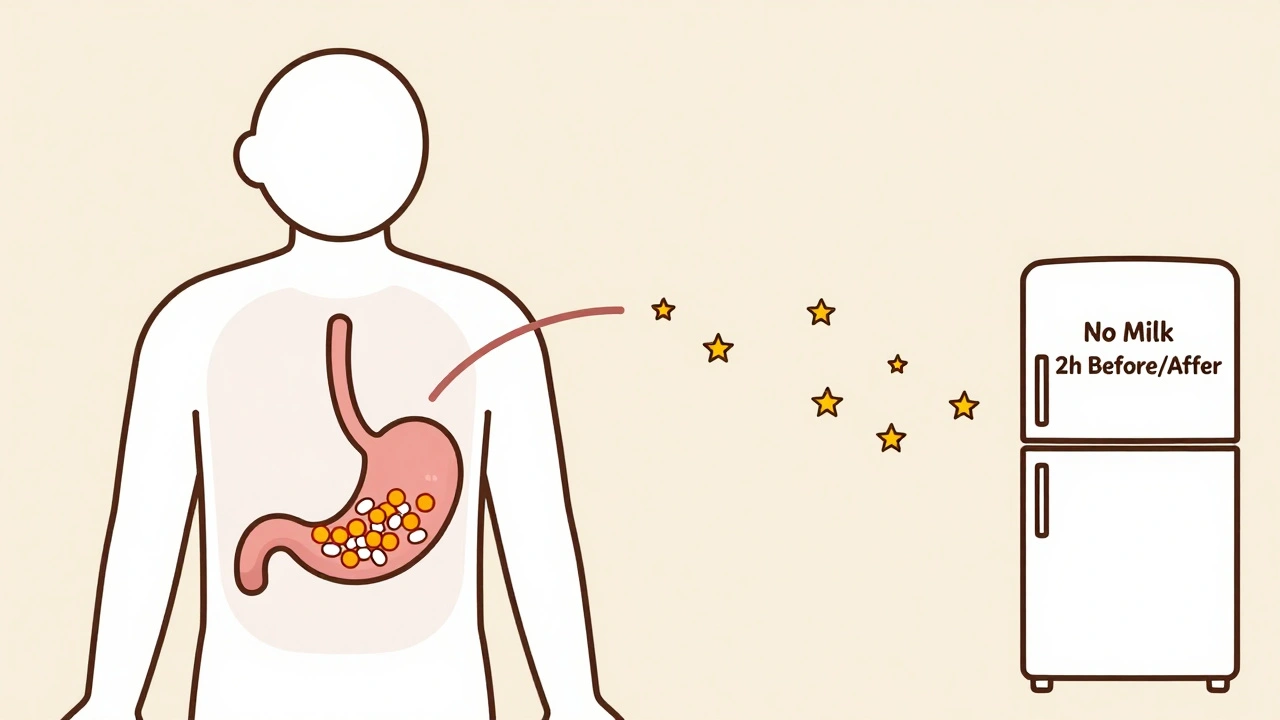
- Keep a small note on your fridge: “No milk 2 hours before or after Cipro.”
- Use a pill app like Medisafe or MyMeds. Many now have alerts for dairy interactions.
Pharmacists see this every day. A 2022 survey found that 43% of patients got no clear instructions about dairy when prescribed affected antibiotics. Don’t assume your doctor told you. Ask: “Should I avoid dairy with this?” If they say “maybe,” ask for specifics. Timing matters.
What’s Changing in 2025?
The FDA updated labeling rules in early 2023. Now, every box of doxycycline or ciprofloxacin must clearly state: “Avoid dairy products for 2 hours before and 4 hours after taking this medication.” That’s a big step.Drugmakers are also working on new versions. Some extended-release ciprofloxacin formulations (like Cipro XR) are less affected - but they cost over $200 per prescription. Generic immediate-release cipro is still $16. The cheaper option works fine - if you follow the timing.
Research is also testing new tetracycline derivatives that resist calcium binding. But these are still in trials. Don’t expect them until 2026.
For now, the only proven fix is time. Not more medicine. Not stronger pills. Just spacing.
Final Thought: It’s Not About Fear - It’s About Control
You don’t have to give up cheese or yogurt forever. You just need to know when to have them. This isn’t about being perfect. It’s about being informed. A small delay - 2 or 4 hours - can mean the difference between a quick recovery and a long, frustrating battle with your infection.Antibiotics are powerful. But they’re not magic. They need the right conditions to work. And sometimes, the most important thing you can do isn’t taking the pill - it’s waiting a few hours before your next snack.
Can I drink milk with doxycycline?
No. Milk and other dairy products can reduce doxycycline absorption by up to 50%. Take doxycycline at least one hour before or two hours after eating or drinking anything with dairy - including yogurt, cheese, or calcium-fortified plant milks.
How long after taking ciprofloxacin can I eat yogurt?
Wait at least four hours after taking ciprofloxacin before eating yogurt. Some studies show yogurt can reduce ciprofloxacin absorption by up to 92%. If you eat yogurt too soon, the antibiotic may not work, and your infection could return.
Does almond milk interfere with antibiotics?
Yes - if it’s calcium-fortified. Many almond, soy, and oat milks have added calcium to mimic dairy. These can bind to tetracyclines and fluoroquinolones just like cow’s milk. Always check the label for “calcium carbonate” or “calcium phosphate.” If it’s there, treat it like dairy.
Can I take antibiotics with food at all?
It depends on the antibiotic. Tetracyclines and fluoroquinolones should be taken on an empty stomach - at least one hour before or two hours after eating. Other antibiotics, like amoxicillin or azithromycin, can be taken with food to reduce stomach upset. Always check your prescription label or ask your pharmacist.
Why do some people say dairy doesn’t affect their antibiotics?
Because they’re not taking one of the affected drugs. Antibiotics like penicillin, amoxicillin, or azithromycin aren’t affected by calcium. If someone says dairy doesn’t interfere, they’re probably on one of those. But if you’re on ciprofloxacin or doxycycline, the rule applies - no exceptions.
What if I accidentally take dairy with my antibiotic?
Don’t panic. Skip your next dairy meal and resume your timing schedule. Don’t double the dose - that won’t fix it and could cause side effects. Just wait until your next scheduled dose and be more careful next time. If you’re treating a serious infection, call your doctor to see if you need to be re-evaluated.




11 Comments
I used to take my doxycycline with my morning yogurt because I thought plant-based = safe. Turns out my almond milk had calcium carbonate. My acne got worse, not better. Now I take it at 7 a.m. on an empty stomach and have my latte at 9. Game changer. 🙌
Of course the government only added warnings now after decades of people getting sicker. Big Pharma doesn't want you to know this because if you took your meds right you'd need fewer prescriptions. They profit off your ignorance. Calcium binding? That's basic chemistry. Why didn't they teach this in med school? Because they're selling pills not knowledge. Wake up people. This is controlled. And don't even get me started on fluoride in water.
This is such a helpful breakdown. I'm a nurse and I see this all the time. Patients think if they're not feeling worse they're fine. But the infection's just lurking. I always tell my patients: "Your antibiotic isn't magic, it's a tool. And tools need the right conditions to work." I even print out a little card for them: "No dairy 2 hours before, 4 after." Simple. Effective. Life-changing.
Just took cipro last night and forgot about the yogurt rule. Felt kinda guilty but didn't panic. Followed the advice here-skipped my bedtime snack and waited until breakfast. No double-dosing. No drama. Just better timing. Seriously, this stuff matters. Thanks for making it so clear.
So... let me get this straight. You're telling me that my beloved oat milk latte, which I've been drinking with my antibiotics for YEARS, is literally sabotaging my immune system? 😱 And now I have to wait FOUR HOURS after taking cipro to have my "healthy" breakfast?? I'm not even mad. I'm impressed. And also terrified. 🤯
i read this and felt seen. i took doxy with my oatmeal and banana every morning for 3 weeks. my infection came back twice. i thought it was me being weak. turns out i just didn't know. now i take it before coffee and have dairy at lunch. feels so much better. thank you for writing this. i needed to know it wasn't my fault.
As someone who grew up in a household where milk was always with meals, this was a revelation. I never knew that fortified soy milk could be just as bad. Now I read every label. I even asked my pharmacist to write a note on my prescription bottle. Small effort, huge difference. Thanks for the clarity.
Wait-you're telling me I can't have my cottage cheese with my doxycycline? But I need the protein! And what about my calcium supplements? Are you saying I have to choose between my bones and my lungs? This is ridiculous. Who even came up with this? I'm not some lab rat. I'm a human being who eats food. This is just another way to control us.
22% of recurring UTIs? That's statistically significant. And yet, no one talks about it. Why? Because the medical establishment prefers to prescribe more antibiotics than educate patients. This isn't a timing issue-it's a systemic failure. The fact that 43% of patients get no instructions is criminal. Someone should be fired.
Ugh. So I gotta wait 4 hours? That's so annoying. Can't I just take the pill after dinner? I'm tired of all this. Just give me a stronger drug already.
You got this. It's not about being perfect-it's about being consistent. One small change-waiting two hours-can save you from months of frustration. I've been there. I'm here now. You're not alone. Keep going. Your body will thank you. 💪