Pre-Medication Timing Calculator
Enter your values above to calculate proper pre-medication timing.
Why Pre-Medication Matters in Modern Medicine
Every year, millions of patients get CT scans, MRIs, or chemotherapy treatments. Most walk away without issue. But for some, the reaction is sudden-nausea, hives, trouble breathing. These aren’t random. They’re preventable. That’s where pre-medication comes in. Using antiemetics, antihistamines, and steroids before a procedure isn’t just routine-it’s a calculated shield against reactions that can turn a routine test into an emergency.
It’s not about giving everyone drugs just in case. It’s about targeting the right people at the right time. The American College of Radiology and Yale Medicine both agree: pre-medication should be reserved for those who’ve had a prior reaction. Giving it to everyone adds risk without benefit. And that’s a key shift in thinking over the last decade.
How Steroids Work Before Contrast Scans
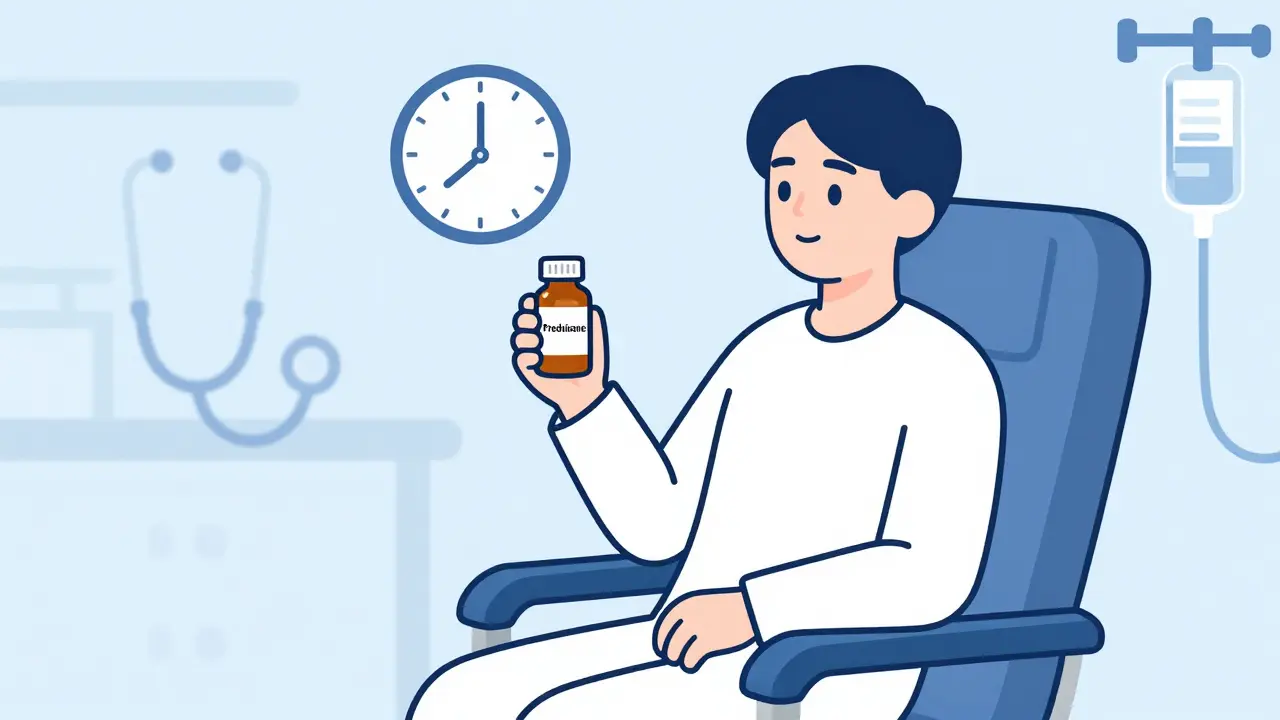
Steroids like prednisone and methylprednisolone are the backbone of pre-medication for contrast reactions. They don’t work fast. That’s the catch. Oral prednisone needs at least 13 hours to reach full effect. For that reason, it’s only used for outpatients with scheduled scans. If you’re coming in for an emergency CT, you won’t get oral steroids-you’ll get IV methylprednisolone instead.
Yale’s protocol is clear: for outpatients with a history of reaction, take 50mg of prednisone at 13, 7, and 1 hour before the scan. For inpatients or emergencies, give 40mg methylprednisolone IV four hours before. Hydrocortisone is the backup if methylprednisolone isn’t available. This timing isn’t arbitrary. It’s based on how long it takes these drugs to suppress the immune response that triggers swelling, itching, and low blood pressure.
And the numbers back it up. Studies show pre-medication with steroids cuts moderate to severe contrast reactions from 0.7% down to just 0.04%. That’s a 94% drop. But here’s the catch: even with steroids, 4.2% of patients still get mild reactions. And severe reactions? Only 75% are prevented. That’s why you still need monitoring during the scan.
Antihistamines: Old vs. New
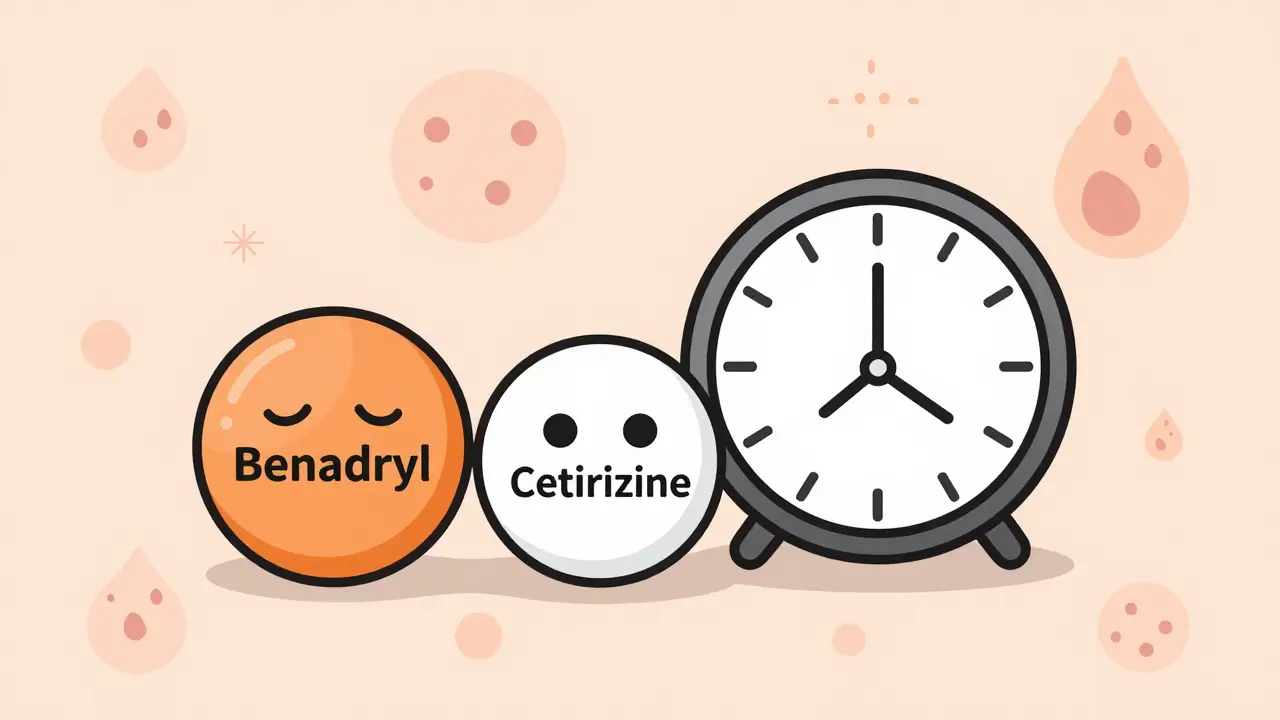
Antihistamines block histamine, the chemical that causes hives and itching. There are two types: first-generation like diphenhydramine (Benadryl®), and second-generation like cetirizine (Zyrtec®).
Benadryl works. But it makes you sleepy-up to 43% of patients report drowsiness. That’s a problem if you’re going to work after your scan or need to drive. Cetirizine, on the other hand, causes drowsiness in only 15% of people. It’s just as effective at preventing reactions, but you’re more likely to feel normal afterward.
For adults, 10mg of cetirizine taken within an hour of the scan is now the standard. For kids over six months, the same dose is used. For infants under six months, diphenhydramine at 1mg/kg is still the go-to because cetirizine hasn’t been studied enough in that group. The key takeaway? Use the newer antihistamine unless there’s a reason not to. Less drowsiness means fewer missed days and fewer accidents.
Antiemetics: Taming Chemo Nausea
When it comes to chemotherapy, nausea isn’t just uncomfortable-it can make patients skip treatment. That’s why antiemetics are part of the pre-medication plan for chemo, not just scans.
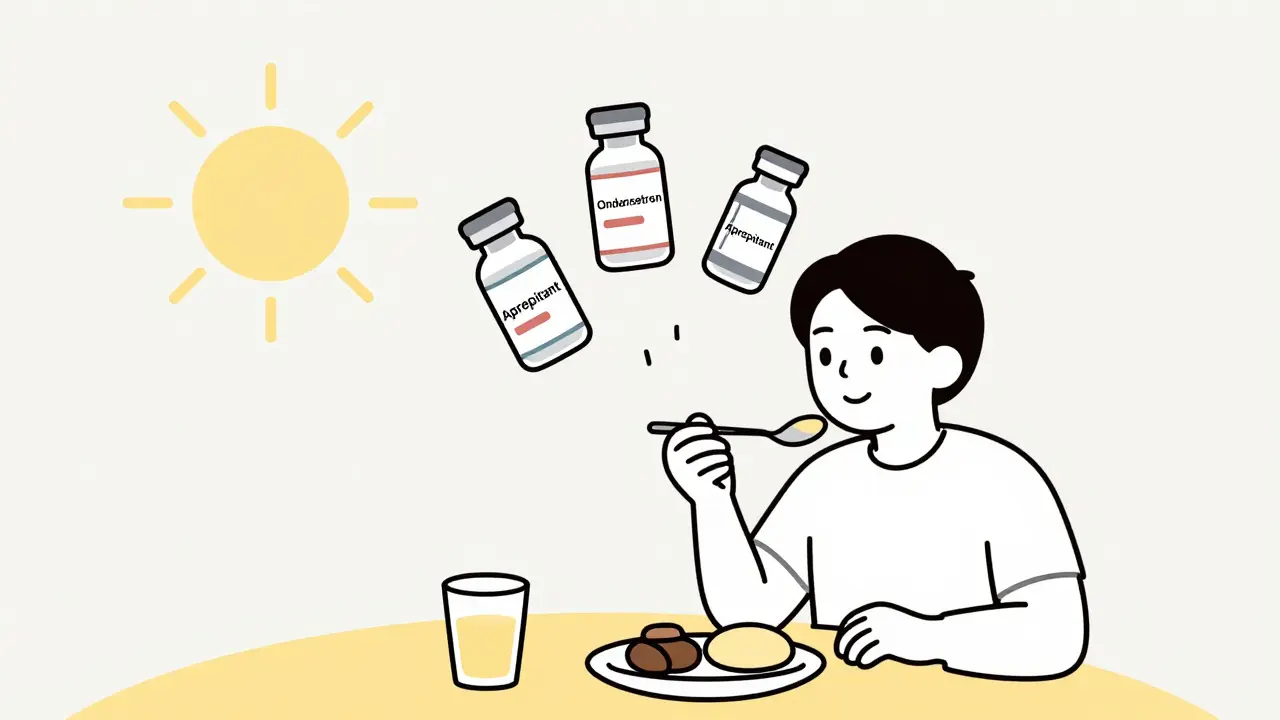
The gold standard today is triple therapy: a 5-HT3 blocker like ondansetron, an NK1 blocker like aprepitant, and dexamethasone (a steroid). This combo stops nausea before it starts. Studies show it gives a 70-80% chance of complete control over acute vomiting. That’s huge compared to older regimens that used just one drug.
For example, cisplatin-a powerful chemo drug-used to cause vomiting in over 90% of patients. Now, with triple therapy, that number drops to 28%. The difference isn’t subtle. Patients report being able to eat, sleep, and even return to work after treatment.
But it’s not perfect. About 15-20% still get breakthrough nausea, especially with the most aggressive chemo regimens. That’s why doctors now track each patient’s response and adjust for future cycles. Some even add olanzapine, an antipsychotic that’s surprisingly effective for nausea.
What Goes Wrong? Common Mistakes and How to Avoid Them
Even with solid science, errors happen. The Institute for Safe Medication Practices found that 68% of hospitals have had medication reconciliation errors with premedication orders. That means a patient’s history of prior reactions gets lost between departments or shifts.
Another big issue? Timing. If a patient is told to take prednisone at 13 hours before the scan but doesn’t get the prescription until 8 hours before, the whole plan fails. That’s why many hospitals now use electronic health records with automated alerts. If a patient has a history of contrast reaction and a scan is scheduled, the system flags it and pops up the correct pre-med order.
Then there’s documentation. A nurse gives the steroid, but doesn’t write it down. The next shift doesn’t know. The patient gets the scan without protection. That’s why barcode scanning of medications before administration is now a best practice. It’s not fancy tech-it’s a simple check that saves lives.
And don’t forget patient compliance. If someone’s supposed to take three doses of prednisone but skips one because they felt fine, they’re at risk. Some clinics now give patients a printed schedule with times and colors, or even text reminders. Small changes, big impact.
Who Needs This? Identifying At-Risk Patients
Not everyone needs pre-medication. But knowing who does is critical. The main red flag? A past reaction to iodinated contrast. That includes hives, swelling, vomiting, or low blood pressure during a previous scan. Even a mild reaction counts.
Other risk factors? Asthma, allergies to shellfish or medications, and a history of anaphylaxis. But here’s the myth to bust: shellfish allergy doesn’t automatically mean you’ll react to contrast. That idea is outdated. The real trigger is the iodine molecule itself, which is chemically different from shellfish proteins.
For children, weight matters. Prednisolone is dosed at 0.7mg per kg, capped at 50mg. No guessing. No rounding up. That’s why pharmacy teams are now involved in every pre-med order-especially for kids.
And if you’ve never had a reaction? You don’t need it. Routine pre-medication for all patients is no longer recommended. It increases cost, risk of side effects, and doesn’t improve outcomes. Stick to the evidence: treat those with history, not everyone.
What’s Next? The Future of Pre-Medication
The field is moving fast. Artificial intelligence is now being used to predict who’s likely to react. A 2023 study from the Journal of the American College of Radiology trained a machine learning model on 12,000 patient records. It predicted contrast reactions with 83.7% accuracy-better than any clinical rule.
On the drug side, newer NK1 antagonists like fosnetupitant are being tested. They’re longer-lasting and may replace aprepitant in the next few years. Also, oral steroids are being replaced in some centers with single-dose IV options that work faster and are easier to track.
But the biggest change isn’t a drug. It’s culture. More hospitals are treating pre-medication like a safety protocol, not an afterthought. That means checklists, staff training, and regular audits. At Yale, compliance hit 94.7% after 12 months of focused effort. That’s not luck. It’s systems.
Getting Started: A Simple Checklist
- Step 1: Identify patients with prior contrast reaction or high-risk chemo regimen.
- Step 2: Confirm timing: 13 hours for oral steroids, 4 hours for IV.
- Step 3: Choose antihistamine: cetirizine for adults and kids over 6 months, diphenhydramine for infants.
- Step 4: For chemo: use triple therapy (5-HT3 blocker + NK1 blocker + dexamethasone).
- Step 5: Use barcode scanning and EHR alerts to prevent errors.
- Step 6: Document everything-medication, time, route, patient response.
These steps aren’t optional. They’re the difference between a smooth scan and a trip to the ER.
Real Talk: What Patients and Staff Say
A radiology tech in Ohio wrote on Reddit: “We’ve done over 200 premedicated scans since we started Yale’s protocol. Zero severe reactions. But scheduling is a nightmare when someone gets a same-day referral.”
An oncology nurse on AllNurses shared: “My patient with lung cancer told me she finally slept through the night after her third chemo cycle. That’s the win. We still see breakthrough nausea, but it’s not the same as before.”
And a pharmacist in Chicago said: “We used to get 3-4 errors a week on premed orders. Now? One every two weeks. It’s not perfect, but it’s getting better.”
The message is clear: these strategies work-but only if they’re done right.


12 Comments
Man, I had a CT last year and they gave me Benadryl-I was out for three hours. Cetirizine? Game changer. No zombie mode, just chill and get the scan done.
I work in oncology and let me tell you-seeing a patient sleep through the night after chemo? That’s the holy grail. Triple therapy isn’t just protocol, it’s dignity restored. We used to have people crying in the chair from nausea. Now? They bring their knitting. Small wins, huge impact.
Anyone who doesn’t pre-medicate is just gambling with lives. My cousin died because they skipped steroids. Don’t be that person.
so like… shellfish allergy =/= contrast reaction? i always thought it was the iodine but now im like… wait what? so why do they still ask? lol
Let’s not romanticize this as some kind of medical enlightenment. The real driver here is liability avoidance. Hospitals implement protocols because they got sued too many times-not because they suddenly care about patient comfort. The 94% reduction in reactions? Great. But the 6% that still happen? Those are the ones that end up in court.
And don’t get me started on ‘EHR alerts.’ They’re noisy, glitchy, and often ignored. I’ve seen techs disable them because they pop up for every third patient. Automation without workflow integration is theater, not safety.
The real win? The fact that nurses now document. That’s not science. That’s bureaucracy finally catching up to common sense.
The philosophical underpinning of pre-medication reveals a deeper tension in modern medicine: the conflict between population-level risk mitigation and individual autonomy. We are no longer treating bodies-we are optimizing systems. The steroid protocol, meticulously timed to suppress cytokine cascades, is not merely pharmacological-it is a ritual of institutional control. The patient’s prior reaction becomes data, their history a variable in a predictive algorithm. We have replaced intuition with algorithms, empathy with evidence-based checklists. And yet, in the quiet moments after the scan, when the patient exhales and says, ‘I didn’t feel a thing,’ we are reminded: systems exist to serve the human, not the other way around. The real triumph is not in the 0.04% reaction rate, but in the restoration of agency-when fear is replaced by trust, and vulnerability is met not with indifference, but with precision.
While the data presented is statistically sound, it fails to address the confounding variable of patient adherence. Studies showing 94% reduction assume perfect compliance with the 13-7-1 hour prednisone regimen. In real-world settings, particularly among elderly or low-literacy populations, compliance drops to 58%. The algorithmic approach assumes rational actors, but human behavior is messy. Until we integrate behavioral economics into pre-medication protocols-nudge theory, pill organizers, caregiver involvement-we’re optimizing the wrong part of the pipeline.
I’ve seen the aftermath of skipped doses. A 72-year-old woman with a history of anaphylaxis skipped her 7-hour prednisone because she ‘felt fine.’ She went into hypotension during her scan. She didn’t die, but she spent three days in ICU. This isn’t theoretical. It’s daily. If you’re a clinician and you’re not double-checking the schedule with the patient? You’re not doing your job. And if you’re a patient and you think ‘I’ll just take it when I get there’? You’re risking your life. I don’t say this to scare you-I say this because I’ve held the hand of someone who didn’t have to be there.
bro i just found out my doc gave me benadryl last time and i was like… why am i so tired?? now i’m gonna ask for zyrtec. no more zombie mode for me lol
As someone who works with pediatric oncology families, I’ve seen how these protocols transform lives-not just medically, but emotionally. When a parent can finally sleep because their child isn’t vomiting all night, it changes the whole dynamic. We don’t just hand out meds-we hand out hope. And when we use the right antihistamine for infants, we’re not just preventing hives-we’re preserving the sacred normalcy of a baby’s first year. This isn’t just clinical. It’s human.
Let’s be real-this whole system is a Rube Goldberg machine held together by duct tape and EHR alerts. We’ve got pharmacists double-checking doses, nurses scanning barcodes, AI predicting reactions, and yet the most common error? Someone forgets to tell the radiology tech the patient is on premed. Because paperwork. Because silos. Because medicine is still run by humans who forget to talk to each other. The science is flawless. The execution? A dumpster fire with a nice logo.
And don’t even get me started on ‘same-day referrals.’ You think the guy getting a CT at 3 PM after a 7 AM ER visit is getting his 13-hour steroid schedule? Nah. He’s getting IV methylprednisolone at 2:45 PM while the tech is yelling at the computer. And somehow, it still works. That’s not science. That’s miracles.
Oh, how quaint-the modern priesthood of medicine, waving their algorithms like incantations, whispering ‘evidence-based’ like a mantra to ward off the demons of uncertainty. But tell me, dear technocrats, when did compassion become a variable in a regression model? When did the trembling hand of a frightened child become a ‘risk factor’ to be statistically neutralized? We have turned the sacred act of healing into a spreadsheet. The steroids suppress the immune response, yes-but what of the soul’s response? The terror? The loneliness? The quiet sob in the scanning room? No algorithm can measure that. No checklist can restore it. We are not machines. We are not data points. We are the ones who tremble… and yet, still, we come.