Every year, millions of people in the U.S. get the wrong medication, the wrong dose, or wrong instructions-sometimes with life-threatening results. You might assume hospitals are the most dangerous place for these mistakes. But the truth is more complicated. Medication errors happen everywhere, but they play out very differently in hospitals versus retail pharmacies. One setting has more errors but more safety nets. The other has fewer errors-but when they happen, they often slip through unnoticed until it’s too late.
How Many Errors Are Really Happening?
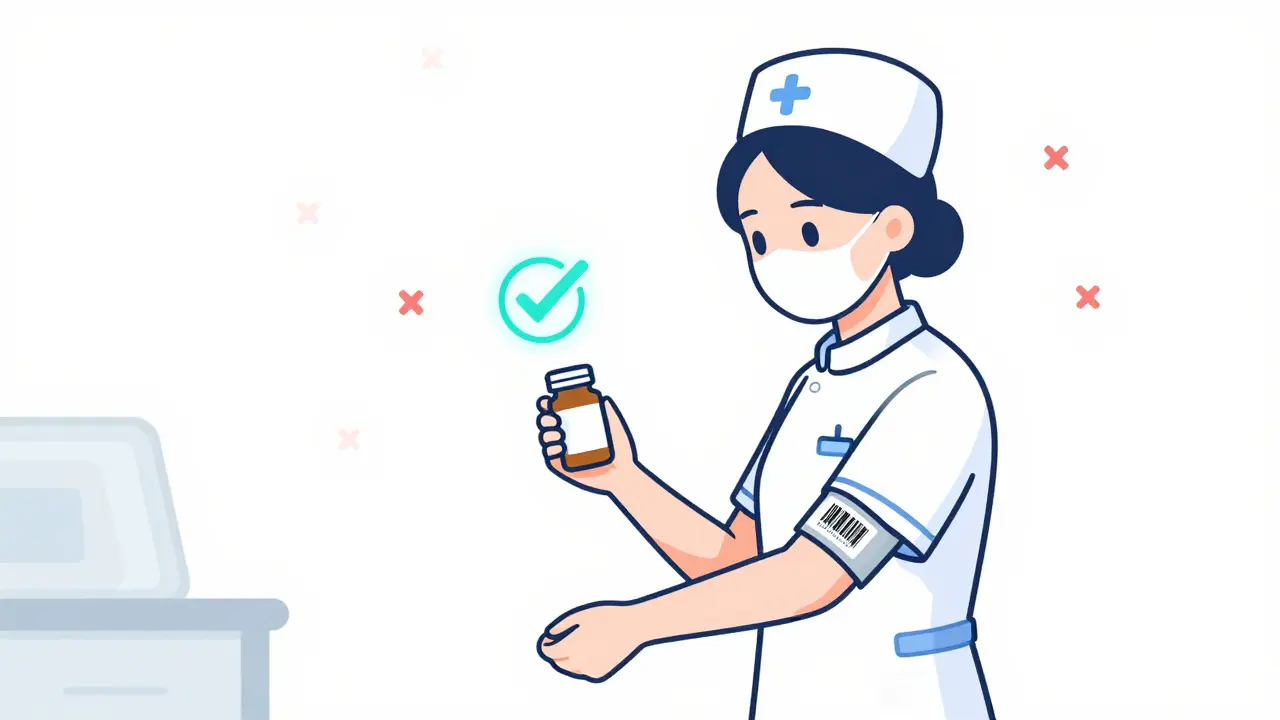
In hospitals, errors are everywhere. A 2006 study across 36 U.S. hospitals found that nearly 1 in every 5 doses given to patients contained some kind of mistake. That’s 20%. These aren’t just typos-they’re wrong drugs, wrong times, wrong amounts. Nurses give meds to patients, and sometimes, the pill in their hand doesn’t match what the doctor ordered. The median error rate during administration? Between 8% and 25%, depending on the unit. Now, compare that to your local pharmacy. The numbers look much better. A 2018 analysis of 23 studies found that community pharmacies make mistakes in only about 1.5% of prescriptions. That’s 15 errors per 1,000 prescriptions. Sounds low, right? But here’s the catch: pharmacies fill about 3 billion prescriptions a year. Even at 1.5%, that’s 45 million errors annually. A typical pharmacy filling 250 prescriptions a day makes about four mistakes every single day. The difference isn’t just in volume-it’s in detection. In hospitals, a nurse checks the medication before giving it. A pharmacist double-checks the order. The barcode on the pill bottle is scanned against the patient’s wristband. If something’s off, someone usually catches it before it reaches the bloodstream. In a retail pharmacy? You’re the last line of defense. The pharmacist hands you the bottle. You walk out. No one follows up. No one calls to ask if you felt sick after taking it. If the label says “take two tablets daily” when it should be “take one tablet weekly,” you might not realize until you end up in the ER.What Kind of Mistakes Happen?
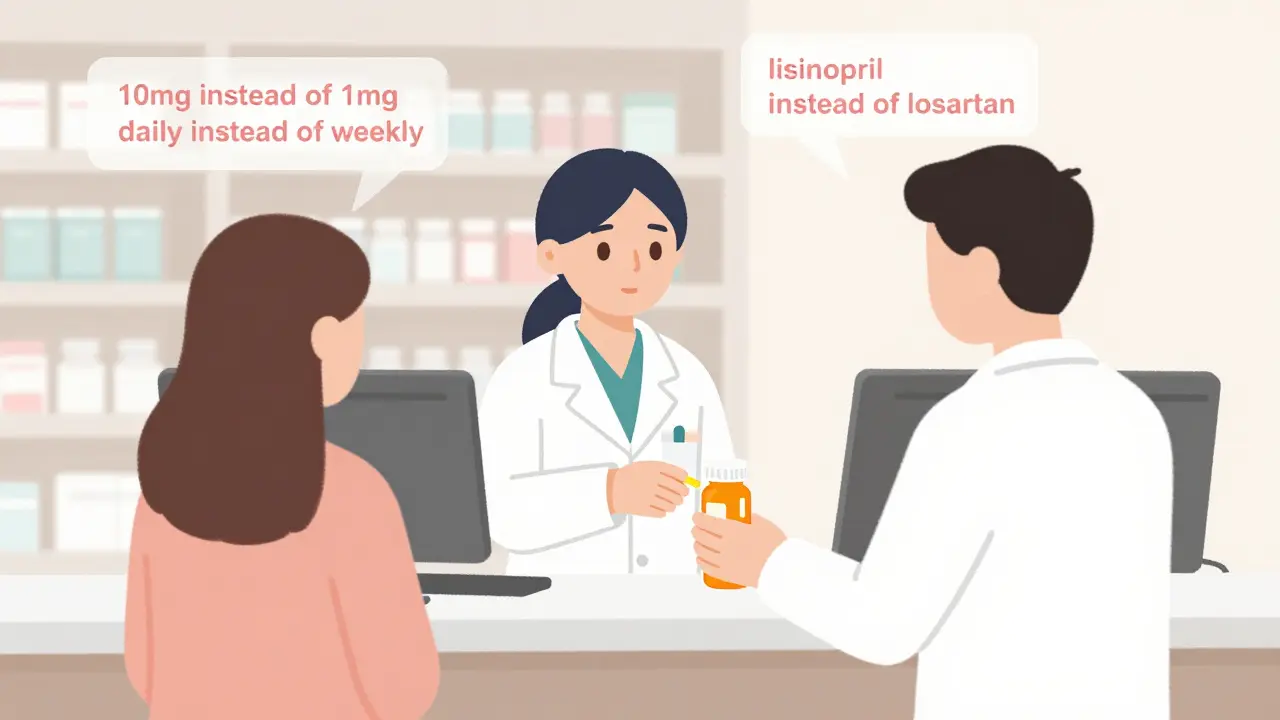
In retail pharmacies, the most common errors are simple but deadly:- Wrong medication (giving lisinopril instead of losartan)
- Wrong dose (10 mg instead of 1 mg)
- Wrong instructions (daily instead of weekly)
- A doctor prescribes the wrong drug because they’re tired
- A nurse misreads the electronic order
- A pharmacist dispenses the right drug but the wrong strength
- A nurse gives it at the wrong time-or to the wrong patient
Why Do These Errors Happen?
In retail pharmacies, most errors come from human factors under pressure. Pharmacists are juggling 20 prescriptions at once. The system beeps. The phone rings. The printer jams. A cognitive slip happens. A label gets misread. A similar-looking drug (like metoprolol and metformin) gets grabbed by accident. Studies show that 80% of community pharmacy errors are tied to how the work is organized-not because pharmacists are careless. It’s the environment: loud, fast, understaffed, and overloaded with technology that doesn’t always help. Hospitals are different. The pressure is higher, but the systems are more layered. Still, errors happen because of communication breakdowns. A doctor writes “morphine 5 mg IV q4h.” The nurse hears “q6h.” The pharmacist doesn’t catch it because the order came through a fax machine from a clinic 50 miles away. Staffing shortages mean nurses are rushing. Patients are sicker. More meds. More interactions. More chances for something to slip. One big difference? Hospitals have reporting systems. If a nurse gives the wrong drug, they log it. The pharmacy team reviews it. A safety committee meets. A process gets changed. Community pharmacies? For years, there was no requirement to report errors. Even today, only a handful of states mandate it. California is one. Most aren’t. That means most mistakes never get recorded. Never get studied. Never get fixed.Who Gets Hurt-and How Badly?
It’s tempting to think hospital errors are worse because they’re more frequent. But that’s not always true. In hospitals, patients are already sick. They’re monitored. If a mistake happens, it’s often caught quickly. A patient gets drowsy after an overdose? The nurse checks their vitals. The doctor is called. Treatment starts immediately. In community pharmacies, the damage is often delayed-and more unpredictable. A patient takes the wrong dose of warfarin for weeks. They don’t feel anything until they bleed internally. A child gets adult-strength antibiotics. They develop a dangerous reaction. A diabetic takes the wrong insulin dose. They go into ketoacidosis. These aren’t theoretical risks. The NIH found that 1 in every 10,000 community pharmacy errors led to hospitalization. That’s 4,500 hospitalizations a year from pharmacy mistakes alone. And the cost? Hospitals spend at least $3.5 billion a year treating injuries from their own medication errors. But community pharmacy errors add billions more-through ER visits, ambulance rides, hospital admissions, and lost work time. The total economic toll from all medication errors? Over $177 billion a year.
What’s Being Done to Fix This?
Hospitals have been investing heavily in safety tech for over a decade. Barcode scanning cuts errors by up to 86%. Electronic prescribing eliminates handwriting mistakes. Automated dispensing cabinets reduce wrong-drug picks. Mayo Clinic cut hospital errors by 52% after linking their EHR directly to the pharmacy system. Retail pharmacies are catching up-but slowly. CVS Health rolled out AI-powered verification systems in 2022. Their internal audit showed a 37% drop in dispensing errors. The University of California San Francisco piloted AI tools that cut transcription errors by 63%. These aren’t sci-fi-they’re real tools being used right now. But technology alone won’t fix this. Culture matters. In hospitals, staff are trained to report errors without fear. In community pharmacies, many pharmacists still worry about getting fired if they admit a mistake. The National Coordinating Council for Medication Error Reporting and Prevention says we need “a culture of safety where reporting doesn’t mean punishment.” That’s true everywhere-but especially in pharmacies, where mistakes are hidden. The CDC and AHRQ now push for standardized error reporting across all pharmacy settings. The 2023 National Action Plan for Adverse Drug Event Prevention includes specific goals for community pharmacies. The FDA is funding pilot programs to integrate AI monitoring into both hospital and retail workflows. These are the first real steps toward parity in safety.What You Can Do
You’re not powerless. Whether you’re getting meds from a hospital or your local pharmacy, you can protect yourself:- Always read the label. Compare it to the prescription your doctor gave you.
- Ask: “Is this the same as last time?” If the pill looks different, ask why.
- Ask the pharmacist: “What is this for? How should I take it? What side effects should I watch for?”
- Keep a list of all your meds-including over-the-counter ones-and bring it to every appointment.
- If something feels off after taking a new med-call your doctor or pharmacist. Don’t wait.
Which setting has more medication errors-hospitals or retail pharmacies?
Hospitals have a higher rate of medication errors-about 20% of doses contain some kind of mistake. Retail pharmacies have a lower rate-around 1.5% of prescriptions. But because pharmacies fill 3 billion prescriptions a year, that 1.5% adds up to 45 million errors annually. So while hospitals make more errors per dose, retail pharmacies make more errors in total.
Why are hospital errors less likely to harm patients?
Hospitals have multiple safety checks: pharmacists verify orders, nurses scan barcodes before giving meds, and patients are monitored closely. If something goes wrong, it’s often caught before it causes harm. In retail pharmacies, the patient is the last and only checkpoint. There’s no one to double-check after you leave the store.
What are the most common types of errors in retail pharmacies?
The most common errors are giving the wrong medication, the wrong dose, or the wrong instructions. Transcription errors-where the pharmacist misreads or miskeys the doctor’s order-are especially dangerous. For example, writing “take daily” instead of “take weekly” for a powerful hormone like estradiol can lead to overdose.
Are medication errors underreported in pharmacies?
Yes. Hospitals have mandatory reporting systems, but most retail pharmacies don’t. Only a few states, like California, require pharmacies to log errors. The FDA receives over 100,000 reports a year-but experts believe that’s less than 10% of actual incidents. Many errors go unreported because pharmacists fear blame or don’t know how to report.
Can technology reduce medication errors?
Absolutely. Barcode scanning in hospitals has cut errors by up to 86%. AI-powered verification systems in pharmacies, like those used by CVS Health, have reduced dispensing errors by 37%. Electronic prescribing eliminates handwriting errors. These tools aren’t perfect, but they’re proven to save lives when used correctly.
What should I do if I think I got the wrong medication?
Don’t take it. Call your pharmacist immediately and ask them to verify the prescription with your doctor. Check the label against your original prescription. If you’ve already taken it and feel unwell, call your doctor or go to the ER. Keep a list of all your medications and bring it to every appointment-it helps catch mistakes before they happen.

9 Comments
Man i read this whole thing and i just kept thinking about my grandma who got the wrong pill last year and ended up in the er
So let me get this straight hospitals are like a chaotic mess with 20% error rates but somehow safer because they have all these scanners and nurses yelling at each other while retail pharmacies are quiet little death traps where you walk out with a bottle that could kill you and no one gives a shit
Also 45 million errors a year and we still act like this is normal like its just part of the american dream
My pharmacist once gave me metformin instead of metoprolol and i almost passed out on the bus i didnt even notice until my heart started racing like a jackhammer
And yeah the system is broken but nobody wants to fix it because pharmacies are run like fast food joints with 12 people trying to fill 200 scripts in an hour
Meanwhile hospitals have teams of people double checking everything and still messing up so what does that say about our entire medical infrastructure
And dont even get me started on the fact that most of these errors never get reported because pharmacists are terrified of getting fired
Its not about technology its about culture and money and how we value human life versus profit margins
Im not saying hospitals are perfect but at least when you get messed up there someone is watching you
In the pharmacy you just get handed a bottle and told have a nice day
And dont tell me to read the label i dont know what half these drugs are for and i paid 80 bucks for them
Its not my job to be a medical detective
While the data presented is compelling, it is imperative to recognize that the structural underpinnings of medication safety are fundamentally unequal between institutional and community settings
The absence of mandatory reporting in retail pharmacies constitutes a systemic failure of accountability
Without standardized error documentation, no meaningful epidemiological analysis can be conducted, and thus no evidence-based interventions can be implemented
The FDA's current pilot programs are a step in the right direction, yet they remain insufficient without federal mandates
Furthermore, the economic burden of these errors is not merely financial-it is a moral cost borne by patients who suffer preventable harm
It is not acceptable that a patient must become a medical detective simply to avoid lethal pharmaceutical negligence
Until pharmacy workflows are restructured to prioritize safety over throughput, and until pharmacists are empowered-not penalized-for reporting errors, this crisis will persist
The normalization of error in community pharmacy is a quiet epidemic, and it demands urgent policy intervention
Our current model treats patients as afterthoughts, not partners in care
so hospitals have more errors but less dead people and pharmacies have less errors but more dead people wait no that doesnt make sense
also i think the guy who wrote this is a pharmacist and just trying to make his job look better
also i spelled medecine wrong again
What this piece really gets at is how we’ve outsourced responsibility for our own health to systems that are designed to be efficient, not safe
We assume because something is automated or professional that it’s foolproof
But humans are messy, systems are brittle, and when you stack complexity on top of pressure, mistakes don’t just happen-they multiply
In hospitals, you’ve got layers of checks because the consequences of failure are immediate and visible
In pharmacies, the consequences are delayed, quiet, and invisible until someone collapses at home
And that’s the real tragedy
We don’t fear what we can’t see
So we don’t fix what we don’t acknowledge
The solution isn’t just more tech
It’s a cultural shift
We need to treat pharmacy errors like we treat hospital-acquired infections
With transparency, accountability, and public outrage
And until we do, we’re all just waiting for the next quiet disaster
I work at a pharmacy and I cry every time I catch a mistake before it goes out
Not because I’m a hero
But because I know how many I miss
We have one pharmacist for 300 scripts a day
The machine beeps
The phone rings
The guy in front of me is yelling because his insurance won’t cover his diabetes meds
And I’m trying to match a handwritten script that looks like a toddler drew it
I’ve given out the wrong dose three times this year
Each time I caught it
Each time I wanted to quit
But I can’t
Because if I leave, someone else has to do this
And they might not catch it
So I keep going
And I pray
And I don’t tell anyone because I’m scared they’ll think I’m incompetent
But I’m not
I’m just tired
And so is everyone else
People keep saying ‘read the label’ like it’s that easy
Most patients are elderly, blind, on five meds, and don’t speak English
And you want them to be medical experts
That’s not safety
That’s negligence dressed up as personal responsibility
Stop blaming the victim
The system is broken
And it’s not their fault
While the emotional weight of this issue is undeniable, the data presented requires contextualization
It is essential to distinguish between error rate per dispensing event and aggregate volume
Hospital systems, despite higher per-dose error rates, benefit from real-time clinical oversight, multidisciplinary review, and immediate intervention protocols
Community pharmacies, operating under significantly different constraints, face challenges rooted in workflow design, staffing ratios, and lack of integrated clinical feedback loops
Technological interventions, such as AI verification and barcode scanning, have demonstrated efficacy
However, their adoption remains inconsistent due to cost, regulatory fragmentation, and organizational resistance
Standardized reporting mandates, coupled with non-punitive safety cultures, are not optional-they are foundational to reducing preventable harm
Until these structural reforms are universally implemented, the burden will continue to fall disproportionately on vulnerable populations
Of course hospitals have more errors
They’re full of drunk doctors and lazy nurses who don’t even read the charts
But at least they have nurses to catch it
Meanwhile in the pharmacy you got some guy in a lab coat who’s been working 14 hours and just wants to go home
He doesn’t care about your meds
He just wants to get paid
And you think you’re safe because it’s a pharmacy
HA
You’re just a number
And if you die from the wrong pill
They’ll just say ‘oh we’re sorry’ and give you a coupon for 10% off
Pathetic