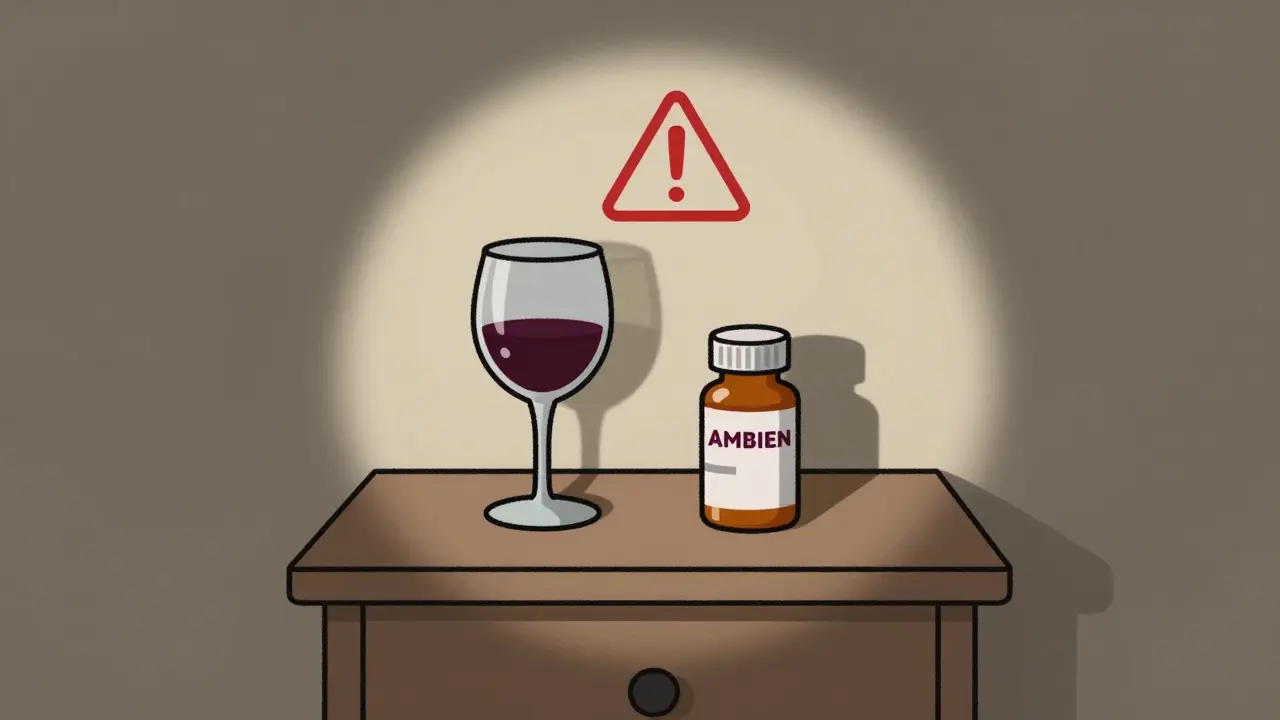
Drinking a glass of wine to help you unwind at night seems harmless-until you’ve also taken your sleep medication. What feels like a small, harmless habit can turn deadly. The combination of alcohol and prescription sleep aids doesn’t just make you drowsy. It slows your breathing, clouds your mind, and can stop your body from waking up when it needs to. This isn’t speculation. It’s documented, measured, and confirmed by medical authorities across the U.S. and the U.K.
Why This Mix Is So Dangerous
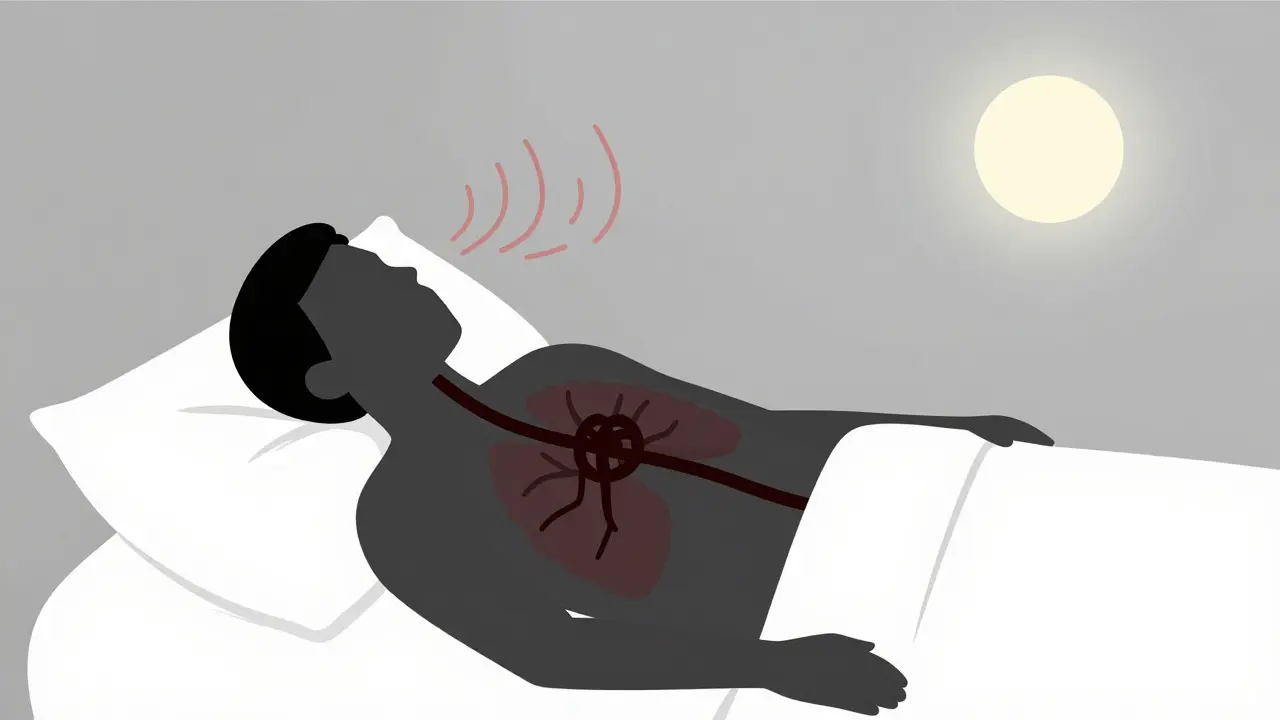
Both alcohol and sleep medications work on the same part of your brain: the GABA receptors. These receptors calm your nervous system. When you take one, it helps you relax. When you take both, they team up in a way that’s not just additive-it’s exponential. A single drink can turn a normal dose of Ambien into an overdose. The result? Your breathing slows to dangerous levels. Your blood oxygen drops. You might not wake up if your airway gets blocked during sleep.The FDA has issued a Black Box Warning for all Z-drugs-including Ambien, Lunesta, and Sonata-because of this exact risk. These drugs were designed to be safer than older benzodiazepines, but when mixed with alcohol, they become more unpredictable and more deadly. Studies show that even a blood alcohol level as low as 0.02% (about one drink) can double the time Ambien stays active in your body. That means you’re sedated for hours longer than you expect.
Which Sleep Medications Are the Riskiest?
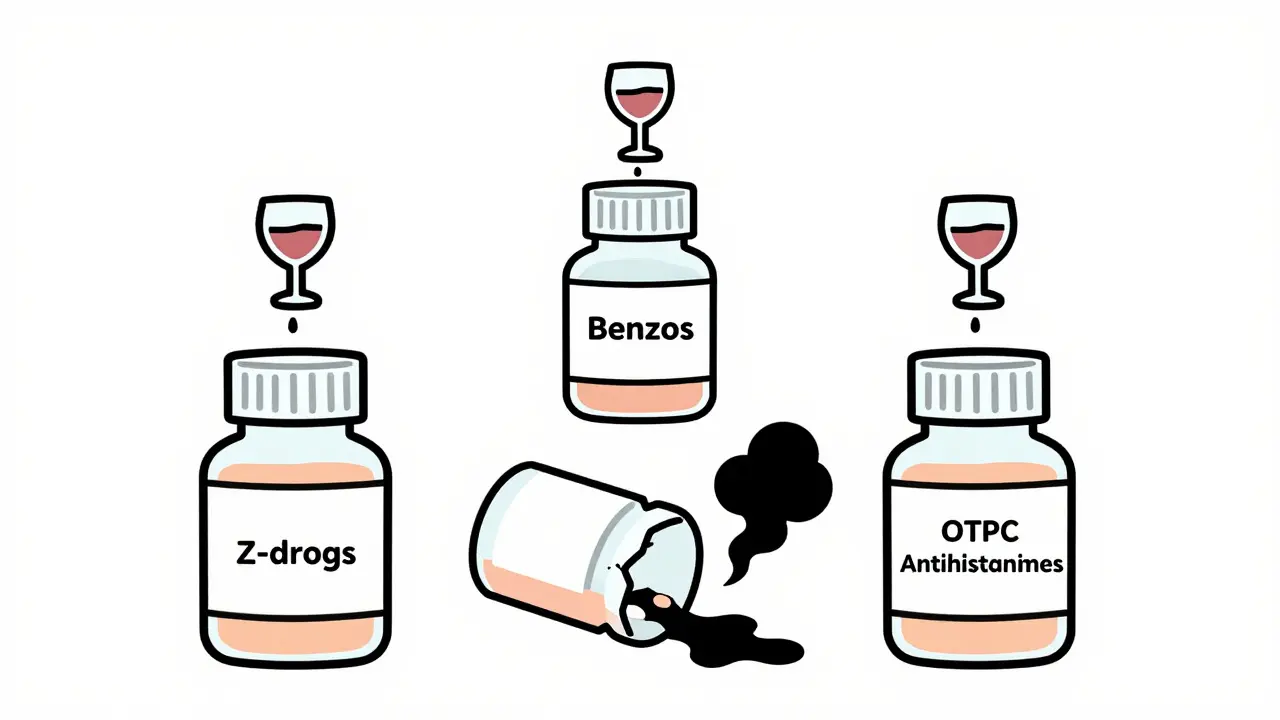
Not all sleep aids are the same when mixed with alcohol. Here’s how they compare:| Medication Type | Examples | Risk Level | Key Danger |
|---|---|---|---|
| Z-drugs | Ambien (zolpidem), Lunesta (eszopiclone), Sonata (zaleplon) | Extreme | Severe respiratory depression, sleep-driving, memory loss |
| Benzodiazepines | Ativan (lorazepam), Klonopin (clonazepam), Restoril (temazepam) | High | Increased fall risk, prolonged sedation, confusion |
| OTC Antihistamines | ZzzQuil (diphenhydramine), Unisom (doxylamine) | Very High (for seniors) | 300% higher fall risk, delirium, hospitalization |
| Melatonin | Natrol, Nature Made | Low | Next-day drowsiness only-no respiratory risk |
Z-drugs are the worst offenders. They act fast, bind tightly to brain receptors, and their interaction with alcohol is brutal. One study found that combining alcohol with zolpidem made driving performance worse than being legally drunk-by 2.7 times. People have woken up miles from home, with no memory of driving, after mixing just half a pill with a couple of drinks. These aren’t rare cases. Clinical trials show the rate of sleep-driving jumps from 0.15% with Z-drugs alone to 2.4% when alcohol is involved.
OTC sleep aids like ZzzQuil might seem harmless because they’re sold without a prescription. But they’re just as dangerous, especially for people over 65. Mixing diphenhydramine with alcohol triples the risk of falling and increases the chance of delirium by 400%. Emergency room data shows hip fractures from these combinations have skyrocketed in older adults.
Real Stories Behind the Numbers
Behind every statistic is a person. On Reddit, users share chilling accounts: "Took Ambien after two glasses of wine. Woke up in my car, parked on a highway. No idea how I got there." Another wrote: "I took Unisom and had a beer. Spent the next day in the hospital-couldn’t remember my own name."These aren’t outliers. The FDA’s adverse event database recorded over 1,800 reports in 2021 alone where people said they had no memory of events after mixing alcohol and sleep meds. Nearly a third of those cases required emergency care. On Drugs.com, Ambien has a 1.8 out of 5-star safety rating specifically because of alcohol interactions. The most common complaint? "Extreme drowsiness that lasted 12 hours or more."
For older adults, the stakes are even higher. AARP forums are filled with stories of seniors who thought "just one drink" wouldn’t hurt-only to end up confused, disoriented, and hospitalized. Their bodies process alcohol and medication slower, so the effects linger longer and hit harder.
What the Experts Say
There’s no gray area here. Doctors, researchers, and regulatory agencies are united: never mix alcohol with prescription sleep aids.Dr. Robert Swift of Brown University explains it plainly: "The body doesn’t just add the effects. It multiplies them." The liver uses the same enzymes-CYP3A4-to break down both alcohol and most sleep medications. When both are present, the system gets overwhelmed. The medication stays in your system longer. The sedation deepens. The risk of stopping breathing rises.
The American Academy of Sleep Medicine calls this combination "medically unacceptable." Their 2023 guidelines state that even one standard drink (14g of alcohol) with a Z-drug significantly increases the chance of complex sleep behaviors-like sleepwalking, sleep-eating, or sleep-driving. These aren’t dreams. They’re real actions performed while the brain is partially asleep.
Dr. Bankole Johnson from the University of Maryland found that 83% of fatal alcohol-Ambien cases happened at blood alcohol levels below the legal driving limit of 0.08%. The median level? 0.051%. That’s less than one drink. You don’t need to be drunk to die from this mix.
What Should You Do Instead?
If you’re using sleep medication, the safest choice is simple: don’t drink alcohol at all. But if you’re struggling with both insomnia and alcohol use, there are better paths.First, talk to your doctor about alternatives. Newer medications like Dayvigo (lemborexant) were designed to avoid GABA interactions. In trials, alcohol only increased its half-life by 15%, compared to 150-200% for Ambien. It’s not perfect, but it’s safer.
Second, consider non-drug treatments. Cognitive Behavioral Therapy for Insomnia (CBT-I) is the gold standard. It’s more effective long-term than pills, with no risk of interaction. The American Medical Association now recommends CBT-I as the first-line treatment for anyone who drinks alcohol-even occasionally.
Third, if you must drink, wait. The NIAAA recommends at least six hours between your last drink and taking a Z-drug. For benzodiazepines, wait 12 hours. But even that isn’t foolproof. The safest rule? Avoid alcohol entirely while on sleep meds.
What If You’ve Already Mixed Them?
If you’ve accidentally combined alcohol and sleep medication, don’t panic-but don’t ignore it either.- Stay awake. Don’t go to bed until the alcohol has fully cleared your system.
- Don’t drive, operate machinery, or make important decisions.
- Watch for signs of trouble: slow breathing, confusion, bluish lips, inability to wake up.
- If you or someone else shows these signs, call emergency services immediately.
There’s no antidote. Treatment is supportive: oxygen, monitoring, and sometimes a breathing tube. The damage happens fast. Prevention is the only real solution.
Why Are People Still Doing This?
Surprisingly, most people who mix alcohol and sleep meds don’t realize how dangerous it is. A 2022 survey found that 68% of patients prescribed sleep aids received no clear warning about alcohol from their doctor. Even when warnings are on the label, 63% of patients overlook them.Pharmacists are now required to hand out printed warnings with every prescription. But if you’re tired, stressed, or used to drinking at night, you might not read it. That’s why the FDA now mandates that the warning "Do not consume alcohol while taking this medication" be printed in 14-point bold font on every medication guide.
The problem isn’t just ignorance-it’s habit. Many people use alcohol to help them sleep because it feels natural. They don’t see it as a drug. But it is. And when it teams up with a prescription, the outcome can be fatal.
What’s Changing in 2026?
The tide is turning. Researchers are now looking for biological markers that can predict who’s most at risk for dangerous interactions. The NIH has launched a $4.7 million study to identify genetic and metabolic clues that make some people more vulnerable.Pharmaceutical companies are shifting away from GABA-targeting drugs. Seven out of the 12 new sleep medications in clinical trials now work on different brain pathways-like orexin receptors-so they won’t interact with alcohol the same way. These drugs may offer real hope for people who need sleep help but can’t quit alcohol entirely.
But until then, the message stays the same: alcohol and sleep medications are a deadly combination. No exceptions. No "just one drink." No "I’ve done it before and nothing happened." That’s not luck-it’s waiting for the next time.
Can I have one glass of wine with Ambien if I wait a few hours?
No. Even if you wait six hours, alcohol can still interact with Ambien. The body doesn’t clear alcohol predictably-factors like weight, liver health, and metabolism vary. The risk of slowed breathing and memory loss remains high. The only safe choice is to avoid alcohol entirely while taking any prescription sleep aid.
Is melatonin safe with alcohol?
Melatonin has minimal dangerous interactions with alcohol. It doesn’t affect breathing or cause sedation like Z-drugs or benzodiazepines. However, combining it with alcohol can still make you feel unusually drowsy the next day-up to 35% more than alcohol alone. It’s not life-threatening, but it’s not ideal.
What should I do if I’ve mixed alcohol and sleep meds and feel fine?
Feeling fine doesn’t mean you’re safe. The most dangerous effects-like slowed breathing or unconsciousness-can happen while you’re asleep. Don’t go to bed. Stay awake for at least 4-6 hours. Have someone check on you. If you feel confused, dizzy, or have trouble breathing, seek medical help immediately. Don’t wait for symptoms to worsen.
Are over-the-counter sleep aids safer than prescription ones?
No. OTC sleep aids like ZzzQuil and Unisom contain antihistamines that are just as dangerous as prescription drugs when mixed with alcohol-especially for people over 65. They increase fall risk by 300% and can cause severe confusion or delirium. Just because they’re sold without a prescription doesn’t mean they’re safe.
Can I switch to a different sleep medication to avoid this risk?
Yes. Newer medications like Dayvigo (lemborexant) are designed to avoid GABA pathways, meaning they interact far less with alcohol. While not risk-free, they’re significantly safer than Ambien or Lunesta. Talk to your doctor about alternatives-especially if you drink alcohol regularly.
14 Comments
so i took ambien after a glass of wine last week and woke up next to my cat wearing my sister’s hat. no memory of how i got there. she says i was humming the theme to 'the office'. i think i’m fine. or maybe i’m dead and this is just my afterlife’s weird glitch.
you people act like alcohol is some kind of enemy. it’s just a drink. if you can’t handle it with your meds, maybe you shouldn’t be on them. this is why america’s so soft. grow a spine.
While I appreciate the comprehensive overview presented in this post, I must emphasize the critical importance of adhering to pharmacological guidelines as established by the FDA and the American Academy of Sleep Medicine. The synergistic effect of alcohol on GABAergic agents is not merely additive-it is multiplicative, and the clinical implications are profound. Patients must be educated with the same rigor as they are prescribed these medications.
Look-I get it. People want to unwind. But calling wine ‘harmless’ while popping Ambien is like saying a lit match is harmless next to a gas tank. The science isn’t even debatable here. And yeah, OTC sleep aids? Even worse. Diphenhydramine + alcohol = senior emergency room VIP pass. Why are we still acting like this is a gray area? It’s not. It’s a red flag with sirens.
I’ve been a sleep coach for 18 years, and I’ve seen too many people think, ‘It’s just one drink,’ or ‘I’ve done it before.’ But here’s the thing: your body doesn’t remember the last time. It only remembers what’s happening right now. Alcohol + sleep meds = your brain thinking it’s time to shut down permanently. I’ve had clients who survived this combo-by pure luck-and now they don’t drink at all. And they sleep better. CBT-I changed their lives. No pills. No risks. Just real, sustainable rest. You can do this.
the data’s clear. the warnings are loud. but people still do it. i guess we’re all just hoping we’re the exception.
In my family, we always had a glass of wine with dinner. My grandmother took temazepam for years. She never mixed them. She said, ‘If it’s medicine, it’s not for fun.’ Simple. Wise. I wish more people listened to elders like her.
Wow. Another fearmongering article from the medical-industrial complex. Next they’ll ban caffeine with Adderall. Maybe they’ll outlaw breathing while on melatonin. This is why people don’t trust doctors anymore. You’re pathologizing normal behavior.
melatonin’s fine. wine’s fine. together? just a little sleepy next day. no big deal.
you americans always make everything so scary. in india we drink and sleep with medicine every day. no one dies. you are weak. your body is weak. you need to be stronger.
It’s interesting how we treat sleep as a problem to be fixed, rather than a state to be respected. Maybe the real issue isn’t the combo-it’s that we’ve outsourced our rest to chemicals. What if the answer isn’t safer pills, but quieter nights?
This is all a scam to sell CBT-I courses. The FDA just wants you to stop drinking so you’ll buy more pills. They’ve been hiding the truth since the 70s. Your liver can handle it. They just don’t want you to know melatonin is the real cure. And why is Dayvigo so expensive? Coincidence? I think not.
alcohol and sleep med same brain part? so what? everything is same brain part. mind is illusion. you are just atoms. stop worrying.
Hey, I just saw someone say melatonin’s fine with wine. That’s... not wrong, but it’s not the full picture. You might not die, but you’ll wake up feeling like you ran a marathon in your pajamas. And if you’re over 60? That next-day fog? Could be your brain saying, ‘I’m done being your backup sedative.’ CBT-I isn’t a product-it’s a reset. And it works better than any pill ever could.