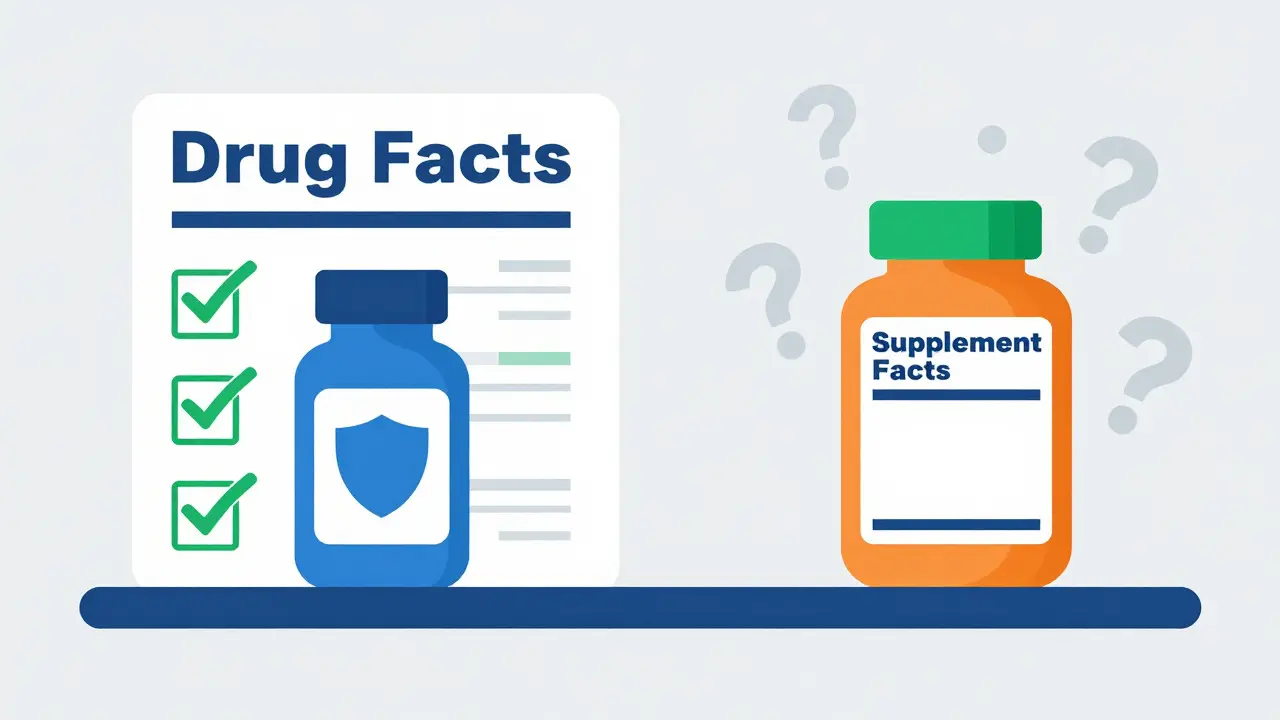
Walk into any pharmacy, and you’ll see them side by side on the shelf: a bottle of ibuprofen next to a jar of multivitamins. They look similar. They’re sold in the same place. Most people assume they are held to the same standards. But here is the uncomfortable truth: the rules governing those two products are completely different.
The Drug Facts label is a standardized labeling format required by the FDA for over-the-counter medications that includes specific safety warnings, dosage instructions, and ingredient lists. It is designed to protect you from harm. The label on your vitamin bottle? That is called a Supplement Facts panel, and it was designed to sell you a product, not necessarily to keep you safe. This distinction creates a massive blind spot for consumers who believe that because a product is on a pharmacy shelf, it has been rigorously tested for safety.
The Regulatory Divide: Food vs. Medicine
To understand why your vitamin label lacks critical warnings, you have to look at how these products are classified. In the United States, over-the-counter (OTC) medications are regulated as drugs under strict FDA guidelines established in 1999. Before an OTC drug hits the market, it must be proven safe and effective for its intended use. The resulting Drug Facts label is mandatory and highly structured. It requires nine specific elements, including active ingredients with exact measurements, detailed warnings about contraindications, and clear directions for use.
Dietary supplements, however, live in a different legal universe. Under the Dietary Supplement Health and Education Act (DSHEA) of 1994, vitamins and herbal remedies are regulated as food, not medicine. This means manufacturers do not need FDA approval before selling their products. They don’t even need to prove their supplements work or are safe. Instead, they use a Supplement Facts panel is the labeling format used for dietary supplements that provides less stringent disclosure requirements compared to the Drug Facts label for medications. While it looks like the Drug Facts label, it omits crucial safety data that would be mandatory on an equivalent medication.
This regulatory gap is staggering. A 2022 commentary in the AMA Journal of Ethics found that 72% of surveyed consumers incorrectly believed supplements undergo the same FDA safety review as medications. You aren’t alone if you’ve made this assumption. The system is designed to make you feel secure, but the labels tell a different story.
What’s Missing From Your Vitamin Bottle?
If you pick up an OTC pain reliever, the label will explicitly warn you if you have liver disease, are taking blood thinners, or are pregnant. It will list potential side effects like nausea or dizziness. Now, pick up a popular multivitamin or herbal remedy. Chances are, you won’t find those warnings.
Here is what the Supplement Facts panel typically leaves out:
- Detailed Drug Interactions: A 2021 study in JAMA Internal Medicine revealed that only 17% of supplement labels warn about potential interactions with prescription medications. Compare that to 100% of OTC medication labels. If you are taking warfarin, St. John’s Wort can drastically reduce its effectiveness, but the supplement label might not mention this risk clearly.
- Pregnancy and Breastfeeding Precautions: OTC medications with teratogenic risks (risks of birth defects) require prominent warnings and often Risk Evaluation and Mitigation Strategy (REMS) programs. Supplements containing high levels of vitamin A (retinol), which carries the same risks, often bury generic warnings in fine print. The American College of Obstetricians and Gynecologists noted that 40% of prenatal vitamins contain vitamin A levels exceeding the recommended daily limit during pregnancy, yet only 22% feature prominent warnings.
- Specific Dosage Instructions for Conditions: OTC drugs provide precise dosing for specific symptoms. Supplements can only make structure/function claims, like "supports immune health," accompanied by the disclaimer: "This statement has not been evaluated by the FDA." This vague language prevents them from giving medical advice, leaving you to guess the right dose.
- Sodium Content: The FDA requires OTC medications to list sodium content per dosage unit. This requirement does not extend to supplements, posing hidden risks for consumers with hypertension or heart conditions.
The Hidden Dangers of Proprietary Blends
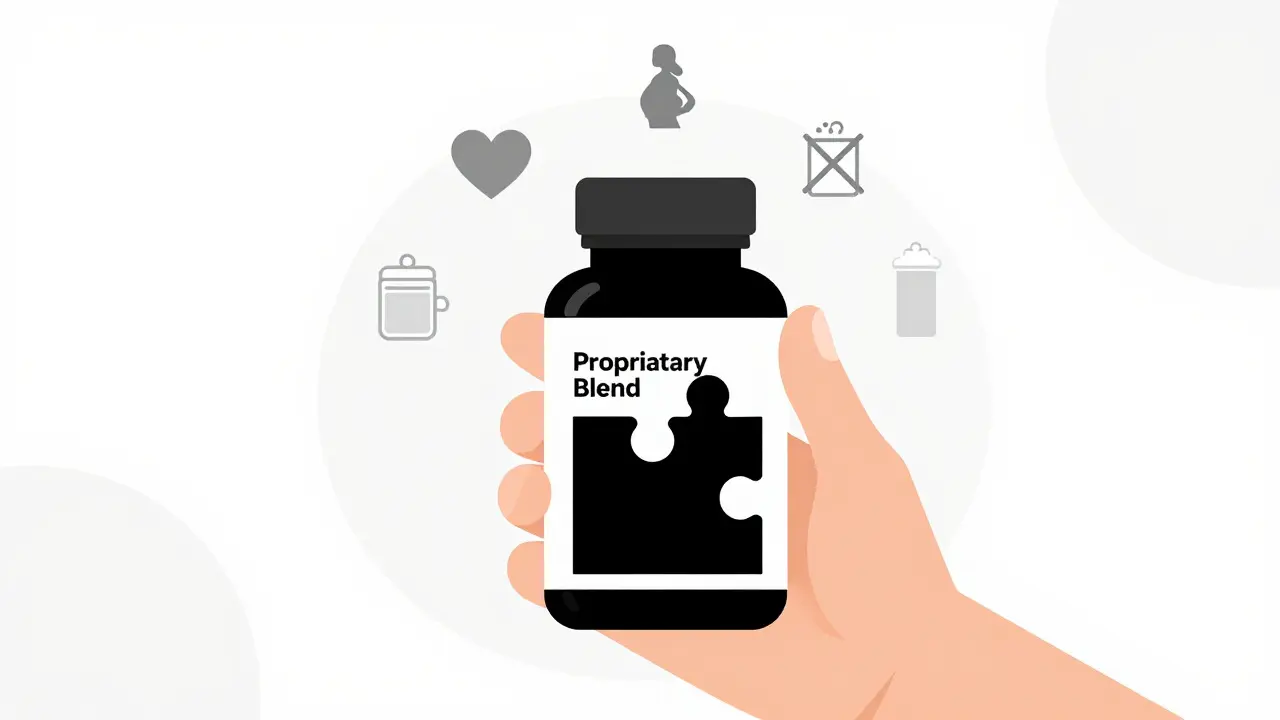
One of the most frustrating aspects of supplement labeling is the use of proprietary blends. Unlike OTC medications, which must list exact milligram amounts of each active ingredient, supplements can group ingredients together under a single total weight. For example, a weight loss supplement might list "Thermogenic Blend: 500mg" without telling you how much of that is green tea extract, caffeine, or guarana.
A 2022 analysis by NSF International found that 63% of weight loss supplements and 41% of protein supplements use these opaque blends. This makes it nearly impossible for you to know if you are consuming a safe amount of any single ingredient. If you are sensitive to caffeine, you might accidentally overdose because the label doesn’t break down the components.
Furthermore, supplements are not required to specify the form of certain nutrients. Vitamin A can be listed in International Units (IU) without clarifying whether it comes from retinol (which has teratogenic risks) or beta-carotene (which is generally safer). This lack of specificity makes risk assessment impossible for the average consumer.
Why Does This Gap Persist?
You might wonder why the FDA hasn’t fixed this obvious safety issue. The answer lies in money and lobbying. The U.S. dietary supplement industry generated $54.2 billion in sales in 2022, growing at 8.3% annually since 2019. This substantial market size gives the industry significant political power. In 2022 alone, the supplement industry spent $8.2 million on federal lobbying to resist efforts to strengthen labeling requirements.
Regulatory enforcement is also reactive rather than proactive. For OTC medications, the FDA must approve them before they reach the market. For supplements, the FDA must prove a product is "adulterated" or "misbranded" to remove it. A 2023 Government Accountability Office investigation found the FDA takes an average of 427 days to act on reports of dangerous supplements, compared to just 45 days for problematic OTC medications. During those 427 days, thousands of consumers could be at risk.
The problem is compounded by poor documentation quality. ConsumerLab.com’s 2023 review found that 76% of supplement websites lacked accessible information about potential side effects, compared to only 4% of OTC medication websites. When the label isn’t enough, the company website should help, but it rarely does.
| Feature | OTC Medication (Drug Facts) | Dietary Supplement (Supplement Facts) |
|---|---|---|
| Regulatory Basis | FDA Drug Regulations (1999) | DSHEA Food Regulations (1994) |
| Pre-market Approval | Required for safety and efficacy | Not required |
| Ingredient Disclosure | Exact mg amounts for all actives | Proprietary blends allowed; forms unspecified |
| Drug Interaction Warnings | Mandatory and specific | Rarely included (only 17% of labels) |
| Pregnancy Warnings | Strict REMS protocols for high-risk drugs | Generic, often buried warnings |
| Claims Allowed | Treat, cure, prevent disease | Structure/function claims only (e.g., "supports health") |
How to Protect Yourself When Buying Supplements
Since the label won’t always save you, you have to take matters into your own hands. Here are practical steps to bridge the information gap:
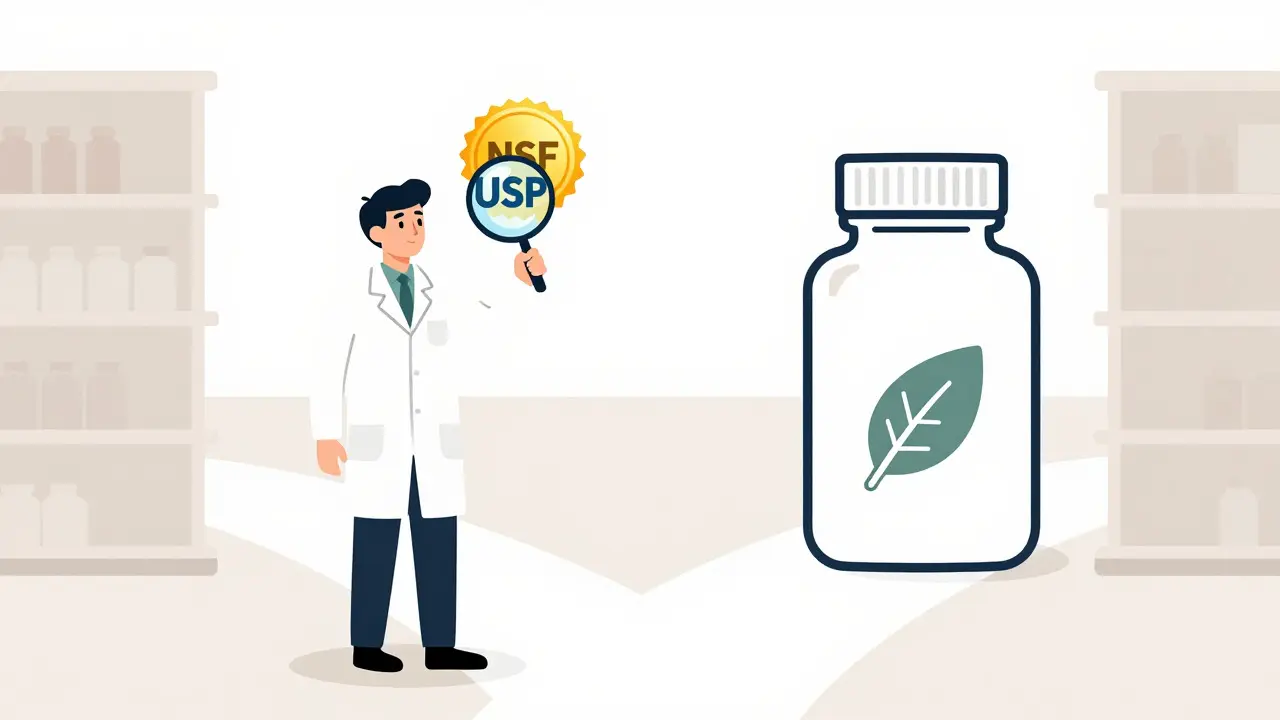
- Check for Third-Party Certification: Look for seals from organizations like NSF International, USP (United States Pharmacopeia), or ConsumerLab. These groups test supplements for purity, potency, and contaminants. As of September 2023, there were 2,147 NSF/ANSI Standard 173 certified products, a 37% increase from 2021, showing that independent verification is becoming more common.
- Use Independent Databases: Don’t rely solely on the bottle. Websites like Examine.com, which reported 4.7 million monthly users in 2023, provide unbiased research on supplement safety, efficacy, and interactions. The NIH’s Office of Dietary Supplements also launched a Supplement Label Database in January 2023, containing 65,000 products with standardized ingredient information.
- Consult Your Pharmacist: Walgreens pharmacists documented 14,327 inquiries in Q1 2023 alone about why vitamin labels differ from medication labels. Pharmacists are trained to spot interactions that labels miss. Ask them specifically about interactions with your current prescriptions.
- Beware of "Natural" Claims: Remember that "natural" does not mean "safe." Many herbs and vitamins have potent biological effects. Treat them with the same respect you would give a pharmaceutical drug.
- Look for Specific Forms: If possible, choose brands that specify the form of nutrients (e.g., methylcobalamin instead of just "vitamin B12"). This indicates a higher level of transparency and quality control.
Future Changes: Will Labels Improve?
There are signs that the landscape may shift. In June 2023, the FDA issued a draft guidance document proposing enhanced labeling requirements for supplements containing high levels of vitamin A. The proposal recommends listing amounts in mcg RAE (Retinol Activity Equivalents) rather than IU and including prominent pregnancy warnings-requirements already mandatory for equivalent OTC medications.
Congressional hearings in July 2023 featured testimony from FDA Commissioner Robert Califf, who acknowledged that "current supplement labeling regulations do not provide consumers with the same level of safety information they receive from OTC medication labels." This admission suggests potential rule changes in the near future. However, until new laws pass, the burden remains on you to read beyond the label.
The Dietary Supplement Listing Act of 2022 (H.R. 5851) aims to require manufacturers to list all products with the FDA, improving traceability. Yet, it lacks provisions to standardize warning labels to match Drug Facts requirements. Until then, treat every supplement with caution, verify its contents independently, and never assume that pharmacy placement equals FDA approval.
Are vitamins considered drugs by the FDA?
No, vitamins and dietary supplements are regulated as food products under the Dietary Supplement Health and Education Act (DSHEA) of 1994, not as drugs. This means they do not require pre-market approval for safety or efficacy, unlike OTC medications.
Why don't supplement labels list drug interactions?
Supplement labels are not legally required to list specific drug interactions in the same way OTC medications are. Studies show that only 17% of supplement labels include such warnings, whereas 100% of OTC medication labels do. This is due to the looser regulatory framework governing supplements.
What is the difference between Drug Facts and Supplement Facts?
The Drug Facts label is mandated for OTC medications and includes detailed safety warnings, dosage instructions, and exact ingredient amounts. The Supplement Facts panel, used for vitamins and herbs, has fewer mandatory disclosures, allows proprietary blends, and permits only structure/function claims rather than disease-treatment claims.
Do I need to worry about vitamin A in prenatal supplements?
Yes. High levels of vitamin A (specifically retinol) can cause birth defects. While OTC medications with similar risks require strict warnings, many prenatal vitamins exceed the 10,000 IU daily limit without prominent alerts. Always check the form of vitamin A and consult your doctor.
How can I verify if a supplement is safe?
Look for third-party certification seals from NSF International, USP, or ConsumerLab. Use independent databases like Examine.com or the NIH’s Supplement Label Database to check for interactions and quality. Always consult your pharmacist or healthcare provider before starting a new supplement.

15 Comments
I always assumed that because the pharmacist was standing right there, everything on the shelf was equally vetted. It is genuinely unsettling to think about how much of my family's daily routine relies on products that haven't been proven safe before hitting the market. The part about proprietary blends really stuck with me since we buy a lot of those 'thermogenic' mixes for my husband's gym routine.
Thanks for sharing this important info. It helps us all stay safer. I check Examine.com now before buying anything new. It is easy to use and saves time. We should all look for the USP seal too.
Oh please, spare me the fear-mongering!! You act like everyone is just popping pills blindly without reading a single word! Most people are smart enough to know that natural doesn't mean magic but also doesn't mean poison either. This article is just trying to scare you into spending more money on 'certified' brands which is just another way for big pharma to squeeze every last dime out of your wallet!!! Stop acting so helpless!
While the points raised here are certainly not without merit, one must consider the broader context of regulatory frameworks which have evolved significantly over the past few decades; furthermore, the assertion that consumers are entirely ignorant is somewhat reductive, as many individuals do engage in due diligence, albeit perhaps not to the extent desired by purists who demand absolute transparency in an industry that operates under fundamentally different legal paradigms than pharmaceuticals.
It is truly disheartening to observe the sheer negligence displayed by both manufacturers and regulators alike. One would expect a higher standard of care from entities responsible for public health, yet we are left with a system that prioritizes profit margins over basic safety protocols. The lack of mandatory interaction warnings is nothing short of criminal negligence disguised as consumer freedom.
i dont see the big deal. if you read the label you are fine. its not rocket science. people just want something to blame when they mess up their own health.
This is such a crucial distinction that often gets overlooked in casual conversations about health. I’ve noticed that many patients assume their prenatal vitamins are automatically safe because they bought them at a reputable pharmacy, unaware of the vitamin A risks mentioned here. It’s empowering to know that third-party certifications like NSF actually exist and can provide that extra layer of security. I always recommend checking Examine.com myself, but seeing it cited here validates its importance even further.
yo this is wild man. i never thought about the lobbying aspect. makes u wonder whats really going on behind the scenes. gotta keep our eyes open folks. dont let them fool u with fancy labels. knowledge is power bro.
In my culture, we rely heavily on traditional herbs and supplements passed down through generations, so this regulatory gap feels very personal. It is sad that modern systems don't protect these traditions better or require clearer labeling. I try to source from local vendors who explain everything, but even then, the lack of standardized testing is worrying. We need more global cooperation on this issue.
Absolutely absurd!! How has this persisted for decades?! The FDA is practically useless when it comes to holding these supplement giants accountable. It’s outrageous that they get to hide behind 'proprietary blends' while charging premium prices. Wake up people!!
Fascinating insight into the labyrinthine world of regulatory arbitrage. It reminds one of the alchemical pursuits of old, where the line between medicine and mere substance was blurred by intent rather than efficacy. Perhaps we ought to view our consumption habits not as passive acceptance, but as active philosophical choices regarding what we invite into our biological temples. Transparency is the cornerstone of trust, after all.
typical red pilling content. most people cant afford the usp certified stuff anyway. its class warfare disguised as health advice. the elite want you to think you're dumb for buying cheap vitamins.
You need to take control of your health. Don't wait for the government to fix things. Check the labels yourself. Talk to your doctor. Be proactive. It is simple if you put your mind to it.
It is frankly embarrassing that we still have to educate the general public on this level of basic consumer protection. If you cannot afford to verify the purity of what you ingest, perhaps you should reconsider your budget priorities. Ignorance is not bliss; it is a liability.
Hey there, friend! This got me thinking about the nature of truth and perception. Just because a label says one thing doesn't mean reality aligns with it. We have to seek deeper understanding beyond the surface. Stay curious and keep questioning everything, my friends!