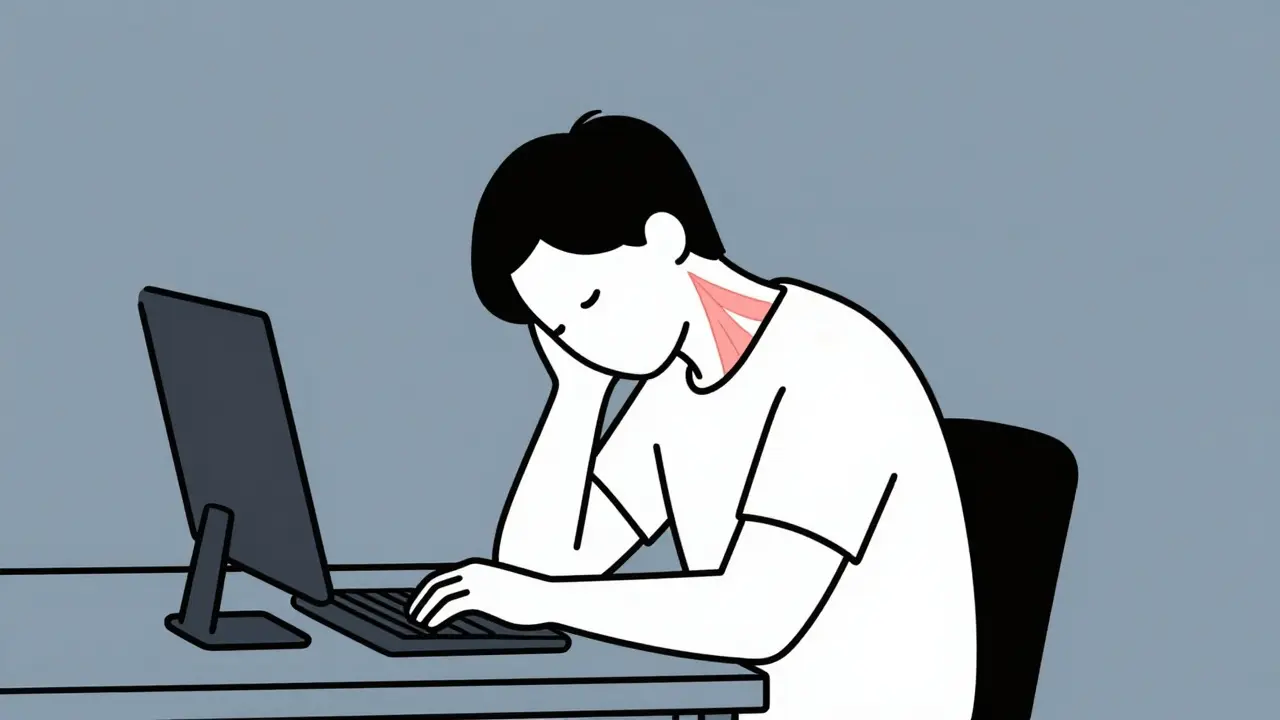
Neck pain isn’t just annoying-it can wreck your sleep, ruin your focus at work, and make even simple tasks like turning your head while driving a chore. If you’ve woken up stiff, felt a sharp ache when looking up, or noticed your shoulders creeping up toward your ears all day, you’re likely dealing with cervical strain. It’s not a spine fracture or a pinched nerve. It’s your muscles and tendons in the neck being overstretched, usually from sitting too long, sleeping wrong, or getting whiplashed in a fender bender. And here’s the good news: most cases heal fast-if you do the right things early.
What Exactly Is Cervical Strain?
Cervical strain means the soft tissues in your neck-muscles, tendons, ligaments-have been pushed beyond their limit. Think of it like pulling a rubber band too far. It doesn’t snap, but it hurts, swells, and tightens up. This isn’t something that shows up on an X-ray. It’s a soft tissue injury, and it’s incredibly common. About 60 to 70% of all neck pain visits to doctors are due to cervical strain, according to the American Association of Neurological Surgeons. You don’t need to be in a car crash to get it. Slouching over your laptop for hours, cradling your phone between your ear and shoulder, or even turning your head too fast while reaching for something in the backseat can trigger it.How Do You Know It’s a Strain and Not Something Worse?
Not all neck pain is the same. That’s why misdiagnosis is one of the biggest problems. If your pain shoots down your arm, makes your fingers tingle, or weakens your grip, it’s probably not a strain-it could be a pinched nerve (cervical radiculopathy). If you’re over 60 and your neck grinds when you turn it, it’s more likely osteoarthritis. Rheumatoid arthritis? That usually wakes you up in the morning with stiffness that lasts over 30 minutes. Cervical strain is simpler: pain stays in your neck and upper shoulders. It gets worse when you move your head, and it gets better when you rest. The pain is usually a dull ache or sharp sting when you twist or tilt. You’ll feel tenderness when someone presses on the back or sides of your neck. Most people rate it a 4 to 6 out of 10 on the pain scale during the first few days.The Three Levels of Strain (And What They Mean for Recovery)
Not all strains are created equal. They come in three grades, and knowing which one you have helps set realistic expectations.- Mild strain: Tiny tears in muscle fibers. Pain starts within hours, peaks in 1-2 days, and fades in 2-3 days. You might feel stiff, but you can still move your head without too much trouble.
- Moderate strain: Bigger tears. Pain lasts 1-2 weeks. You’ll notice real limits in how far you can turn your head or look up. Swelling and muscle spasms are common.
- Severe strain: A near-complete tear. This is rare without trauma, but it happens. Recovery takes 6 to 12 weeks. You might need imaging to rule out a full rupture. If you can’t hold your head up or feel numbness, see a doctor immediately.
The muscles most often affected? The trapezius (the big muscle from your neck to your shoulder), the levator scapulae (runs from your neck to your shoulder blade), and the sternocleidomastoid (the thick band running from your ear to your collarbone). Ultrasound studies show these are the usual suspects in 65% of cases.
What Not to Do (The Mistakes That Make It Worse)
There’s a lot of bad advice out there. Here’s what you should avoid:- Wearing a neck brace all day: It might feel good at first, but keeping your neck still for more than 48-72 hours actually slows healing. A 2022 study of 1,200 patients showed immobilization longer than that led to 37% longer recovery times.
- Staying in bed: Rest is good for the first day or two. But staying inactive? That stiffens everything up and makes pain worse.
- Overdoing NSAIDs: Ibuprofen or naproxen can help with pain and swelling early on. But using them for more than 7-10 days doesn’t help more than plain acetaminophen-and it raises your risk of stomach problems by 15%, according to the American Academy of Physical Medicine and Rehabilitation.
- Ignoring posture: If you’re the type who leans forward at your desk or holds your phone low, you’re setting yourself up for repeat injuries. Forward head posture affects 68% of office workers, and it’s a major reason why some strains turn chronic.
What Actually Works: Evidence-Based Treatment Steps
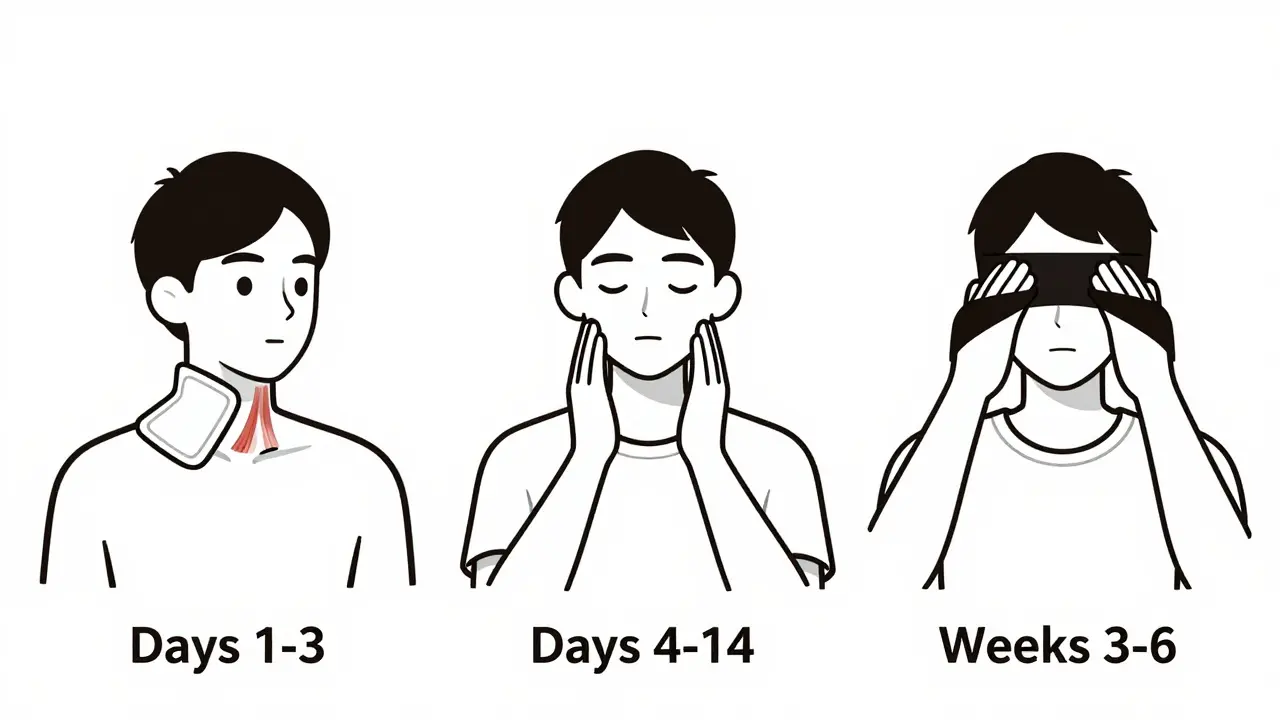
The best treatments aren’t flashy. They’re simple, consistent, and backed by science.Days 1-3: Protect, Ice, and Move Gently
- Apply ice packs (15-20 minutes every 2-3 hours) to reduce swelling. A bag of frozen peas wrapped in a towel works fine.
- Take short walks. Movement keeps blood flowing to the area and prevents stiffness.
- Do gentle chin tucks: Sit or stand straight, then slowly pull your chin straight back, like you’re making a double chin. Hold for 3 seconds. Repeat 10 times, 3 times a day.
A 2022 study in the Journal of Athletic Training found that this kind of intermittent ice application reduced pain 32% more than keeping ice on all day.
Days 4-14: Bring Back Movement
This is when recovery really starts. You’re not just healing-you’re rebuilding strength.- Continue chin tucks.
- Add scapular retractions: Sit or stand, squeeze your shoulder blades together like you’re trying to hold a pencil between them. Hold for 5 seconds. Do 10 reps, 3 times a day.
- Slow, controlled neck rotations: Turn your head slowly left and right. Don’t force it. Go only as far as pain allows. Do 5 reps each side, twice daily.
By day 14, people who stick to these exercises see an average 18.7-degree improvement in how far they can rotate their neck, according to the Spine Journal.
Weeks 3-6: Build Strength to Prevent Recurrence
This is where most people slip up. They feel better and stop doing exercises. Big mistake. That’s when strains come back.- Use resistance bands (TheraBand®) for neck strengthening. Loop the band around your forehead and gently push your head forward against resistance. Do 2 sets of 15 reps, 3 times a week.
- Strengthen your lower traps and serratus anterior-muscles that pull your shoulder blades down and back. Push-ups on your knees, scapular wall slides, and rows with light dumbbells help.
- Work on posture: Set a phone reminder to check your head position every hour. Your ears should be over your shoulders, not in front of them.
Research from the British Journal of Sports Medicine shows resistance training boosts strength gains by 23% compared to bodyweight alone.
What About Physical Therapy, Chiropractic, or Massage?
Yes, they help-but not all the same way.- Physical therapy: Best option overall. Patients who start PT within 72 hours recover 28% faster than those who wait. 78% of people report major improvement within two weeks. Look for therapists who focus on movement retraining, not just hands-on manipulation.
- Chiropractic: Many feel immediate relief after an adjustment. But 32% of users on Healthgrades say the relief is temporary and they need frequent visits. It’s good for short-term comfort, not long-term repair.
- Massage: Helps relax tight muscles, especially in the trapezius. But if you don’t combine it with exercises, the pain comes back.
One Reddit user, u/NeckPainWarrior, went from chronic strain to pain-free after six months of PT focused on scapular stability. Their forward head posture improved from 4.2cm to 1.8cm-measured by their therapist. That’s the kind of change that sticks.
Why Some People Get Stuck in Chronic Pain
About 10-15% of cervical strains turn chronic. That means pain lasts longer than 3 months. Why?- Delayed care: One study found people waited an average of 8.2 weeks before seeing a specialist. By then, the strain had turned into myofascial pain syndrome-much harder to treat.
- Ignoring posture: If you keep sitting like a question mark at your desk, your neck muscles never get a real chance to heal.
- Pain fear: People who catastrophize pain-think “This will never get better”-are 3.2 times more likely to develop chronic symptoms, according to the 2023 update to physical therapy guidelines.
The NIH is currently running a trial called CERVICO to see if treating people within 72 hours can cut chronic pain rates from 15% down to 8%. Early results look promising.
Prevention: Stop It Before It Starts
The best treatment is avoiding it altogether.- Adjust your screen so the top is at eye level. No more looking down.
- Use a headset or speakerphone instead of cradling your phone.
- Take a 2-minute break every hour. Stand up, stretch your arms overhead, do 5 chin tucks.
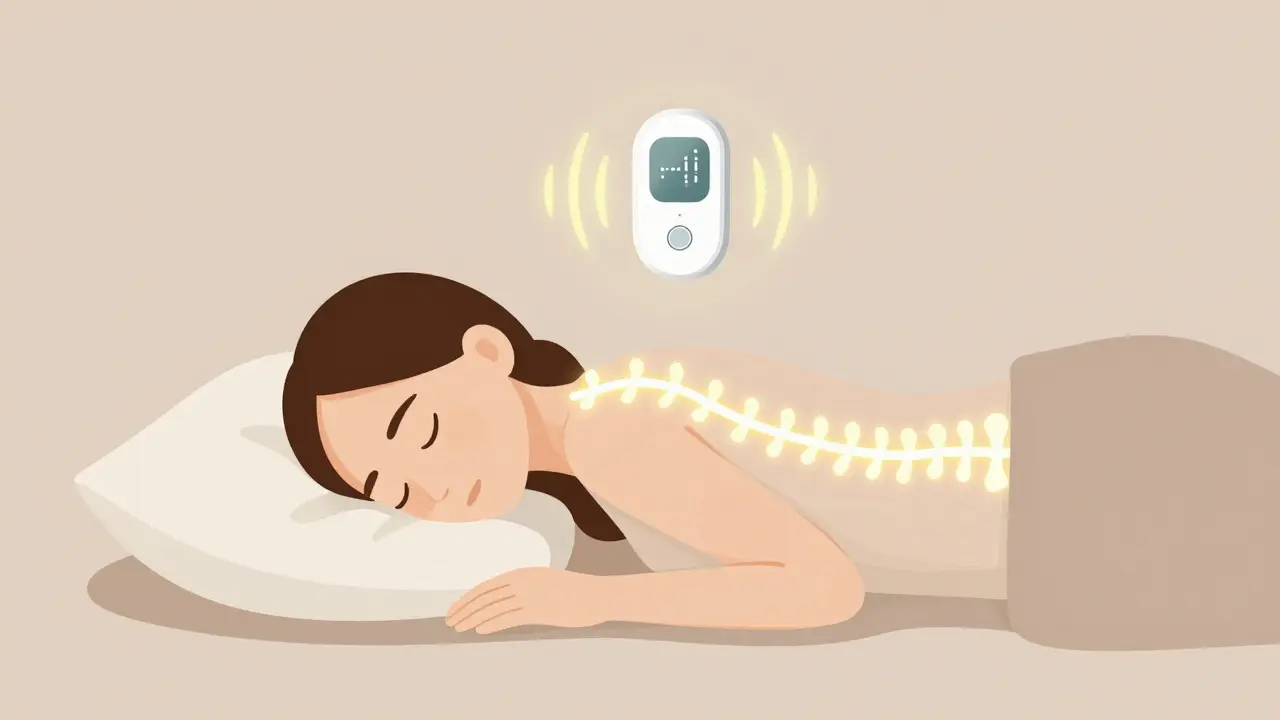
- Sleep on your back or side with a pillow that supports your neck’s natural curve-not too high, not too flat.
- Try a wearable biofeedback device like NeckSense™. It vibrates when you slouch, helping you correct posture in real time. Approved by the FDA in early 2023.
When to See a Doctor
Most strains heal on their own. But call your doctor if:- Pain is severe or getting worse after 3 days
- You have numbness, tingling, or weakness in your arms or hands
- You lose bladder or bowel control (rare, but serious)
- You had a recent injury (car crash, fall)
- Pain lasts longer than 4 weeks despite home care
Don’t wait. The longer you delay, the harder it is to reverse.
Final Thought: It’s Not Just About Pain
Cervical strain isn’t just a physical issue. It’s a signal. Your body is telling you your habits need to change. Whether it’s your posture, your workload, or how you sleep, fixing the root cause is what keeps pain from coming back. You don’t need surgery. You don’t need opioids. You just need to move better, rest smarter, and stick with the basics.How long does cervical strain usually take to heal?
Most mild to moderate cervical strains heal within 2 to 4 weeks. Mild cases resolve in 2-3 days, moderate ones take 1-2 weeks, and severe cases can take 6-12 weeks. Starting treatment early-especially physical therapy within 72 hours-can speed recovery by nearly a third.
Is heat or ice better for neck strain?
Use ice in the first 48-72 hours to reduce swelling and inflammation. After that, heat helps relax tight muscles and improve blood flow. Apply heat for 15-20 minutes at a time, especially before stretching or exercising. Don’t use heat right after an injury-it can make swelling worse.
Can neck strain cause headaches?
Yes. Tight muscles in the neck, especially the upper trapezius and sternocleidomastoid, can refer pain to the base of the skull and forehead, triggering tension headaches. These are often mistaken for migraines. Treating the neck strain usually resolves the headache within days.
Should I use a neck brace?
Only for short-term relief-no more than 2-3 days. Wearing a brace longer than that weakens neck muscles and delays healing. Studies show immobilization beyond 72 hours increases recovery time by 37%. If you need support, try a soft collar for comfort during travel or sleep, not daily use.
What exercises should I avoid with neck strain?
Avoid heavy lifting, overhead movements, or any exercise that causes pain in your neck. Skip crunches, heavy shoulder presses, and high-impact activities like running or jumping until your pain is gone. Focus on gentle mobility and scapular control first. Return to intense workouts only after you’ve regained full, pain-free range of motion.
Can stress make neck strain worse?
Absolutely. Stress causes you to unconsciously tense your neck and shoulder muscles. This increases pain sensitivity and slows healing. Adding breathing exercises, mindfulness, or even short walks can reduce muscle tension and help you recover faster. Cognitive-behavioral strategies are now part of official treatment guidelines for people with high pain catastrophizing scores.
Neck pain doesn’t have to be a life sentence. Most people recover fully with the right approach. The key isn’t finding a miracle cure-it’s being consistent with simple, smart habits. Move gently. Strengthen slowly. Fix your posture. And don’t ignore it until it becomes chronic.

9 Comments
This article is pure garbage. You think people don’t know how to sit? Like we’re all just lazy idiots who need a 5000-word lecture on chin tucks? I’ve had neck pain for 12 years and no ‘gentle movement’ fixed it. You’re just selling a lifestyle brand wrapped in pseudoscience.
Bro, this is like a yoga guru wrote a medical textbook after binge-watching TED Talks. But honestly? The 72-hour PT window is legit. I’m a software dev from Bangalore, and my trapezius was doing the cha-cha after 8-hour Zoom marathons. Started chin tucks + TheraBand like you said-now my neck doesn’t scream when I check my phone. No magic, just muscle memory. 🙏
There’s a quiet wisdom here, really. We treat our bodies like machines that can run on caffeine and neglect, then act surprised when they rebel. The neck isn’t just a hinge-it’s a conversation between your posture, your stress, and your soul. That 10-15% who go chronic? They’re not ‘weak.’ They’re unheard. The real cure isn’t in the exercises-it’s in listening. Slow down. Breathe. Let your shoulders drop. Not because a study says so, but because you deserve to feel at home in your own skin. 🌿
Let’s be honest-this reads like a corporate wellness brochure ghostwritten by a grad student who aced their biomechanics final but has never once held a real job. The ‘FDA-approved NeckSense™’? That’s not innovation, that’s capitalistic exploitation of chronic pain. And citing Reddit users as clinical evidence? Pathetic. Where’s the double-blind RCT? Where’s the control group? This isn’t medicine-it’s influencer content dressed in Helvetica.
Okay so I’ve been dealing with this since 2018 after that Uber accident where the driver slammed on the brakes and I went from 60mph to ‘oh god my neck’ in 0.3 seconds. I tried everything-chiro, acupuncture, cupping, even a $300 ‘ergonomic’ pillow that made me sleep like a corpse. The ice thing? Works. The chin tucks? Fine. But here’s what nobody tells you-the real villain is your fucking mattress. I switched from memory foam to a firm latex one and suddenly my neck stopped feeling like it was being slowly crushed by a sleeping bear. Also, stop using your phone in bed. I know you think you’re being productive, but you’re not. You’re just training your cervical spine to hate you. And yes, I’ve tried every app, every posture reminder, every ‘neck yoga’ video on YouTube. None of it matters if your entire life is built around staring at a rectangle. You’re not broken. Your environment is. Fix that first. The rest is just noise.
Wow what a revolutionary idea-move your neck? Who knew? I’m shocked this isn’t on the cover of Time magazine. Also, ‘don’t wear a neck brace’-groundbreaking. Next you’ll tell us water is wet and gravity exists. And ‘use ice first’? Genius. I’m selling this to NASA. They’ve been wasting billions on Mars missions when they could’ve just told astronauts to put a bag of peas on their necks. 😘
Everyone here is acting like this is some deep life lesson. It’s a muscle injury. You hurt it. You fix it. Stop turning it into a spiritual awakening. I had this after a car crash. I did the exercises. I didn’t cry about it. I didn’t meditate. I didn’t buy a $200 posture tracker. I just did the damn chin tucks and moved on. Stop romanticizing pain. It’s not poetry. It’s biology. And if you’re still in pain after 4 weeks? See a doctor. Not a guru. Not a Reddit post. A real one. With a degree. Not a TikTok bio.
Same. Woke up like this last week. Ice. Chin tucks. 3 days. Gone. No drama. No apps. No therapy. Just stop being a zombie at your desk. 🤷♀️
This article contains multiple grammatical errors, inconsistent punctuation, and an inappropriate conflation of anecdotal evidence with clinical guidelines. Furthermore, the reference to a Reddit user as a valid data point undermines the credibility of the entire piece. Additionally, the term ‘NeckSense™’ is improperly capitalized without formal trademark notation. As a licensed physical therapist with a doctorate in biomechanics, I must emphasize that the recommended protocols are largely sound-but the presentation is unprofessional and potentially misleading to lay readers. For the record: ice should be applied for 15–20 minutes every two hours during the acute phase, not ‘every 2–3 hours.’ Precision matters.