SSRI-Opioid Risk Checker
Medication Interaction Checker
Check if your SSRI medication is safe with a specific opioid painkiller to avoid serotonin syndrome risk.
Select your medications to see the risk level.
When you’re taking an SSRI for depression or anxiety and need pain relief, it’s easy to assume that any opioid will be safe. But that’s not true. Some opioid painkillers can trigger a dangerous, even deadly, reaction called serotonin syndrome when mixed with SSRIs. It doesn’t happen often-but when it does, it hits fast, and many doctors miss it at first.
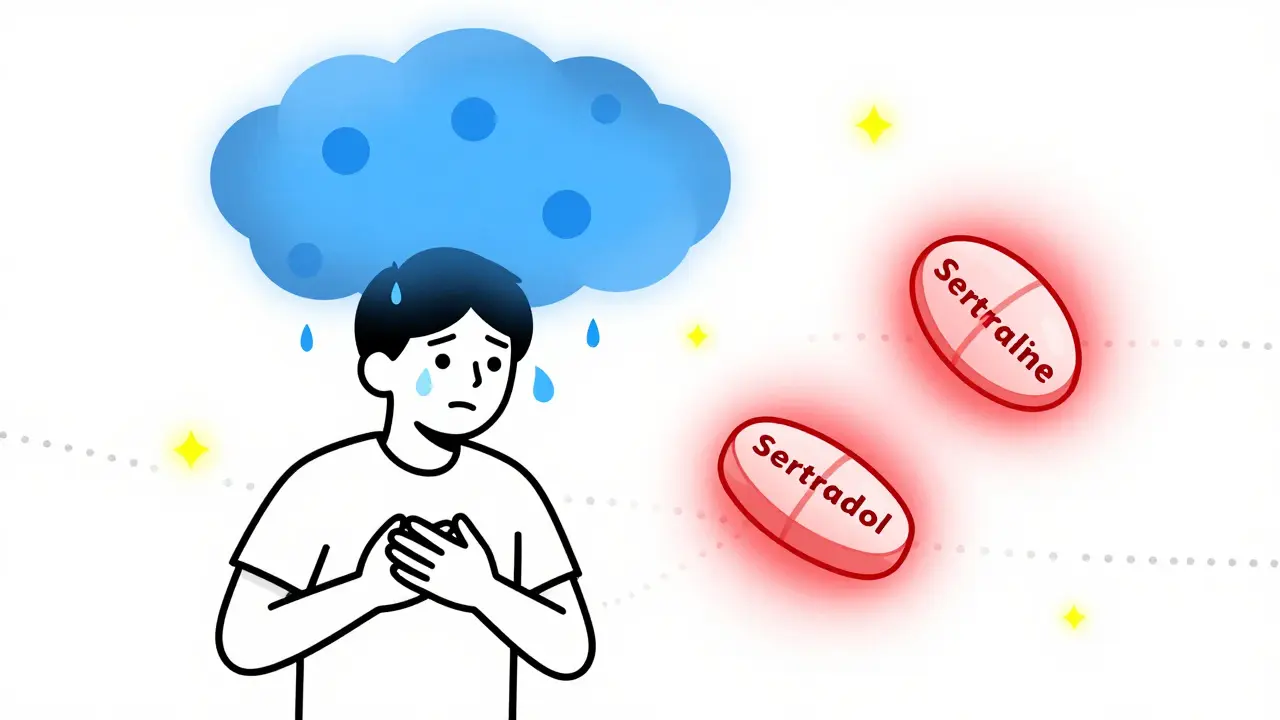
Imagine this: you’ve been on sertraline for months. Your mood is stable. Then you twist your ankle, and your doctor prescribes tramadol. Within hours, you start shaking uncontrollably. Your heart races. You sweat like you’ve run a marathon in winter. You feel agitated, confused, like your body is on fire. This isn’t anxiety. It’s serotonin syndrome-and it’s happening because tramadol and sertraline are both flooding your brain with too much serotonin.
It’s not just tramadol. Methadone and pethidine (meperidine) carry the same risk. But morphine, oxycodone, and buprenorphine? They’re much safer. The difference isn’t random. It’s chemistry. Some opioids block the serotonin transporter (SERT), the same system SSRIs target. That means serotonin builds up faster than your body can clear it. Other opioids don’t touch SERT at all. They work differently. That’s why not all opioids are equal when you’re on an SSRI.
What Exactly Is Serotonin Syndrome?
Serotonin syndrome isn’t an allergy. It’s a toxic overload. Your brain and nervous system get overwhelmed by too much serotonin, a chemical that helps regulate mood, sleep, and pain. When you combine two drugs that boost serotonin-like an SSRI and a risky opioid-you push levels beyond what your body can handle.
The symptoms come on fast. Usually within hours of taking a new dose or increasing one. Mild cases look like shivering, diarrhea, a fast heartbeat, or sweating. But severe cases? That’s when things turn dangerous. Core body temperature spikes above 41°C (106°F). Muscles lock up. You can’t move. Seizures happen. Without treatment, about 1 in 10 people die.
Doctors don’t diagnose this with a blood test. They use the Hunter Criteria-a set of clinical signs that are 97% accurate. If you have spontaneous muscle spasms, or muscle rigidity with fever and sweating, or clonus (involuntary twitching) with agitation-it’s serotonin syndrome until proven otherwise. Many cases are misdiagnosed as strokes, infections, or even psychiatric episodes. That delay can be fatal.
Which Opioids Are Safe With SSRIs?
Not all opioids are created equal. Here’s what the data shows:
| Opioid | Risk Level | Why? |
|---|---|---|
| Tramadol | High | Strongly blocks serotonin reuptake. 30x more potent than morphine at this. |
| Methadone | High | Inhibits serotonin transporter. Linked to 2.8x higher risk than morphine. |
| Pethidine (Meperidine) | High | One of the most dangerous combinations. High fatality rate. |
| Morphine | Low | No serotonin transporter inhibition. Preferred for pain with SSRIs. |
| Oxycodone | Low | No significant SERT activity. Safe alternative. |
| Buprenorphine | Low | Minimal serotonin interaction. Often used in chronic pain with depression. |
| Fentanyl | Unclear | No SERT inhibition in labs-but 127 real-world cases of serotonin syndrome reported. |
Even codeine, once thought to be safe, has been linked to serotonin syndrome in patients on SSRIs. One case in 2018 involved a patient taking paroxetine who developed symptoms after codeine. So don’t assume safety just because a drug is "old" or "common."
And fluoxetine? It’s especially risky because it sticks around. Its active metabolite, norfluoxetine, can linger for up to 16 days after you stop taking it. That means even if you quit your SSRI, you’re still at risk for weeks. Sertraline? Clears in about a day. That’s why switching medications isn’t as simple as stopping one and starting another.
Who’s Most at Risk?
It’s not just about the drugs. Your body matters too.
Older adults are at higher risk. People over 65 take, on average, 31% more medications than younger people. More pills = more chances for dangerous overlaps. The American Geriatrics Society specifically warns against using tramadol in seniors on SSRIs.
People with liver or kidney disease are also more vulnerable. Their bodies can’t clear these drugs efficiently. Even a normal dose can become toxic.
And then there’s genetics. About 7% of people are "poor metabolizers" of a liver enzyme called CYP2D6. That’s the enzyme that breaks down tramadol. If you’re one of them, tramadol turns into a more potent serotonin booster than intended. Studies show these people have over 3 times the risk of serotonin syndrome.
And here’s the kicker: the number of people taking both antidepressants and opioids has jumped. In 2022, over 1 in 5 opioid prescriptions went to someone already on an SSRI or SNRI. That’s millions of people walking around with a hidden risk.
How to Prevent Serotonin Syndrome
Prevention is simple-but only if you know what to look for.
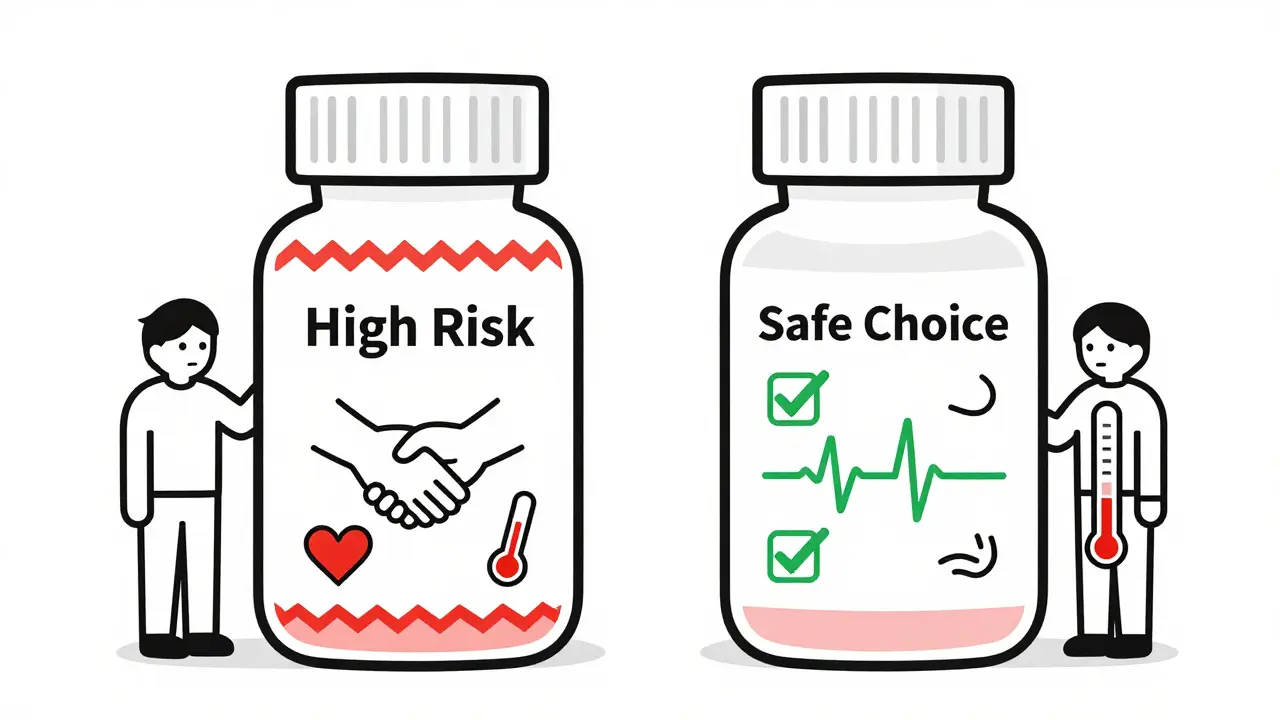
- Avoid high-risk combinations entirely. If you’re on an SSRI, don’t take tramadol, methadone, or pethidine. Period. There are safer painkillers.
- Choose morphine, oxycodone, or buprenorphine. These don’t interfere with serotonin. They’re just as good for pain, without the danger.
- Wait before switching. If you’re stopping an SSRI-especially fluoxetine-wait at least 5 weeks before starting a risky opioid. For other SSRIs, wait 14 days.
- Ask your pharmacist. Pharmacists see all your meds. If you fill prescriptions at different places, they won’t know unless you tell them. Always list every drug you take.
- Check your EHR. Hospitals and clinics using modern systems like Epic now flag dangerous combinations automatically. If your doctor doesn’t see a warning, ask why.
- Know the warning signs. If you start shivering, twitching, sweating, or feel unusually agitated after starting a new painkiller, stop it and call your doctor. Don’t wait.
Some hospitals have cut these dangerous prescriptions by over 80% just by adding automatic alerts in their computer systems. That’s not magic. It’s basic safety design.
What If It Happens?
If you suspect serotonin syndrome, act fast.
- Stop all serotonergic drugs immediately.
- Go to the ER. Don’t wait. Don’t call your GP. Go.
- Severe cases need cyproheptadine-an antihistamine that blocks serotonin receptors. Dose: 12 mg first, then 2 mg every 2 hours if needed.
- Benzodiazepines like lorazepam help calm muscle spasms and agitation.
- For high fever: cool you down with ice packs, fans, IV fluids.
There’s no magic cure. But if caught early, most people recover fully within 24-72 hours. Delayed treatment? That’s when organ failure and death happen.
What’s Changing in 2026?
Regulators are catching up. The FDA now requires opioid medication guides to include serotonin syndrome warnings. The European Medicines Agency updated tramadol labels in 2021. But the real shift is happening behind the scenes.
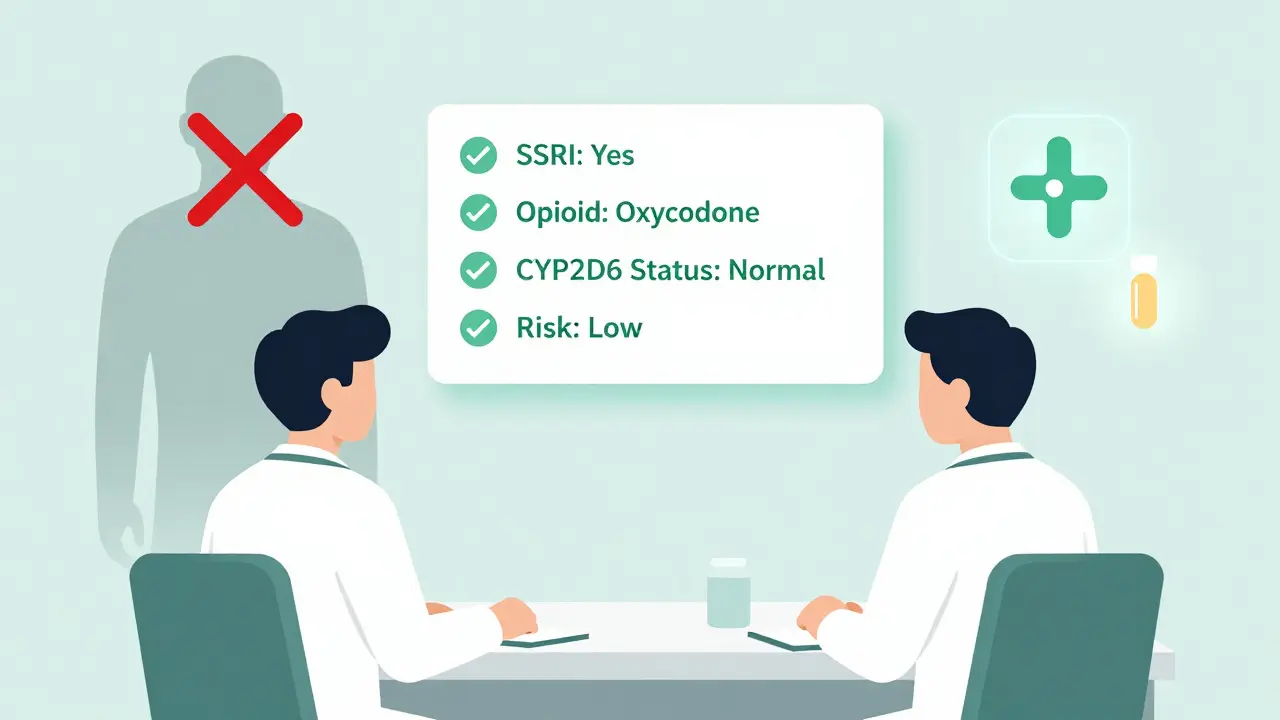
Hospitals are building AI tools that scan your full medication list and flag risks before a prescription is even written. Epic Systems is rolling out new tools in 2024 that check for 17 genetic and drug interactions linked to serotonin metabolism. That means in the near future, your doctor might get an alert like: "Patient is CYP2D6 poor metabolizer. Tramadol + sertraline = high risk. Suggest oxycodone instead."
Researchers are also hunting for blood biomarkers that could detect serotonin syndrome before symptoms get severe. A $2.4 million NIH study launched in 2023 is looking for early signals in the blood-before your temperature spikes or your muscles lock up.
This isn’t science fiction. It’s the next step in making drug safety automatic-not optional.
Final Takeaway
If you’re on an SSRI and need pain relief, you’re not stuck with dangerous choices. Morphine and oxycodone work just as well. Tramadol isn’t the only option. The risk isn’t theoretical-it’s documented in thousands of real cases. And the symptoms don’t wait for a doctor’s appointment. They show up fast.
Ask your doctor: "Is this opioid safe with my antidepressant?" If they say "probably," push for specifics. Ask if they’ve checked the serotonin interaction. If they don’t know, ask for a pharmacist to review your meds.
One conversation can save your life. Don’t assume. Don’t guess. Know what’s in your pills-and what they do together.

14 Comments
I was on sertraline for years and got prescribed tramadol for a bad back flare-up. Didn’t know the risk until I ended up in the ER shaking like I had a seizure. They thought it was a panic attack. Took them hours to connect the dots. This post saved my life.
It is, indeed, a matter of profound public health significance that the pharmacological interactions between selective serotonin reuptake inhibitors and certain opioid analgesics remain under-recognized by both clinicians and patients alike. The data presented herein, particularly regarding the serotonin transporter inhibition profiles of tramadol and methadone, is not only scientifically robust but also clinically indispensable.
One must emphasize that the Hunter Criteria, with its 97% diagnostic accuracy, ought to be universally integrated into emergency triage protocols. Furthermore, the absence of mandatory pharmacogenetic screening for CYP2D6 status prior to prescribing tramadol in populations with high SSRI utilization constitutes a systemic failure of pharmacovigilance.
I urge all medical institutions to adopt AI-driven decision-support systems, as referenced in the article, without delay. The ethical imperative is clear.
Wow. So you're telling me that people are dying because doctors are lazy and don't check drug interactions? Shocking. I'm sure this never happened before 2020. Also, why are you blaming opioids? Maybe the real problem is that people are on SSRIs for no reason at all. Anxiety? Just go for a walk. Depression? Get a dog. Stop medicating everything.
And don't even get me started on 'pharmacogenetic screening.' Next you'll say we need DNA tests before we drink coffee.
Thank you for writing this. I’m a nurse and I’ve seen this happen twice in my unit. One guy thought tramadol was just ‘a milder painkiller’-he had no idea it was a serotonin booster. He was 72, on fluoxetine, and woke up screaming in the middle of the night. We had to intubate him. I wish every prescriber had to read this before they hit ‘send’ on a script.
Ohhhhh, so now we’re supposed to trust ‘data’ and ‘studies’? Tell me, how many of these ‘safe’ opioids like oxycodone were prescribed to people who later became addicted? You’re swapping one danger for another. And don’t even get me started on the pharmaceutical lobby pushing morphine as ‘safe’ because it’s cheaper than developing new drugs. Wake up. Everything’s a trap.
Did you know the FDA didn’t mandate serotonin syndrome warnings on tramadol until 2021? That’s because they were lobbied by Purdue Pharma and Teva. And guess who owns the patent for cyproheptadine? A subsidiary of Johnson & Johnson. This isn’t medicine-it’s a multi-billion-dollar game of Russian roulette with your nervous system. The real cure? Stop trusting Big Pharma. Start fasting. And maybe try grounding your feet on the earth. Serotonin imbalance? It’s your wifi routers.
I’ve been on sertraline since college and just had a knee replacement last year-my surgeon prescribed oxycodone and I was nervous as hell, so I printed out this whole post and gave it to him. He was like, ‘Wow, you’re way more informed than most patients.’ Honestly, I just googled ‘SSRI + pain meds’ and this was the first legit thing I found. So thank you. And also, I’m still alive. No shaking. No sweating. Just pain and Netflix.
The clinical implications of this pharmacological interaction are both significant and under-addressed in contemporary medical education. The data presented is methodologically sound and aligns with current evidence-based guidelines from the American College of Clinical Pharmacy and the British National Formulary. Furthermore, the inclusion of pharmacogenetic risk stratification, particularly with regard to CYP2D6 polymorphisms, represents a critical advancement in personalized medicine. I strongly recommend that all primary care providers undergo continuing education on this topic, and that electronic health record systems be required to implement mandatory clinical decision support alerts for serotonergic drug combinations.
I’m on fluoxetine and my doctor gave me codeine last year for a toothache. I felt weird for a day-like my skin was buzzing-but I didn’t say anything. I thought it was just stress. Reading this made me realize I got lucky. I’m going to ask my pharmacist to review everything next time I fill a script. Thanks for the heads-up.
Wait, so morphine is ‘safe’? But isn’t morphine the drug that killed Prince? And oxycodone? That’s OxyContin, the opioid crisis starter. You’re telling me the real danger is tramadol, but the ‘safe’ ones are the ones that turned entire towns into ghost towns? This isn’t safety-it’s rebranding. You’re just swapping one poison for another and calling it ‘evidence-based.’
Ah, the modern pharmacopeia-where molecules are wielded like incantations, and the human nervous system is reduced to a biochemical spreadsheet. We’ve turned healing into a ledger of receptor affinities and metabolic half-lives, as if the soul were merely a serotonin gradient. Tramadol? A villain. Morphine? A saint. But what of the metaphysical cost? The quiet desperation that drives us to seek chemical equilibrium in the first place? We treat the symptom, not the silence. And in doing so, we mistake the map for the territory. The real syndrome isn’t in the synapses-it’s in the society that tells us we need a pill to feel human.
This is exactly the kind of info we need more of. I’m a med student and I didn’t learn any of this in class. Just read this and immediately shared it with my group. We’re making a study guide on SSRI-opioid combos now. If more docs knew this, so many people wouldn’t end up in the ER. Seriously, thank you for writing this. It’s practical, clear, and saves lives.
They’re lying. The whole thing’s a cover-up. Serotonin syndrome is just a distraction. The real danger is the microchips in the pills that sync with your phone. That’s why they say ‘stop the drug’-because they want you to disconnect. The ‘cyproheptadine’? It’s just a placebo. The real cure is turning off your Wi-Fi and sleeping under a copper blanket. I’ve been doing it for 3 years. No more anxiety. No more tremors. Just silence. And the government hates me for it.
I’m from India and we see this all the time. People buy tramadol over the counter without a prescription and mix it with whatever antidepressant they’re on. No one checks. No one cares. I told my uncle not to take it with his fluoxetine-he ignored me. He ended up in ICU. Now he’s fine but scared. I’m printing this out and giving it to every pharmacy I know. This needs to be translated into Hindi and Tamil. Lives depend on it.