
Traveling can be exciting, but motion sickness and jet lag can turn a dream trip into a nightmare. Millions of people deal with nausea, dizziness, or sleepless nights on planes, boats, or trains. And while medications can help, using them wrong can make things worse-sometimes dangerously so. The key isn’t just taking something, it’s taking the right thing, at the right time, and knowing what to avoid.
Understanding Motion Sickness and How Medications Work
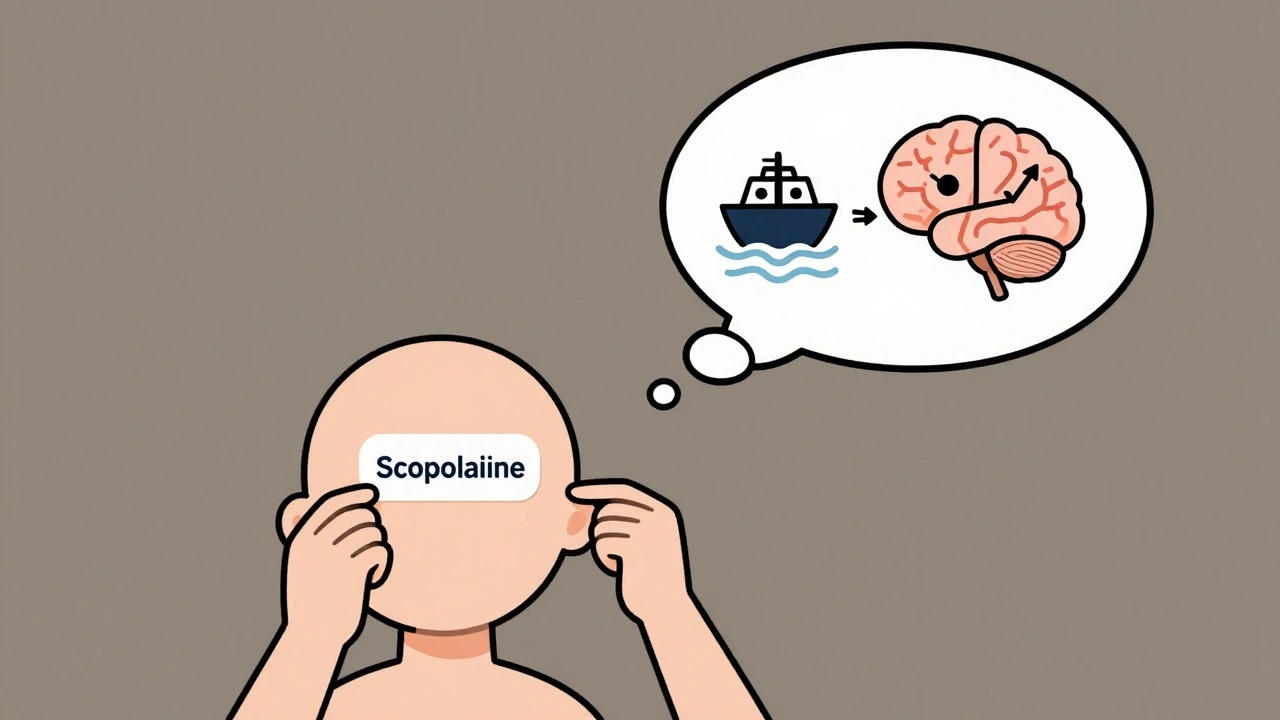
Motion sickness happens when your brain gets mixed signals. Your eyes see one thing-like a moving screen or a rocking boat-but your inner ear and body feel something else. This mismatch triggers nausea, sweating, and vomiting. It’s not weakness. It’s biology. About 25-30% of adults get it during travel, especially on cruises, buses, or small planes.
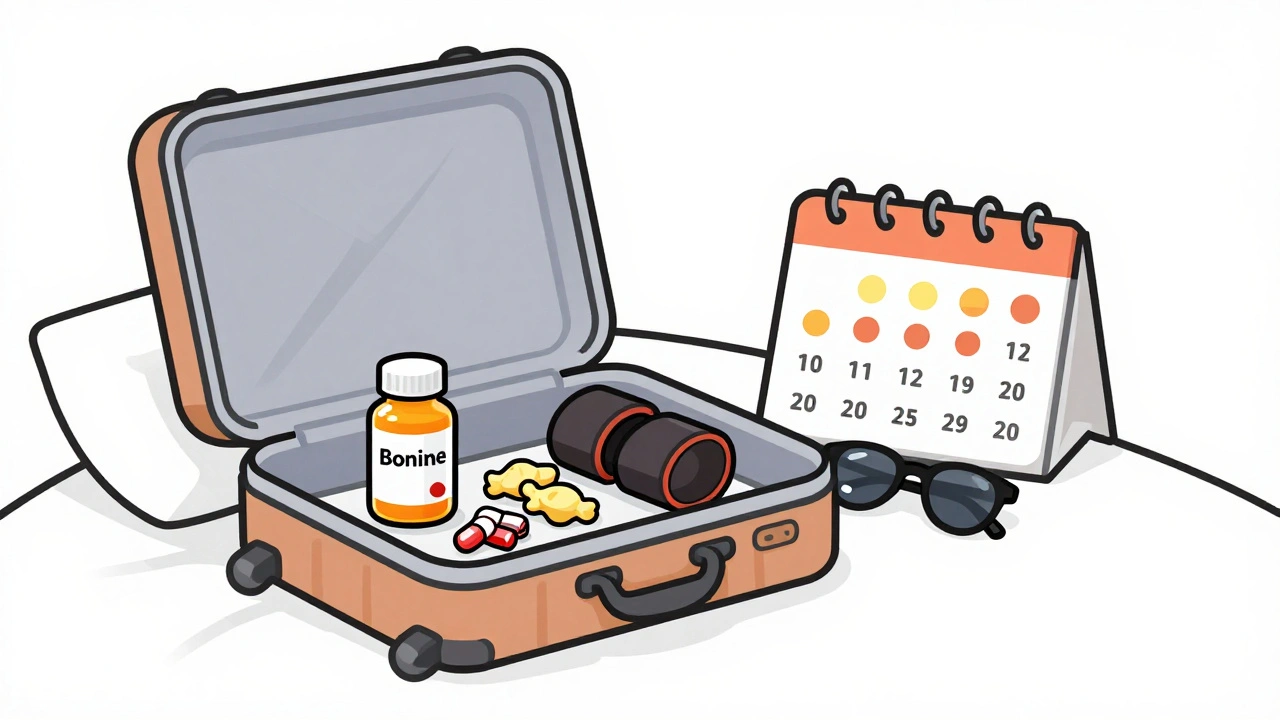
The most common medications fall into four groups: antihistamines like dimenhydrinate (Dramamine) and meclizine (Bonine), anticholinergics like scopolamine (Transderm Scop), phenothiazines like promethazine (Phenergan), and a few newer options. Each works differently and has different risks.
Dramamine (dimenhydrinate) is the classic choice. It works fast-within 30 minutes-and blocks the signals causing nausea. But it also causes drowsiness in about 35% of users. That’s fine if you’re on a cruise and can nap, but dangerous if you’re driving or need to stay alert.
Bonine (meclizine) is a gentler option. It’s less likely to knock you out-only 18% report drowsiness-and lasts up to 24 hours. That’s why so many travelers prefer it for long trips. But it takes longer to kick in-about 40 minutes on average-so plan ahead.
Scopolamine patches are the gold standard for long trips. Applied behind the ear at least 4 hours before travel, they release medication slowly over 72 hours. They’re 75% effective for motion sickness, better than pills for extended exposure. But they come with trade-offs: dry mouth (22% of users), blurred vision (15%), and, in rare cases, confusion-especially in older adults. One user on CruiseCritic reported needing Biotene every two hours on a seven-day cruise just to speak.
What You Must Avoid With Motion Sickness Meds
Not all medications are safe for everyone. Promethazine (Phenergan) is powerful but risky. It’s the most sedating option, causing drowsiness in 40% of users. The FDA has a black box warning: it can cause life-threatening breathing problems in children under 2. Never give it to a toddler.
Scopolamine is also dangerous for people with glaucoma. It can trigger a sudden, painful spike in eye pressure. If you’ve ever been told you have “narrow angles” or “closed-angle glaucoma,” skip the patch. Ask your doctor for alternatives.
And don’t confuse motion sickness meds with allergy pills. Zyrtec, Claritin, and Allegra won’t help with nausea-even though they’re antihistamines too. They’re designed for runny noses, not inner ear confusion. Taking them won’t prevent motion sickness. It’s a common myth.
Jet Lag: It’s Not Just Tiredness
Jet lag isn’t about being tired. It’s about your body clock being out of sync. When you fly across five or more time zones, your brain still thinks it’s home time. You feel awake at 2 a.m. and sleepy at noon. Nine out of ten long-haul travelers get it.
The best treatment isn’t a sleeping pill-it’s melatonin. Your body makes it naturally at night. Taking a supplement helps reset your internal clock. Studies show 0.5 mg is just as effective as 5 mg for most people. Higher doses don’t help-they just increase side effects like weird dreams or morning grogginess.
Take melatonin 30 minutes before your target bedtime at your destination. For eastward travel (like flying to Europe), take it in the evening. For westward travel (like flying to the U.S. from Asia), take it in the morning. Timing matters more than dose.
When Sleeping Pills Might Help-And When They Don’t
Some travelers turn to zolpidem (Ambien) or eszopiclone (Lunesta) to force sleep on a plane. They work. Zolpidem improves sleep onset in 72% of users. But here’s the catch: 1.8% report sleepwalking. 0.9% have memory loss. And 4.3% feel groggy the next day-bad news if you have a meeting at 8 a.m.
The American Academy of Sleep Medicine warns against long-acting benzodiazepines for jet lag. They increase fall risk by 27% in travelers over 65 and cause next-day brain fog. Don’t use them unless you’re stuck in a hotel room for 12 hours with no plans.
Modafinil is sometimes used to stay awake during the day. But it lasts 12-15 hours. Take it too late, and you’ll be wide awake all night. Only use it in the morning, and only if you’ve tried melatonin and light exposure first.
Timing Is Everything
Medication timing can make or break your trip.
- Scopolamine patch: Apply 4+ hours before travel. Remove after 72 hours. Withdrawal symptoms can start 24 hours later.
- Dramamine: Take 30-60 minutes before boarding. Don’t drive for at least 6 hours after.
- Bonine: Take 1 hour before. Less drowsy, but slower to work.
- Promethazine: Take 1-2 hours before. Avoid driving for 15 hours after. Not for kids under 2.
- Melatonin: Take 30 minutes before target bedtime at destination. No alcohol-can cause disorientation.
- Zolpidem: Only take on the plane if you can sleep 8+ hours. Never take before driving or walking in unfamiliar places.
Light exposure is just as important. If you’re flying east, get morning sunlight at your destination. If you’re flying west, get evening light. This helps your body adjust faster than any pill.
What Experts Really Say
The CDC and the American Academy of Sleep Medicine agree: medications should be a last resort. For mild motion sickness, sitting near a window, looking at the horizon, or chewing gum often works better than pills. For jet lag, adjusting your sleep schedule a few days before travel is more effective than melatonin.
Dr. Emily Sena from the CDC writes in the 2024 Yellow Book: “Medications should be considered only when non-pharmacological measures fail.” That means try walking, drinking water, avoiding heavy meals, and getting sunlight before you reach for a pill.
And don’t trust internet advice. Reddit users rave about scopolamine patches-but many also say they felt confused or dizzy. One 72-year-old traveler needed medical help after the patch made him lose track of time. Elderly travelers are especially vulnerable.
Market Trends and New Options
The motion sickness market is growing. Dramamine still leads with 42% of sales, but Bonine is catching up. In 2024, the FDA approved a new scopolamine buccal film that absorbs through the cheek. Early results show 30% fewer side effects than the patch.
For jet lag, melatonin supplements make up 63% of the global market. But new research is looking at NK1 receptor antagonists-non-sedating drugs that target nausea without drowsiness. In 2024 trials, they were 78% effective. They’re not on shelves yet, but they’re coming.
Your Action Plan
Here’s what to do before your next trip:
- For short trips (under 6 hours), try non-medication tricks first: fresh air, ginger candies, focusing on the horizon.
- If you need a pill for motion sickness, choose Bonine for shorter trips, scopolamine patch for cruises or long car rides.
- Never use promethazine if you’re under 18 or over 65 unless your doctor says so.
- For jet lag, start melatonin at 0.5 mg, 30 minutes before bedtime at your destination.
- Avoid caffeine after noon. It stays in your system for 5 hours.
- Don’t mix alcohol with any of these meds-it increases dizziness, confusion, and sleepwalking risk.
- Always read the label. Side effects aren’t listed in ads. They’re in the tiny print.
Travel should be about seeing the world-not fighting nausea or lying awake at 3 a.m. The best medication is preparation. The safest one is the one you don’t need.
Can I take motion sickness pills and melatonin together?
Yes, but only if you’re careful. Motion sickness meds like Bonine or Dramamine are taken before or during travel. Melatonin is taken at night at your destination. Don’t take them at the same time. Mixing them can increase drowsiness and confusion. Space them out by at least 4 hours.
Is it safe to use scopolamine patches if I’m over 65?
Use with caution. About 12% of travelers over 65 report confusion, disorientation, or hallucinations after using scopolamine patches. The FDA now requires a bold warning on the packaging. If you’re elderly, talk to your doctor first. Try Bonine or non-medication options like ginger or pressure bands instead.
Why does melatonin sometimes make me feel weird?
Melatonin isn’t a sleeping pill-it’s a signal. Taking too much (over 1 mg) can disrupt your natural rhythm and cause vivid dreams, morning grogginess, or mild disorientation. Stick to 0.5 mg. If you still feel off, try taking it 2 hours before bed instead of 30 minutes. Light exposure and sleep schedule adjustments often work better than higher doses.
Can I drive after taking motion sickness medication?
Only if you know how your body reacts. Dramamine and promethazine can make you dangerously drowsy. The CDC recommends waiting at least 6 hours after Dramamine and 15 hours after promethazine before driving. Meclizine (Bonine) is safer, but still avoid driving for 4-6 hours after your first dose. Test it at home before your trip.
Are there natural alternatives to these medications?
Yes. For motion sickness: ginger capsules (1,000 mg), acupressure wristbands (like Sea-Bands), and sitting near a window with a fixed horizon. For jet lag: exposure to natural light at the right times, staying hydrated, and adjusting your sleep schedule 2-3 days before departure. These don’t work for everyone, but they have no side effects and are safe for kids and pregnant women.


11 Comments
OMG this is LIFE-SAVING 🙌 I took Dramamine on my cruise last month and woke up feeling like a zombie... switched to Bonine this time and I’m dancing on the deck like I’m in a Beyoncé video 💃🌴
Let’s be real - if you’re relying on pharmaceuticals to get through a flight, you’ve already lost the game. The real solution? Don’t fly. Or better yet, don’t travel. Stay home. Watch Netflix. Your spine will thank you.
I’m sorry, but I have to call out the dangerous misinformation here. Melatonin at 0.5 mg? That’s pediatric dosing. The FDA recommends 1–5 mg for adults. You’re not helping people - you’re enabling ignorance. And don’t get me started on the glorification of scopolamine patches. That’s not a travel hack - it’s a chemical escape pod.
There’s something deeply human about how we’ve outsourced our biological rhythms to pills. We’ve forgotten how to listen to our bodies - we just want a button to press for ‘normal sleep’ or ‘no nausea.’ But maybe the real journey isn’t across time zones… it’s back to listening. The horizon, the wind, the quiet - those were the original remedies. We just got loud.
I took a scopolamine patch for the first time last week… and let me tell you - I thought I was in a David Lynch movie. The world tilted. My cat looked at me like I was a ghost. I spent 3 hours staring at a wall wondering if I was still on Earth. I’m not mad… just… profoundly confused. 🌌
I tried ginger candies. I tried pressure bands. I tried staring at the horizon. I tried breathing. I tried praying. Then I took Dramamine. I woke up 8 hours later in a puddle of drool with my phone in my hand and a text to my ex that said 'u up?'... I’m never flying again. Or texting. Or existing.
bro i just took bonine and melatonin together bc i was tired and thought why not lol i woke up at 3am in portugal thinking i was in my childhood bedroom and my dog was talking to me in spanish. i dont regret it. but i also dont recommend it. also ginger is magic. eat it like chips.
You say 'don't mix alcohol with these meds.' But you don't say how many people DIE from this. You don't mention the ER visits. You don't say that 42% of travelers who use scopolamine patches report 'cognitive fog' - which is just a polite way of saying 'I forgot my own name.' And yet, you still recommend it. This isn't advice. It's negligence wrapped in bullet points.
I’m from Nigeria and I’ve taken 17 long-haul flights. I never use pills. I drink water, chew gum, and walk the aisle every hour. My body adjusts. I sleep when it’s dark. I eat when it’s light. I don’t fight time - I walk with it. Maybe the medicine isn’t the problem… maybe it’s how we think we need to control everything.
It is imperative to underscore the profound ethical implications of disseminating such pharmacologically permissive guidance without explicit contraindications for geriatric populations. The normalization of off-label polypharmacy in travel contexts constitutes a public health liability of alarming proportions. One must question the editorial rigor of this publication.
I read this whole thing. Then I cried. Not because I was sick - but because I realized I’ve been treating my body like a broken machine. I took melatonin for three nights. Slept like a baby. Didn’t touch a pill. Got up at dawn in Tokyo. Watched the sunrise. Felt the air. And for the first time in years… I didn’t need to fix anything. Just be. Thank you.