If you are pregnant or planning to become one, taking gabapentin (Neurontin) or pregabalin (Lyrica) might be causing you some anxiety. These medications, known collectively as gabapentinoids, have become incredibly common for treating nerve pain and anxiety. But does this widespread use mean they are safe for your baby? The short answer is complicated. While the risk of major birth defects is low compared to older drugs, new evidence points to specific concerns about heart development and newborn health that every patient needs to understand.
You are not alone in this dilemma. Prescriptions for these drugs among pregnant women in the United States skyrocketed from 0.2% in 2000 to nearly 4% by 2014. Today, it is estimated that over 4% of pregnancies involve gabapentin use. Most of these prescriptions are for pain management rather than epilepsy. This shift has forced doctors and researchers to look closer at what happens when these chemicals cross the placenta.
Understanding Gabapentinoids and Placental Transfer
To understand the risks, we first need to know how these drugs work in the body. Gabapentinoids are GABA analogues originally developed for epilepsy but now widely used for neuropathic pain and anxiety. They were not designed to treat mood or pain directly, which makes their long-term effects less predictable than older, more established classes of drugs.
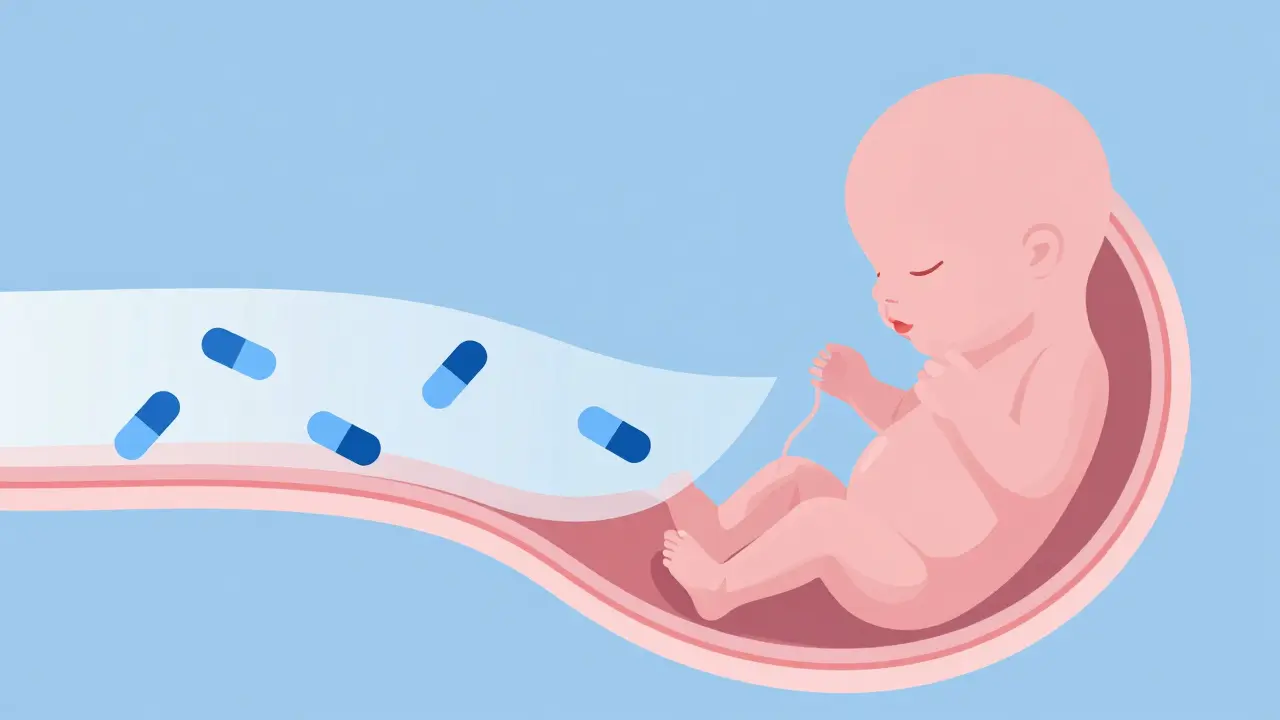
The critical issue here is transfer. Gabapentin has a low molecular weight (171.27 g/mol) and is highly water-soluble. These physical properties allow it to cross the placental barrier easily. A 2022 study published in *Frontiers in Pharmacology* confirmed exactly this: they found gabapentin present in fetal brain tissue. When you take a standard dose, peak levels hit your blood within 2-3 hours, and the drug stays in your system for 5-7 hours before half of it clears out. With daily dosing, your baby receives sustained exposure throughout the day and night.
This is different from many other medications that do not cross the placenta as readily. Because the drug reaches the fetus, it interacts with developing cells. In laboratory settings using human neural cultures, researchers saw that therapeutic levels of gabapentin altered the shape of dopamine-producing neurons. Specifically, the length of the neuron branches decreased by over 37%. It also downregulated key genes like Nurr1 and Bdnf, which are essential for healthy brain development. While this was an in-vitro (lab dish) study, it provides a biological mechanism for why caution is necessary.
Risk of Birth Defects: What the Data Shows
The biggest fear for most parents is major congenital malformations-structural birth defects. Here, the news is somewhat reassuring, but with important caveats.
A massive study published in *PLOS Medicine* in 2020, led by Dr. Elisabetta Patorno at Harvard Medical School, analyzed Medicaid data to compare outcomes. They found that the overall risk of major malformations with gabapentin was slightly higher than in unexposed pregnancies (Relative Risk [RR] = 1.07), but this difference was not statistically significant. To put that in perspective, older antiepileptic drugs like valproic acid carry a 10-11% risk of major defects. Gabapentin’s baseline risk sits around 3.2%, compared to 3.0% in the general population. That is a small absolute increase.
However, "overall" risk hides specific dangers. The same study flagged a concerning signal for cardiac malformations. When mothers had consistent exposure (defined as two or more prescriptions during pregnancy), the risk of heart defects increased significantly (RR = 1.40). This was particularly true for conotruncal defects, which affect the heart's main arteries and chambers. If you are prescribed gabapentin regularly, especially during the first trimester when the heart forms, this specific risk warrants discussion with your doctor.
| Medication | Major Malformation Risk | Specific Concerns | Regulatory Status (US/EU) |
|---|---|---|---|
| Valproic Acid | High (10-11%) | Neural tube defects, cognitive impairment | Contraindicated unless no alternative |
| Lamotrigine | Low (RR 0.8-1.0) | Minor cleft lip/palate signal (debated) | Preferred antiepileptic |
| Gabapentin | Slightly Elevated (RR 1.07) | Cardiac defects (conotruncal) with consistent use | Category C / Special Consideration |
| Pregabalin | Data Limited | Animal studies show developmental toxicity | Contraindicated in EU unless benefits outweigh risks |
Neonatal Outcomes: The Third Trimester Danger Zone
If the first trimester poses risks for structural defects, the third trimester poses risks for newborn behavior and survival. This is where the data becomes much clearer and more alarming.
Babies exposed to gabapentin until delivery face a significantly higher chance of needing intensive care. The *PLOS Medicine* study reported that infants exposed late in pregnancy had a 34% higher risk of preterm birth and a 22% higher risk of being small for gestational age. More critically, the risk of admission to the Neonatal Intensive Care Unit (NICU) jumped by 33%.
Why does this happen? It appears to be related to withdrawal or adaptation issues. A study published in *Neurology* looked at 209 women who took gabapentin during pregnancy. Among those who continued taking it right up to delivery, 38% of their babies required NICU admission, compared to just 2.9% in the control group. Some of these infants exhibited symptoms of neonatal adaptation syndrome: tremors, irritability, poor feeding, and breathing difficulties. While this syndrome is less severe and less frequent than the opioid withdrawal seen in babies exposed to painkillers like oxycodone, it still requires medical intervention and can prolong hospital stays for both mother and child.
Gabapentin vs. Pregabalin: Which Is Safer?
Pregnant patients often ask if switching between Neurontin (gabapentin) and Lyrica (pregabalin) makes a difference. Currently, there is not enough direct head-to-head data to say definitively that one is safer than the other for humans. However, regulatory bodies are treating them differently based on available evidence.
In Europe, the European Medicines Agency (EMA) issued a safety communication in June 2022 expressing concern about pregabalin. Animal studies showed clear signs of developmental toxicity with pregabalin. As a result, the EMA’s Pharmacovigilance Risk Assessment Committee recommended in September 2022 that pregabalin should be contraindicated in pregnancy unless the benefit clearly outweighs the risk. In contrast, while gabapentin carries warnings, it has not faced the same level of restriction in Europe, largely because there is simply more human data available for it.
In the United States, both drugs remain FDA Pregnancy Category C, meaning animal studies have shown adverse effects, but adequate human studies are lacking. The British National Formulary (2023) advises avoiding gabapentin unless benefits outweigh risks, citing reported toxicity. For most clinicians, gabapentin is currently the preferred agent if a gabapentinoid must be used, simply because we know more about its specific risk profile (like the cardiac signal) and can monitor for it.
Clinical Guidelines and Decision Making
So, what should you do if you have been taking these meds for years? The American College of Obstetricians and Gynecologists (ACOG) released Committee Opinion No. 797 in January 2020, which sets the standard for care. Their guidance is strict: gabapentin should only be used during pregnancy if non-pharmacological approaches have failed and the condition is severe enough to justify the potential risks.
This means if you are taking gabapentin for mild anxiety or occasional back pain, your doctor will likely encourage you to taper off before or immediately upon confirming pregnancy. However, if you suffer from severe neuropathic pain that prevents you from functioning, sleeping, or eating, stopping the medication abruptly could harm both you and the baby through stress and lack of self-care. In these high-need cases, 32% of surveyed obstetricians said they would continue the drug, closely monitoring the patient.
If you decide to continue treatment, here is what current best practices look like:
- Fetal Echocardiography: Because of the specific link to conotruncal heart defects, a detailed heart ultrasound is recommended if you have taken gabapentin consistently during the first trimester.
- Lowest Effective Dose: Doctors aim to keep the dosage as low as possible to minimize fetal exposure.
- Third-Trimester Planning: You may discuss tapering the dose in the final weeks of pregnancy to reduce the risk of neonatal adaptation syndrome, though this must be done carefully to avoid seizure recurrence or severe pain flares.

Future Research and Regulatory Changes
The landscape is changing rapidly. Recognizing the gap in data, the FDA announced in January 2024 that all gabapentinoid manufacturers must conduct post-marketing surveillance studies. They require tracking of 5,000 pregnancy outcomes by 2027. This will provide the robust, real-world data that has been missing for decades.
Additionally, the National Institutes of Health (NIH) funded a longitudinal study (NCT04567891) starting in 2023. This study is tracking 1,200 children exposed to gabapentin in utero to see if there are long-term neurodevelopmental effects, such as learning disabilities or behavioral issues, as they grow up. Preliminary data is expected in late 2025. Until then, we rely on the current epidemiological evidence, which suggests that while gabapentin is not as dangerous as valproic acid, it is certainly not risk-free.
Market trends also reflect this caution. The Institute for Clinical and Economic Review (ICER) projects that pregabalin use in pregnancy will drop by 25-35% by 2027 due to stricter regulations and safety signals. There is a broader shift toward non-pharmacological interventions and alternative medications like duloxetine, which may have a more favorable safety profile for certain conditions.
Key Takeaways for Patients
Navigating medication during pregnancy is stressful. Remember these core points:
- Do not stop abruptly: Sudden cessation can cause seizures or severe withdrawal. Always consult your provider.
- First Trimester Caution: Consistent use increases the risk of heart defects. Ask about a fetal echo.
- Third Trimester Risks: Use near delivery increases the chance of NICU admission and withdrawal-like symptoms in the baby.
- Pregabalin vs. Gabapentin: Gabapentin has more human data; pregabalin faces stricter bans in Europe due to animal toxicity data.
- Benefit vs. Risk: If your pain or mental health condition is severe, the benefit of treatment may outweigh the risks. This is a personal decision made with your healthcare team.
Is gabapentin safe for breastfeeding?
Gabapentin passes into breast milk, but usually in low amounts. The concentration in milk is typically lower than in maternal plasma. Most experts consider it compatible with breastfeeding for full-term infants, as the risk of sedation or feeding problems is low. However, you should monitor your baby for excessive sleepiness or poor feeding. Pregabalin also passes into milk, and caution is advised, especially for newborns or premature infants whose kidneys are not fully developed.
Can I switch from pregabalin to gabapentin if I find out I am pregnant?
This is a decision for your doctor. Switching medications involves cross-tapering, which takes time. Since the first trimester is the critical period for organ formation, delaying a switch might expose the fetus to pregabalin during the highest-risk window. However, given the limited data on pregabalin and stricter regulatory stances in Europe, many clinicians prefer to transition to gabapentin or a different class of drug if feasible, provided the transition can be managed safely without destabilizing your condition.
What are the symptoms of neonatal adaptation syndrome from gabapentin?
Symptoms usually appear within the first few days after birth and can include jitteriness or tremors, irritability or high-pitched crying, difficulty feeding or sucking, sleep disturbances, and in rare cases, respiratory distress. Unlike opioid withdrawal, these symptoms are generally milder and shorter-lived, but they often require supportive care in the NICU to ensure the baby stays hydrated and stable.
Does gabapentin cause autism or long-term brain damage?
Current large-scale studies have not found a direct causal link between gabapentin exposure and autism spectrum disorder. However, the 2022 *Frontiers in Pharmacology* study did show changes in neuron growth in lab settings, raising theoretical concerns about neurodevelopment. Long-term follow-up studies are currently underway (expected results in 2025) to track cognitive and behavioral outcomes in children exposed in utero. Until that data is available, we cannot rule out subtle long-term effects, but immediate major brain damage is not a documented outcome.
Are there non-drug alternatives for nerve pain during pregnancy?
Yes, and ACOG recommends trying these first. Options include physical therapy tailored for pregnancy, cognitive behavioral therapy (CBT) for pain management, acupuncture (performed by a certified practitioner experienced with pregnant patients), transcutaneous electrical nerve stimulation (TENS) units (avoiding the abdomen and lower back in later stages), and warm compresses. These methods carry no risk to the fetus and can sometimes reduce the need for medication entirely.