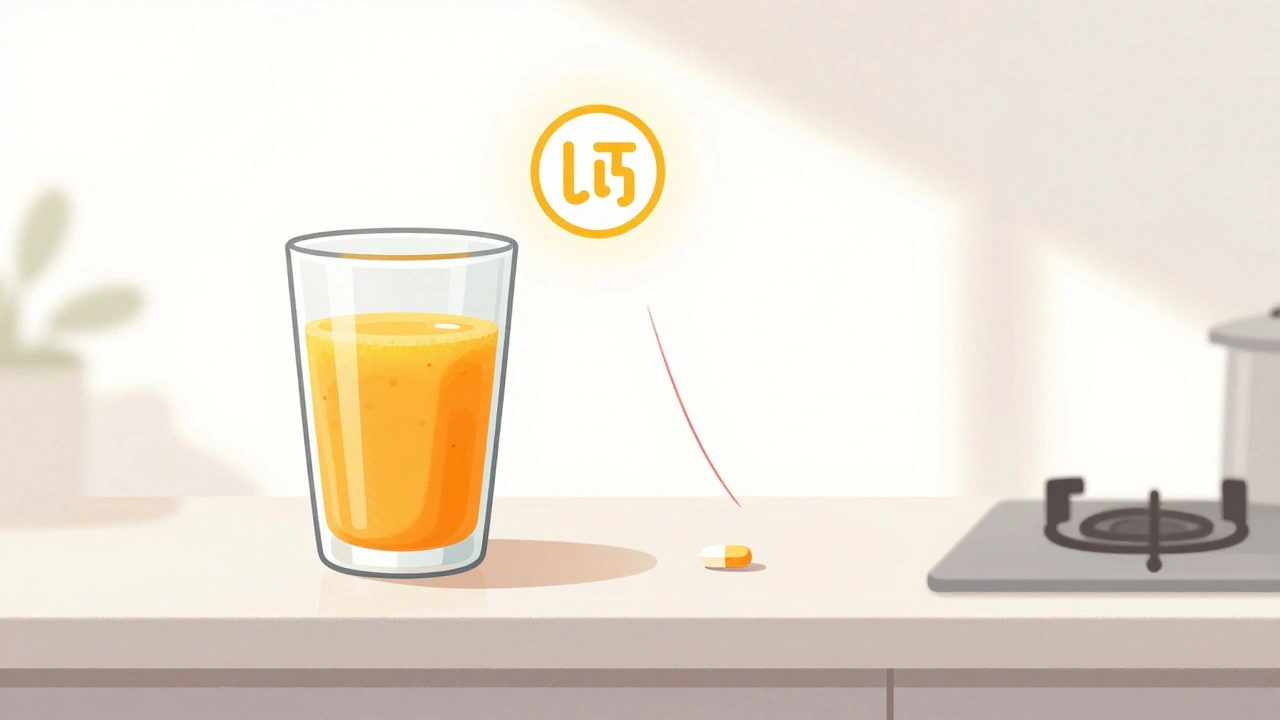
Calcium Medication Timing Calculator
Warning: Calcium in fortified juices can reduce medication absorption by up to 80%. This calculator shows the minimum safe time gap for common medications.
Select Your Medication
About Calcium-Fortified Juice
Most calcium-fortified juices contain 300-350 mg of elemental calcium per 8-ounce serving, which is enough to significantly reduce medication absorption.
Key fact: Calcium binds to drugs in the first 30-60 minutes after ingestion. Waiting less than the recommended time may not be sufficient.
Important Safety Note
The minimum safe time gaps shown are based on clinical studies. For medications like levothyroxine, the FDA recommends a 4-hour gap. Always consult your pharmacist for personalized advice.
Drinking a glass of calcium-fortified orange juice with your morning pill might seem like a smart health move-especially if you’re trying to boost your bone health or avoid dairy. But here’s the problem: that juice could be quietly ruining the effectiveness of your medication. It’s not just a myth. It’s a well-documented, clinically significant interaction that’s happening every day, often without patients even realizing it.
How Calcium Turns Your Medication Into a Waste of Money
Calcium in fortified juices doesn’t just sit there. It actively binds to certain drugs in your gut, forming large, insoluble complexes that your body can’t absorb. Think of it like a magnet pulling the drug molecules away from where they need to go. The result? Less of the medicine reaches your bloodstream. That means your infection doesn’t clear up. Your thyroid levels stay out of range. Your bones keep weakening.The science is clear. Studies show calcium concentrations above 200 mg per serving-common in most fortified juices-can reduce drug absorption by up to 80%. A single 8-ounce serving of Tropicana Pure Premium High Calcium or similar brands delivers 300-350 mg of elemental calcium. That’s more than enough to interfere with medications.
Which Medications Are Most at Risk?
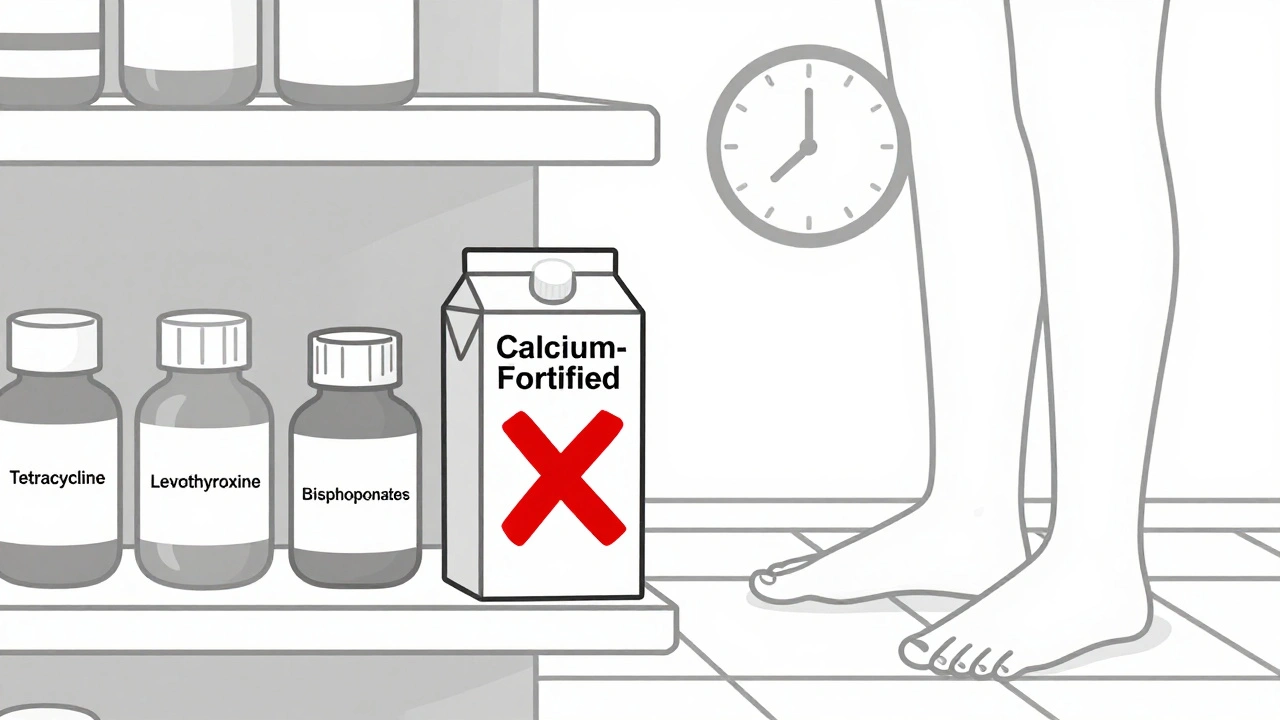
Not all drugs are affected equally. But if you’re taking one of these, you need to pay attention:- Tetracycline antibiotics (doxycycline, minocycline): Calcium binds tightly to these, blocking absorption. If you take them with calcium juice, you might end up with a persistent infection.
- Fluoroquinolones (ciprofloxacin, levofloxacin): A 2021 study found that patients who took ciprofloxacin with calcium-fortified orange juice had a 25-30% failure rate in treating urinary tract infections-compared to just 8-10% when taken correctly.
- Bisphosphonates (alendronate, risedronate): These osteoporosis drugs need an empty stomach and plain water. Calcium juice can cut their absorption by over 50%, making them nearly useless.
- Levothyroxine (Synthroid, Levoxyl): This one’s especially dangerous. A 2021 study showed calcium-fortified juice can reduce levothyroxine absorption by 35-55%. Patients often need dose increases of 25-50 mcg just to get their thyroid levels back in line. One woman on Drugs.com reported drinking two glasses daily with her Synthroid for six months-until her TSH levels shot up.
- Antifungals (ketoconazole): Calcium interferes with absorption, lowering drug levels and risking treatment failure.
Why Orange Juice Is Worse Than Milk
You might think dairy is the main culprit. But calcium-fortified orange juice is actually more problematic. Why? Two reasons.First, it’s acidic. Citric acid lowers stomach pH, which changes how some drugs dissolve. A 2021 study found that calcium-fortified orange juice reduced ciprofloxacin absorption by 42%, while plain calcium-fortified water only cut it by 31%. The acid makes the binding worse.
Second, people don’t realize it’s a problem. A 2022 survey by the National Community Pharmacists Association found 68% of patients believe fortified juices are “safe” with medications. That’s not just ignorance-it’s a public health blind spot.

How Long Should You Wait?
Timing matters. You can’t just take your pill an hour after your juice. Different drugs need different separation times:- Tetracyclines: Wait at least 2-3 hours before or after taking calcium-fortified juice.
- Bisphosphonates: Wait 30 minutes to 2 hours. Some guidelines say 2 hours minimum, especially if you’ve eaten.
- Levothyroxine: The American Thyroid Association recommends a full 4-hour gap. That means no juice at breakfast. No juice with your pill. Take it on an empty stomach with water, then wait four hours before drinking anything else.
And no, waiting 15 minutes won’t cut it. The binding happens fast-in the first 30-60 minutes after ingestion. If you’re not giving it enough time, you’re gambling with your treatment.
What Do Pharmacists See in Real Life?
Community pharmacists are on the front lines. A 2023 survey of 512 pharmacists by Pharmacy Times found that 73% regularly see patients taking calcium-fortified juice with affected medications. But only 28% of those patients remembered being warned about it.One pharmacist in Bristol told me about a 68-year-old man on alendronate who’d been drinking calcium OJ every morning for years. His bone density kept worsening. He thought his meds weren’t working. Turns out, he was drinking the juice 20 minutes after his pill. Once he switched to plain water and waited two hours, his bone markers improved within six months.
Patients often don’t connect the dots. They see “fortified with calcium” on the label and think it’s a good thing. They don’t see the fine print. And most labels don’t even include warnings. A 2023 study analyzed 47 top-selling calcium-fortified juice products. 92% had no mention of medication interactions on the packaging.
Why This Problem Is Getting Worse
Fortified juices are everywhere now. They’re marketed as “heart-healthy,” “bone-strengthening,” and “perfect for lactose-intolerant families.” And they’re growing in popularity. In the U.S., sales have increased 18% since 2018, according to Nielsen data. But education hasn’t kept up.The Institute for Safe Medication Practices added calcium-fortified beverages to its 2023 List of High-Alert Food-Drug Combinations. Why? Because they saw a 37% spike in reported incidents of therapeutic failure between 2021 and 2023. That’s not a fluke. That’s a pattern.
And the cost? A 2022 analysis estimated these interactions cost the U.S. healthcare system $417 million a year-extra doctor visits, lab tests, hospital stays, and failed treatments. All preventable.
What Should You Do?
If you take any of the medications listed above, here’s what to do right now:- Check your medication label. Does it say anything about calcium, dairy, or antacids? If not, ask your pharmacist.
- Look at your morning routine. Do you drink fortified juice with your pills? If yes, stop. Switch to plain water.
- Wait the full recommended time. Don’t guess. Use a timer if you have to.
- Ask your pharmacist: “Is my medication affected by calcium-fortified drinks?” Don’t assume they’ll tell you. They’re busy. You have to ask.
- Read labels on juice cartons. If it says “fortified with calcium,” treat it like a drug interaction risk-not a health boost.
And if you’re trying to get more calcium? There are safer ways. Almonds, kale, canned sardines with bones, fortified plant milks (taken at a different time), or a calcium supplement taken separately from your meds. You don’t need to drink juice to protect your bones.
The Bigger Picture
This isn’t just about one juice or one pill. It’s about how we think about food and medicine. We assume if it’s healthy, it’s safe. But food isn’t always friendly with drugs. Calcium-fortified juice is a perfect example: marketed as a wellness product, but quietly undermining treatment for millions.Healthcare providers need to do better. Labels need to change. But until then, you’re your own best advocate. Don’t trust marketing. Don’t assume. Ask. Double-check. Wait.
Because your medication works only if your body can absorb it. And calcium-fortified juice? It’s stealing your dose before it even starts.


12 Comments
This is the dumbest thing I’ve read all week. You act like calcium juice is some kind of villainous drug saboteur. People have been drinking OJ with their meds for decades and they’re still alive. Maybe your body just needs to adapt instead of you panic-clicking every label like a hypochondriac. I take my Synthroid with orange juice and my TSH is perfect. Coincidence? Maybe. But I’ll stick with what works.
The data presented here is methodologically sound and clinically significant. The 80% absorption reduction cited in multiple peer-reviewed studies is not anecdotal-it’s pharmacokinetic fact. The acidic environment of citrus juice alters ionization states of tetracyclines and fluoroquinolones, increasing chelation potential with divalent cations like calcium. This isn’t marketing fear-it’s biochemistry. Ignoring it isn’t bravery, it’s negligence.
i just found out my mom takes her alendronate with her calcium orange juice. she’s been doing it for 5 years. i’m going to talk to her tonight. thank you for writing this. i didn’t know this was a thing. i’ll make sure she switches to water and waits 2 hours. small change, big difference.
Consider the systemic implications: fortified juices are not merely dietary supplements-they are engineered consumer products designed to exploit the placebo effect of health halo. The pharmaceutical industry, regulatory bodies, and food manufacturers are complicit in a silent, billion-dollar collusion where patient safety is sacrificed for profit margins. The fact that 92% of labels omit interaction warnings is not an oversight-it is a calculated omission. We are living in a pharmacological dystopia where wellness is weaponized against the vulnerable. Wake up.
Just had a chat with my pharmacist about this-she said it’s one of the top 5 questions she gets every day. I always thought milk was the issue, never thought OJ was worse. I’ve switched to plain water with my doxycycline and set a phone alarm to wait 3 hours. Small habit, huge difference. Also, if you’re lactose intolerant, try fortified almond milk-but take it at lunch, not with your pill. 🙏
this is why america is dying you people are so paranoid about everything now its not a conspiracy its just common sense if you want to be healthy dont take pills with juice drink water and stop being a medical drama queen
The chelation kinetics of calcium with tetracycline-class antibiotics follow a 1:1 stoichiometric binding model with a dissociation constant (Kd) in the micromolar range, which is orders of magnitude lower than the therapeutic plasma concentration thresholds. The citric acid component further destabilizes gastric pH homeostasis, accelerating the formation of insoluble calcium-drug complexes. This is not speculation-it’s physical chemistry in vivo.
I’m a pharmacist and I see this every single day. The worst part? Patients are usually so grateful once they find out. One guy came back in tears because his thyroid levels finally normalized after switching from OJ to water-he’d been misdiagnosed with ‘non-responsive hypothyroidism’ for years. Just ask your pharmacist. Seriously. It takes 30 seconds. Don’t wait until your bone density drops or your UTI comes back.
I used to drink my calcium OJ with my levothyroxine because I thought it was helping me. Then my doctor said my TSH was skyrocketing and I had no idea why. I switched to water, waited 4 hours, and within 6 weeks my levels were perfect. I wish I’d known sooner. This post saved me a lot of stress and extra tests. Thank you for sharing the real facts.
STOP DRINKING JUICE WITH YOUR PILLS TODAY. I did it for 3 years and my bones were crumbling. I switched to water and waited. My doctor said my bone density improved 8% in a year. You can do it too. Just say no to OJ with meds. Your body will thank you. 💪
What is absorption, really? Is it a biological phenomenon or a social construct of pharmaceutical efficacy? If a drug binds to calcium in the gut but the patient feels better-does it matter? Or is the body’s subjective experience the only true metric of therapeutic success? The reduction in serum concentration may be quantifiable, but the reduction in suffering? That’s harder to measure. We mistake numbers for truth.
in india we dont drink calcium oj at all. we take medicine with water. why make it complicated? simple is better. you guys overthink everything.