What is Borderline Personality Disorder?
Borderline Personality Disorder (BPD) isn’t just about mood swings or being "emotional." It’s a condition where emotions don’t just rise quickly-they crash hard, stay too long, and leave people feeling out of control. People with BPD often struggle with intense fear of abandonment, unstable relationships, impulsive behavior, and repeated self-harm. Many feel empty inside or have sudden bursts of anger that scare even themselves. It’s not weakness. It’s not attention-seeking. It’s a real neurological and emotional wiring issue that makes everyday stress feel like a life-or-death crisis.
For decades, people with BPD were told to just "get over it" or were dismissed as difficult. But research changed that. In the late 1980s, psychologist Dr. Marsha Linehan created Dialectical Behavior Therapy (DBT) specifically for people who felt broken by their own emotions. She didn’t try to fix their personality-she taught them how to survive it.
Why DBT Works When Other Therapies Don’t
Most therapies focus on understanding why you feel a certain way. DBT doesn’t waste time on that. It asks: "What can you do right now to stop the pain?" It’s not about insight-it’s about action. The National Institute for Health and Care Excellence (NICE) recommends DBT as the first-line treatment for BPD because it works. Studies show it cuts self-harm by nearly half compared to standard care. Suicide attempts drop by 50% within a year. Emergency room visits for self-injury fall by over half in just four months.
What makes DBT different? It combines two opposite ideas: acceptance and change. You learn to accept your emotions as real-even if they’re overwhelming-while also learning tools to change how you respond to them. This balance is what keeps people from giving up. You’re not being told to stop feeling. You’re being taught how to feel without destroying yourself.
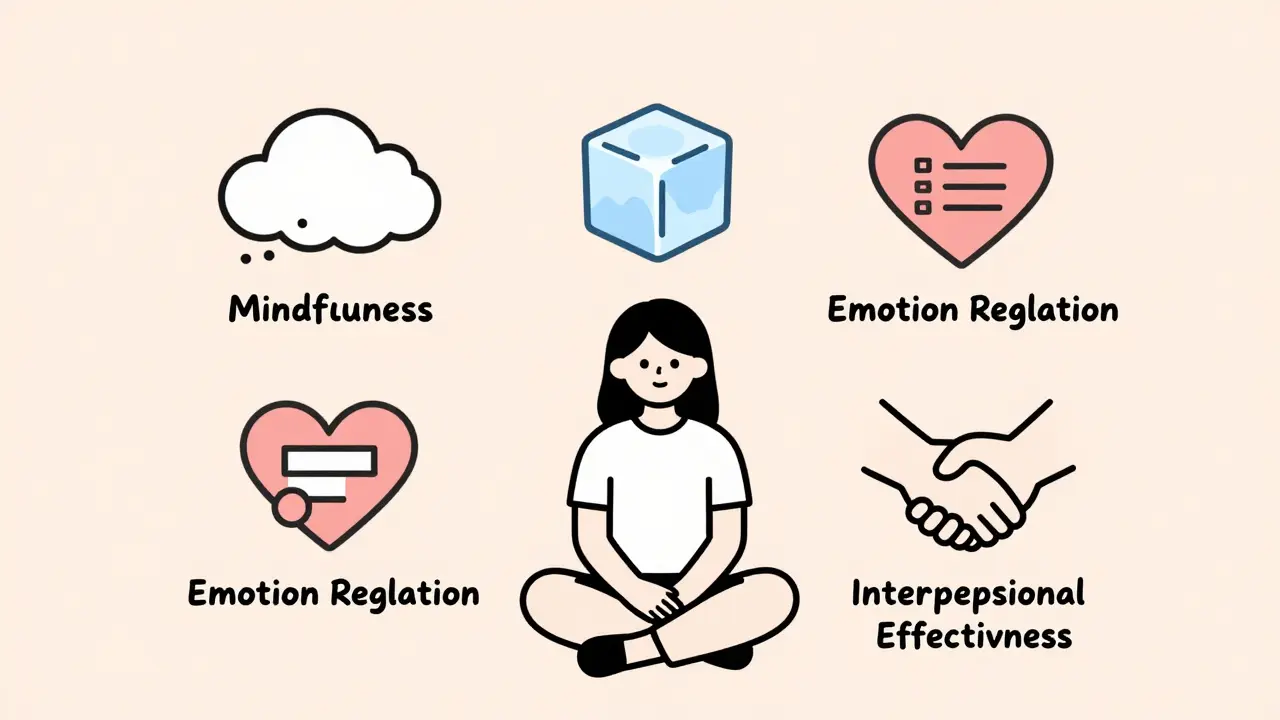
The Four Core DBT Skill Modules
DBT isn’t a vague therapy. It’s a structured set of skills broken into four clear modules. Each one targets a different part of the crisis cycle.
- Mindfulness: This isn’t meditation for relaxation. It’s training your brain to notice what’s happening without getting swept away. You learn to observe your thoughts like clouds passing by, not commands you have to obey. Simple practices like naming your emotions (“I’m feeling abandoned”) or focusing on your breath for 30 seconds can stop a meltdown before it starts.
- Distress Tolerance: This is your emergency toolkit. When you’re in crisis-maybe you’re holding a razor, or you’re screaming at someone you love-this module gives you skills to survive until the storm passes. Techniques like TIPP (Temperature, Intense exercise, Paced breathing, Paired muscle relaxation) physically calm your nervous system. Splash cold water on your face. Do 20 jumping jacks. Breathe in for 4 seconds, hold for 7, out for 8. These aren’t tricks. They’re biology.
- Emotion Regulation: This is where you learn to reduce emotional suffering over time. The PLEASE skill (Treat Physical Illness, Balanced Eating, Avoid mood-altering drugs, Balanced Sleep, Exercise) might sound basic, but skipping sleep or drinking alcohol can turn a bad day into a hospital visit. Opposite Action teaches you to act against your emotional urge-like reaching out instead of isolating when you feel rejected. After six months of consistent use, people report a 40% drop in emotional intensity.
- Interpersonal Effectiveness: BPD often destroys relationships because emotions override communication. DEAR MAN (Describe, Express, Assert, Reinforce, stay Mindful, Appear confident, Negotiate) gives you a script for saying what you need without losing your voice-or your person. GIVE (be Gentle, show Interest, Validate, use Easy manner) helps you repair damage after an explosion. FAST (be Fair, no Apologies, Stick to values, be Truthful) stops you from begging for love or swallowing your truth to avoid conflict.
Crisis Planning: Your Personal Survival Blueprint
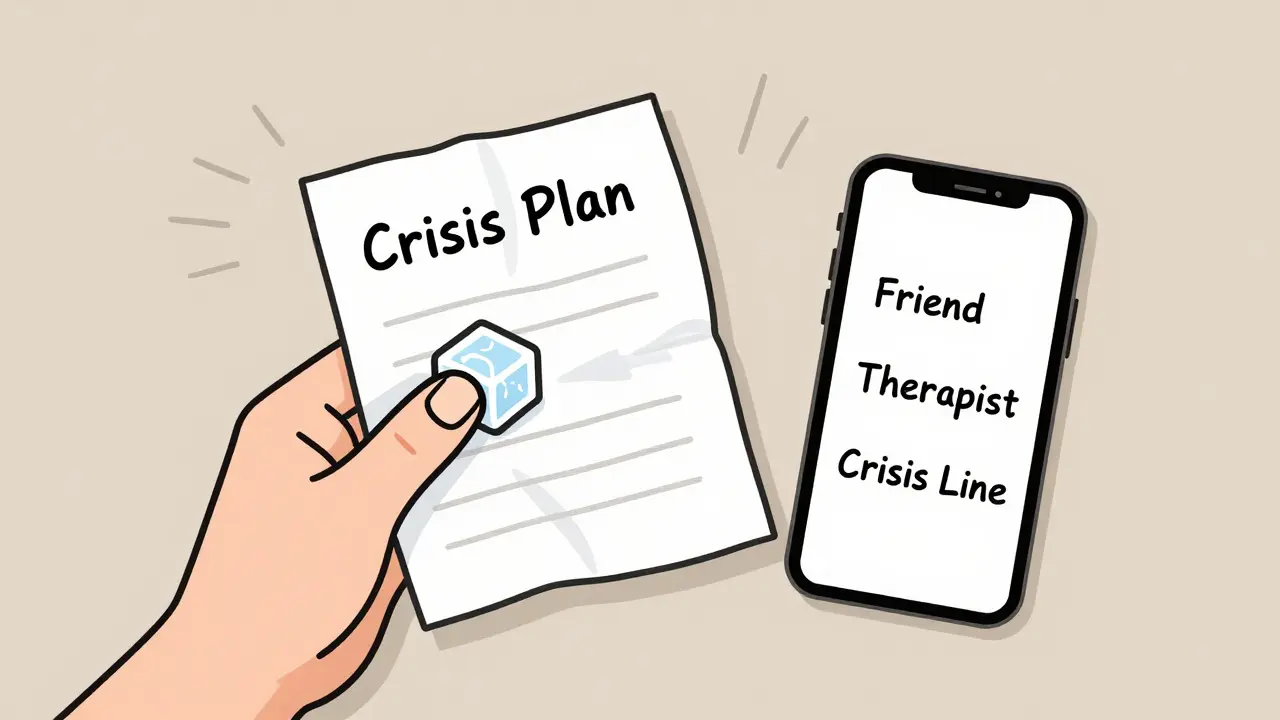
A crisis plan isn’t a nice-to-have in DBT-it’s mandatory. Think of it like a fire escape plan for your mind. You create it when you’re calm, so you don’t have to think during a meltdown.
Start with this: What does your crisis look like? Is it silence? Rage? Self-harm? Write it down. Then list your top three skills that work for you. For many, it’s TIPP + STOP (Stop, Take a step back, Observe, Proceed mindfully). Then, who do you call? Not just your therapist-real people. A friend who won’t panic. A sibling who texts back. A crisis line. Put their numbers in your phone under "Emergency Contacts."
Include physical actions: "When I feel like cutting, I put ice cubes in my hands and count to 60." Or: "I walk around the block three times while listening to this playlist." Write your reasons for staying alive. Not abstract ones like "my family loves me." Write specific things: "I still want to see my niece graduate." "I haven’t finished that book." "I want to try sushi again."
Keep this plan on your phone, printed on paper, taped to your mirror. When you’re in the middle of a storm, your brain won’t work. You need the plan to work for you.
Real Stories: What DBT Actually Feels Like
One user on Reddit, u/RecoveryWarrior2020, used DEAR MAN during an argument with her partner. Instead of yelling and walking out, she said: "I feel ignored when you don’t reply to my texts for hours. I need to know you’re thinking of me, even if you’re busy. Can we agree on a quick text back?" He didn’t change overnight, but he didn’t leave either. That was the first time she held a relationship together without screaming.
Another person, u/DBTSurvivor, kept the PLEASE checklist on her fridge. She’d check it every morning: Had she slept? Had she eaten? Had she taken her meds? It sounds silly, but missing one of those things could send her into a spiral. Within six months, her therapist noticed she hadn’t gone to the ER in over a year.
And then there’s IMPROVE: Imagery, Meaning, Prayer, Relaxation, One thing in the moment, Vacation, Encouragement. One man in his 40s, who had tried to kill himself 11 times, used this skill during a suicidal night. He imagined himself on a beach in Hawaii, hearing waves, feeling warm sand. He didn’t feel better. But he didn’t take pills. He made it to morning. That was the first time in 10 years.
Challenges and Real Limits of DBT
DBT isn’t magic. It’s hard. And it takes time. Most people drop out before six months because the homework feels overwhelming. Writing out emotion logs. Practicing skills when you’re too tired. Sitting in group sessions when you just want to hide. The average compliance rate in the first three months is only 40%. But by month six, it jumps to 75%. The skills start to stick.
Some people find the structure too rigid. The worksheets can feel clinical. The therapist might ask you to repeat a skill 20 times before you’re ready. That’s not cruelty-it’s repetition that rewires the brain. But it’s exhausting.
And access? There are only about 1,842 certified DBT therapists worldwide. In rural areas, you might have to drive two hours or wait six months for an appointment. Telehealth has helped, but not everyone has reliable internet or privacy to talk openly.
DBT also doesn’t fix everything. If your main struggle is identity confusion-"Who am I?"-without intense emotional outbursts, other therapies might work better. DBT shines when you’re in crisis, not when you’re lost in thought.
How to Get Started
You don’t need to be perfect to begin. You just need to be willing to try.
- Find a therapist trained in DBT. Look for certification from the Linehan Board of Certification. If you can’t find one, ask your GP for a referral to a mental health clinic that offers DBT programs.
- Commit to the full package: weekly individual therapy, weekly group skills class (usually 2 hours), and access to 24/7 phone coaching. Skipping any part reduces effectiveness.
- Get the workbook: "The Dialectical Behavior Therapy Skills Workbook" by Matthew McKay is the standard. It’s not a self-help book-it’s a training manual. Use it.
- Start small. Pick one skill-maybe TIPP-and practice it daily, even when you’re fine. Build the habit before you need it.
- Write your crisis plan now. Don’t wait for a breakdown. Do it while you’re calm.
It’s not easy. But for the first time, there’s a path that doesn’t demand you change who you are. It just asks you to learn how to live with your pain without letting it kill you.
What Comes After DBT?
DBT isn’t the end. It’s the foundation. Many people move on to other therapies after mastering the skills-like Acceptance and Commitment Therapy (ACT) or Schema Therapy-to dig deeper into identity and core beliefs. Others stay in DBT for years because the skills keep working.
New tech is helping too. Apps like DBT Coach and Virtual Reality DBT are making practice easier. One pilot study found users stuck with digital tools 68% of the time, compared to just 45% with paper worksheets. AI tools are starting to adapt skill recommendations based on your heart rate or sleep patterns. This isn’t the future-it’s happening now.
DBT has been the gold standard for over 30 years. Experts predict it will remain so through at least 2030. The goal isn’t to become emotionless. It’s to become someone who can feel everything-and still choose to live.
Can DBT help someone with BPD who doesn’t self-harm?
Yes. While DBT was originally designed for people with self-harm and suicidal behaviors, its skills work for anyone struggling with emotional overwhelm. Many people with BPD don’t engage in physical self-harm but still experience intense shame, rage, or abandonment panic. The emotion regulation and interpersonal skills in DBT help manage these reactions without acting out. The crisis planning tools also prevent escalation into dangerous behavior, even if it hasn’t happened yet.
How long does it take to see results from DBT?
Most people notice small improvements within 2-4 months-like fewer outbursts or better sleep. Major changes, like reduced self-harm or stable relationships, usually take 6-12 months. The key is consistency. Practicing skills daily, even for five minutes, builds new neural pathways. It’s not about speed-it’s about repetition.
Is DBT covered by insurance?
In the UK and US, most private insurers and Medicare cover DBT when delivered through certified programs. Coverage typically includes 12-20 sessions per year. You’ll need a diagnosis of BPD and proof that the provider is certified by the Linehan Board of Certification. Always check with your insurer first, but DBT is one of the few psychotherapies with strong insurance backing for BPD.
Can I do DBT on my own without a therapist?
You can learn the skills from books or apps, but full DBT requires professional support. The group setting provides accountability. The therapist helps you apply skills to your real-life triggers. Phone coaching offers real-time support during crises. Doing it alone often leads to frustration or skipping hard parts. It’s like trying to learn surgery from a YouTube video. Possible? Yes. Safe or effective? Not usually.
What if I can’t afford DBT?
Free or low-cost options exist. Many community mental health centers offer DBT-informed groups at sliding-scale fees. Online support groups like Reddit’s r/DBT provide peer support. Apps like DBT Coach and Woebot offer free skill training. Libraries often have copies of the DBT workbook. You can start with mindfulness and distress tolerance skills on your own-then seek professional help when you’re ready. Progress is possible, even without perfect access.

9 Comments
This is hands-down the most practical, no-BS breakdown of DBT I’ve ever read. TIPP isn’t just a trick-it’s a lifeline. I used the ice-cube trick during a panic attack last week and actually made it to my therapist’s office without calling 911. Seriously, thank you for writing this.
Also, the ‘I want to try sushi again’ part? Broke me. In the best way.
I'm from Nigeria and we don't talk about this stuff much... but I read this and felt seen. In my culture, emotional pain is seen as weakness. But you showed how it's biology, not character. Thank you for this. 🙏
Honestly, this feels like a corporate wellness pamphlet dressed up as therapy. "Balance your sleep"? That’s it? You’re telling me someone who’s been traumatized since childhood just needs to drink more water and do jumping jacks? Please. This is emotional capitalism at its finest.
I’ve been in DBT for 3 years. The workbook is garbage. The group sessions are soul-crushing. And the therapist who told me to "observe my emotions like clouds"? She didn’t even have a license. This post is dangerously naive. Real healing isn’t a checklist. It’s messy. It’s ugly. It’s not a TED Talk.
I love how this breaks down DEAR MAN like it’s a negotiation script. But let’s be real-when you’re in full emotional overload, your prefrontal cortex is offline. You can’t recite acronyms when your amygdala’s screaming. That’s why phone coaching matters. The structure’s not the magic-the safety net is.
This is why America’s mental health system is broken! We turn trauma into a bullet-pointed workbook! Who wrote this? A pharmaceutical rep? DBT is a Band-Aid on a severed artery! We need systemic change, not another self-help app!
There’s a metaphysical tension here: DBT accepts the self as broken while demanding behavioral change. It’s dialectical, yes-but is it existential? Or just behavioral conditioning dressed in mindfulness jargon? The real question isn’t whether it works-it’s whether it allows for the mystery of suffering to remain sacred, or reduces it to a skill set.
Also, the 40% compliance rate? That’s not resistance. That’s the soul saying, "I’m not a project."
To everyone who says DBT is too clinical or too rigid: I was skeptical too. I thought it was just another version of "think positive." But after 8 months of doing the emotion log every night-even when I didn’t want to-I stopped screaming at my kid. Not because I "fixed" myself. But because I finally had a way to pause. It’s not magic. It’s muscle memory.
I’ve been doing DBT for 2 years. The crisis plan saved my life. I have a sticky note on my bathroom mirror: "I want to see the ocean again." I haven’t been in 7 years. But I’m alive. And that’s enough for today.