Medication Side Effect Lookup Tool
Find side effect information from trusted sources
Search for any medication to see side effect information from multiple authoritative sources
Knowing what side effects a medication might cause isn’t just helpful-it’s essential. Whether you’re taking a new prescription, managing multiple drugs, or just want to understand what to watch for, getting accurate, up-to-date side effect information can make a real difference in your health. But where do you actually find this information? Not all sources are created equal. Some are outdated. Others are buried in technical jargon. A few are free. Some cost money. And only one is the official, legally required source for drug safety details in the U.S.: the FDA.
The FDA’s FDALabel Database: The Gold Standard
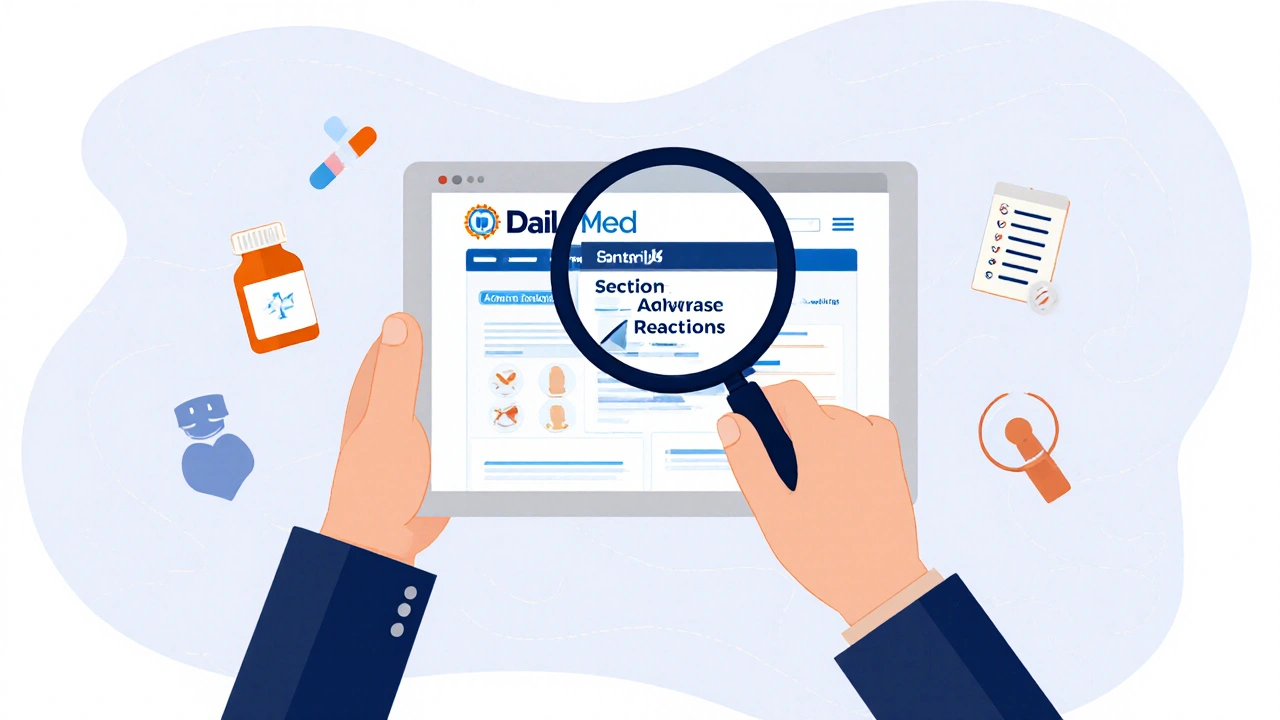
The most authoritative source for side effect information is the FDA’s FDALabel database, hosted on DailyMed. This isn’t a summary or a simplified version-it’s the exact label that drug manufacturers submit to the FDA before a medication is approved. Every prescription and over-the-counter drug sold in the U.S. must have this label, and it’s updated whenever new safety data emerges.
To find it, go to DailyMed and search for your drug by name. Once you open the label, scroll to Section 6: Adverse Reactions. This section lists side effects observed in clinical trials, ranked by how often they occurred. You’ll see terms like “common,” “uncommon,” or “rare,” and sometimes actual percentages. For example, the label for lisinopril might say: “Cough occurred in 5% of patients in clinical trials.”
But here’s the catch: this only includes side effects seen during clinical trials. That means rare reactions-like those affecting 1 in 10,000 people-or side effects that only show up after years of use might not be listed. That’s why you shouldn’t stop at FDALabel alone.
MedlinePlus: The Patient-Friendly Alternative
If the FDA label feels like reading a legal contract, MedlinePlus is your translator. Run by the National Library of Medicine, this free site breaks down side effects into plain language. It doesn’t replace the FDA label-it complements it.
For example, instead of saying “dizziness occurred in 8.3% of subjects,” MedlinePlus says: “You might feel lightheaded when you stand up quickly. This is common and usually goes away after a few days.” It also includes what to do if you experience a side effect, when to call your doctor, and even how to store the drug safely.
A 2023 survey of 2,891 users found that 87% found MedlinePlus easier to understand than FDA labels. It’s especially helpful for older adults, non-native English speakers, or anyone who just wants clear, quick answers without digging through medical jargon.
OnSIDES: The Power Tool for Deep Research
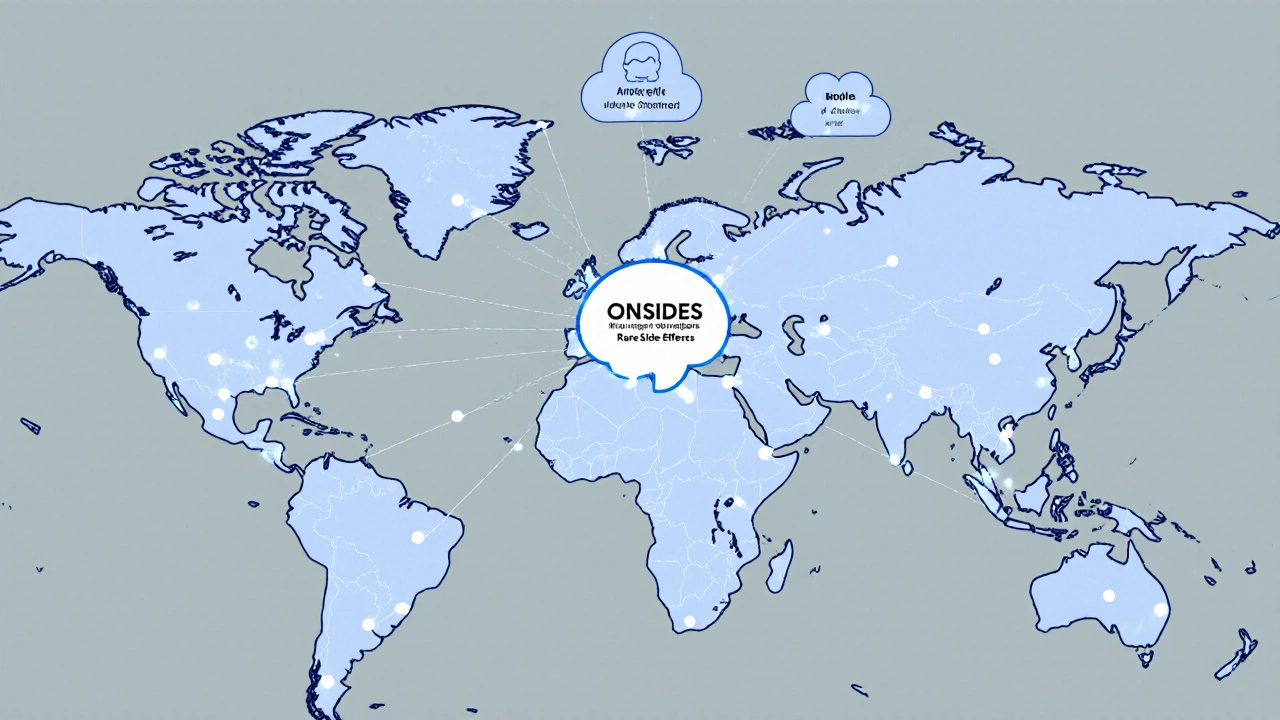
What if you want to know side effects that aren’t even on the label? That’s where OnSIDES comes in. Built by Columbia University’s Tatonetti Lab and launched in 2023, OnSIDES uses artificial intelligence to scan every FDA-approved drug label in the U.S. and beyond. It doesn’t just pull what’s written-it finds patterns across millions of reports.
As of November 2023, OnSIDES contains over 3.6 million drug-side effect pairs for nearly 2,800 active ingredients. Compare that to the average FDA label, which lists only about 69 side effects. OnSIDES found over 300 additional high-confidence side effects per drug that aren’t officially listed-things like hair loss from a blood pressure drug, or anxiety from an antibiotic.
It’s not meant for casual users. You need to know how to navigate a database, and the site (nSIDES.io) is geared toward researchers and clinicians. But if you’re a healthcare provider or someone managing a complex medication regimen, it’s the most comprehensive public tool available for uncovering hidden risks.
VigiAccess: Real-World Reports from Around the World
What happens after a drug hits the market? Side effects that didn’t show up in trials start appearing. That’s where VigiAccess comes in. Run by the World Health Organization’s Uppsala Monitoring Centre, it pulls data from over 100 countries, totaling more than 35 million individual case reports as of early 2024.
Here’s how it works: if a patient in Sweden has a rare reaction to a drug, and their doctor reports it, that report goes into VigiBase. VigiAccess lets you search for any drug and see how many times a specific side effect has been reported globally. For example, you can see that 287 people reported severe joint pain after taking a certain statin.
But there’s a big limitation: it doesn’t tell you how many people took the drug. If 10 million people used the drug and only 287 reported pain, that’s a very different risk than if only 1,000 people took it. That’s why VigiAccess is best used to spot potential signals-not to calculate exact risk.
Why You Should Avoid SIDER and Offsides
You might come across two older databases: SIDER and Offsides. SIDER, created by the European Molecular Biology Laboratory, was once popular. But its website clearly states: “The data in SIDER is from 2015 and therefore out of date!” That’s five years before many drugs currently on the market were even approved.
Offsides, also from Columbia University, was useful for its focus on off-label side effects. But it hasn’t been updated since 2012. It’s still cited in old research papers, but it’s no longer reliable for current decisions. Relying on these tools is like using a 2015 map to navigate today’s roads.
What About PDR.Net and Other Paid Services?
PDR.Net has been around since 1947 and still charges $49.99 a year for access. It’s essentially a digital version of the old Physician’s Desk Reference. While it’s convenient for quick lookups and includes drug comparisons, it’s not more accurate than the FDA’s free database. The American Medical Association has warned that PDR may reflect industry influence in how side effects are presented.
Most pharmacists and doctors don’t use it anymore. They use DailyMed or electronic health record systems that pull directly from FDA data. Paying for PDR.Net is unnecessary unless you need a very specific feature, like printing labels for patient handouts.
How to Use These Tools Together
Here’s a simple, practical way to get the full picture:
- Start with MedlinePlus for a clear, easy-to-read summary of common side effects and what to do about them.
- Check the FDA’s FDALabel on DailyMed to see what the manufacturer officially reported-especially for serious warnings.
- If you’re on multiple medications or have unusual symptoms, search VigiAccess to see if others have reported similar issues globally.
- If you’re a clinician or researcher, use OnSIDES to uncover side effects that aren’t on the label at all.
Don’t rely on one source. Each gives you a different piece of the puzzle. The FDA label tells you what was known before approval. VigiAccess shows you what’s happening in the real world. OnSIDES reveals what’s been missed. And MedlinePlus helps you understand it all.
What’s Changing in 2025 and Beyond
The FDA is updating its system to make side effect data easier to find. By 2026, all drug labels must be in a standardized digital format that can be read by computers. This means future searches will be faster, and side effects will be easier to compare across drugs.
OnSIDES is now updated quarterly, adding new data from labels released in the past three months. That’s a big step forward. But even with better tools, the biggest problem remains: less than 1% of all side effects are ever reported. That means most risks are still hidden.
The future of medication safety lies in combining data from electronic health records, patient reports, and AI analysis. But for now, the best strategy is simple: use multiple trusted sources, ask your pharmacist questions, and never assume a drug is completely safe just because it’s approved.
When to Call Your Doctor
Not every side effect is dangerous. But some need immediate attention. Call your doctor if you experience:
- Severe dizziness or fainting
- Difficulty breathing or swelling of the face, lips, or throat
- Unexplained bruising or bleeding
- Yellowing of the skin or eyes
- Sudden chest pain or irregular heartbeat
- Thoughts of self-harm or severe mood changes
Even if you’re not sure it’s related to your medication, it’s better to check. Many serious side effects are rare-but they’re treatable if caught early.
Can I trust side effect information on drug company websites?
No. Drug company websites often highlight benefits and downplay risks. They may list only the most common side effects or bury serious warnings in fine print. Always verify information with the FDA’s FDALabel or MedlinePlus, which are independent and legally required to be accurate.
Are all side effects listed on the label?
No. Labels only include side effects seen during clinical trials, which typically involve a few thousand people over months or a few years. Rare side effects-like those affecting 1 in 10,000 or 1 in 100,000 people-or long-term effects that appear after years of use often aren’t known until after the drug is on the market. That’s why post-marketing databases like VigiAccess and OnSIDES are so important.
Why does my pharmacist say to check the FDA label if it’s so hard to read?
Pharmacists know the FDA label is the most accurate and legally binding source. Even if it’s dense, it’s the official record. They use it to catch important warnings you might miss elsewhere. But they also know it’s not user-friendly, which is why they often pair it with MedlinePlus or a printed summary to help you understand it.
Is it safe to rely on online forums like Reddit for side effect info?
Online forums can help you feel less alone, but they’re not reliable for medical decisions. People report extreme reactions, anecdotal experiences, or unrelated symptoms. One person’s bad reaction doesn’t mean it’s common or even linked to the drug. Use forums for context, but always verify with trusted sources like the FDA or MedlinePlus.
What should I do if I can’t find side effect info for a supplement?
Supplements aren’t regulated the same way as prescription or OTC drugs. The FDA doesn’t require them to list side effects or prove safety before sale. If you’re taking a supplement, check the manufacturer’s website-but be skeptical. Talk to your doctor or pharmacist. They may have access to research or case reports on the ingredients. Never assume a supplement is safe just because it’s “natural.”
Final Tip: Keep a Side Effect Log
Write down any new symptom you notice after starting a medication-when it started, how bad it is, and what you were doing when it happened. Bring it to your next appointment. This simple habit helps your doctor spot patterns you might miss. It also gives you a clear record if you need to report a side effect to the FDA through their MedWatch system.
14 Comments
I’ve been using DailyMed for years, and honestly? It’s the only place I trust. I used to rely on WebMD until I found out they sometimes pulled data from drug company press releases. FDA label is the raw deal - no fluff, no marketing. Just facts. Even if it’s dense, I print it out and highlight the scary stuff.
This is such a vital guide! 💙 I shared this with my mom - she’s 72 and on 7 meds. She said MedlinePlus finally made her feel like she wasn’t reading a legal document. Thank you for making this so clear. We need more posts like this!
OnSIDES blew my mind. I was researching a weird twitch I got on metoprolol and found 12 other people reported it - none of them on the label. I showed my cardiologist and he was like, ‘Huh. We should document that.’ Honestly? This changed how I think about meds. Not all side effects are created equal - some are just invisible until enough people report them.
Don’t use SIDER. It’s outdated. Don’t use Offsides. It’s dead. Don’t pay for PDR. It’s overpriced. Use DailyMed. Use MedlinePlus. Use VigiAccess. Use OnSIDES. Done.
Y’all need to check out OnSIDES. 🤯 I’m not a doctor but I’ve been tracking my dad’s meds since his stroke. Found out his anticoagulant had a hidden link to hair loss that no one ever mentioned. I printed the report and gave it to his pharmacist. He was like, ‘We’ve seen this before.’ But no one told us. This tool saved us from a whole lot of panic. 🙌
Reddit threads are dangerous. I’ve seen people quit their blood pressure meds because someone said ‘it made them depressed.’ That’s not science - that’s fear. Use the tools listed here. If you’re worried, talk to your pharmacist. Not a stranger on the internet. Your life isn’t a TikTok trend.
Let’s be real - we live in a world where pharmaceutical giants control the narrative. The FDA label? It’s a legal shield, not a truth-teller. Clinical trials are designed to minimize risk, not expose it. VigiAccess? It’s a drop in the ocean of unreported suffering. OnSIDES? A glimmer of AI-driven justice. But none of it changes the fact that we’re all lab rats in a system that profits from silence. We need transparency - not just better websites. We need accountability. We need to stop treating side effects as ‘acceptable trade-offs’ and start treating them as moral failures.
Post-marketing surveillance data is inherently confounded by reporting bias. VigiAccess aggregates spontaneous adverse event reports (SAERs), which lack denominator data - meaning incidence rates cannot be calculated. OnSIDES employs machine learning to infer signal-to-noise ratios via Bayesian hierarchical modeling across FAERS, EudraVigilance, and WHO-UMC datasets. This allows for relative risk estimation beyond label disclosures. However, the absence of temporal sequencing limits causal inference. Still - statistically significant clustering of rare events (>3x background rate) is clinically actionable.
Just wanted to say thanks for this. I’m from Canada and we don’t have DailyMed here, but I found the equivalent on Health Canada’s site. Same deal - official, free, no BS. Also, supplements? Yeah, they’re the wild west. I took ashwagandha for anxiety and ended up with liver issues. No one warned me. Now I check every ingredient on PubChem. It’s a habit now.
Bro, in India we don’t even get these resources! My aunt took a diabetes drug and got severe rashes - doctor said ‘it’s normal.’ I found out later it was listed as rare in the FDA label. We have no access to VigiAccess, no MedlinePlus in Hindi, no one tells us. This post? It’s a lifeline. I’m translating it into Hindi right now. Someone needs to share this in every village.
Why are you even wasting time with all these sites? Just Google the drug name + ‘side effects’ and read the first 3 results. If it’s not on WebMD or Drugs.com, it’s not real. Stop overcomplicating it. Most people don’t need OnSIDES. They need a pharmacist who cares. And most pharmacists? They’re too busy to help you anyway.
Look. I live in New York. I’ve been on 14 different meds in 5 years. I’ve seen side effects no one predicted. I’ve seen doctors ignore them. I’ve seen patients die because someone thought ‘it was just anxiety.’ This isn’t about databases. This is about power. The system doesn’t want you to know the truth. These tools? They’re cracks in the wall. Keep digging.
Been using this exact method since 2021. MedlinePlus for the layman summary, DailyMed for the scary bits, VigiAccess when something feels off. Found out my antidepressant was linked to teeth grinding - 370 reports worldwide. Told my dentist, he’s been watching for it ever since. Small win. Knowledge is power.
Just wanted to say - this is the kind of post that makes Reddit worth it. Thank you. I’m printing this out and putting it in my pill organizer. I’ll share it with my book club. We’re all getting older. We need to know how to stay safe.