Warfarin-NSAID Bleeding Risk Calculator
Understanding Your Risk
This calculator helps you understand how much your bleeding risk increases when combining warfarin with NSAIDs. Based on clinical evidence, some combinations can double or even quadruple your risk of serious bleeding events.
Your Medication Details
Your Health Factors
Your Bleeding Risk Assessment
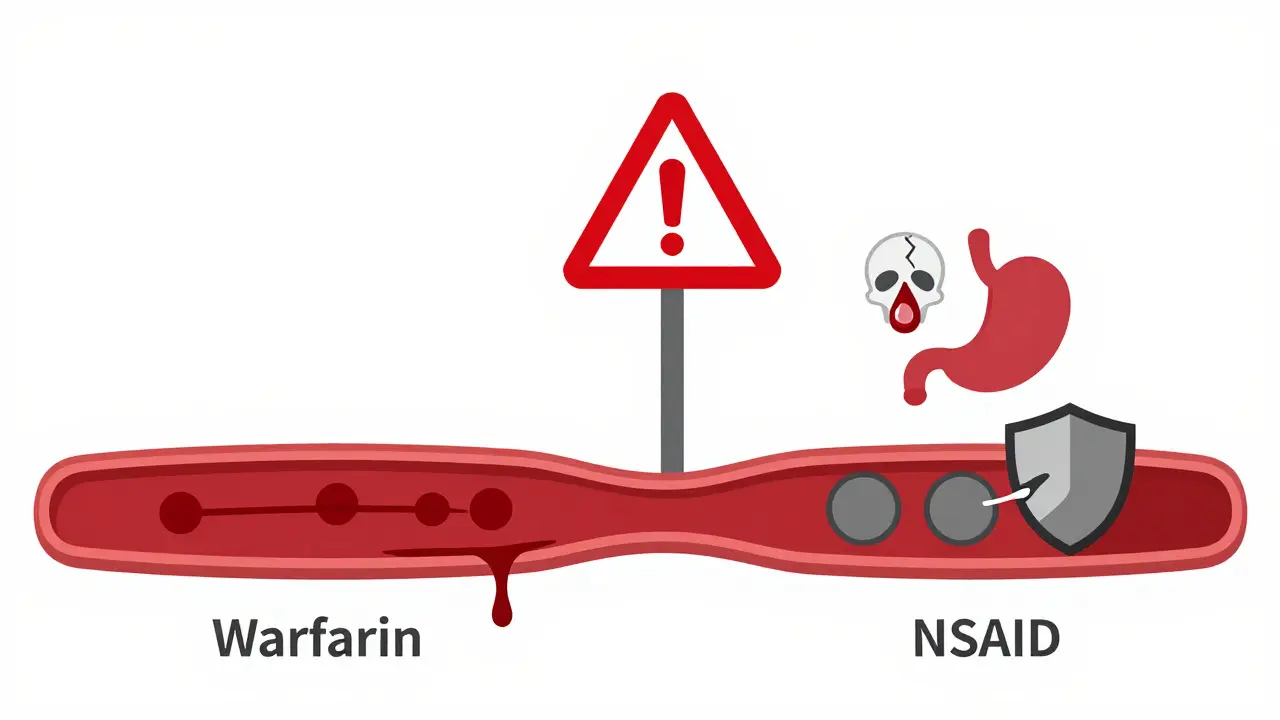
Every year, millions of people take warfarin to prevent dangerous blood clots - especially if they have atrial fibrillation, a history of deep vein thrombosis, or a mechanical heart valve. At the same time, countless others reach for over-the-counter NSAIDs like ibuprofen or naproxen for a headache, sore knee, or back pain. What most don’t realize is that combining these two drugs can double their risk of serious, sometimes deadly, bleeding.
How Warfarin and NSAIDs Work - and Why They Don’t Mix
Warfarin is an old but still widely used blood thinner. It works by blocking vitamin K, which your body needs to make clotting factors. Without those factors, blood takes longer to clot - which is exactly what doctors want when someone’s at risk of stroke or pulmonary embolism. But this delicate balance can be shattered by common painkillers.
NSAIDs - nonsteroidal anti-inflammatory drugs - include everything from aspirin and ibuprofen to naproxen and diclofenac. They reduce pain and swelling by blocking enzymes called COX-1 and COX-2. But here’s the problem: COX-1 also helps platelets stick together to form clots. When NSAIDs block it, platelets become less effective. That’s fine on its own. But when you add that to warfarin’s effect, you’re hitting the body’s clotting system from two sides at once.
And it gets worse. NSAIDs also damage the stomach lining. They reduce protective mucus and increase acid exposure. That’s why long-term NSAID users often get ulcers. When warfarin is added, even a small stomach bleed can turn into a major hemorrhage.
The Numbers Don’t Lie - Bleeding Risk Skyrockets
A 2023 study from Aarhus University Hospital, backed by the European Society of Cardiology, found that people taking warfarin who also used NSAIDs had more than double the risk of bleeding compared to those on warfarin alone. That’s not a small increase. That’s a life-threatening jump.
The risk varies depending on which NSAID you take:
- Naproxen: 4.1 times higher bleeding risk
- Diclofenac: 3.3 times higher
- Ibuprofen: 1.79 times higher
And it’s not just your stomach. The same study showed:
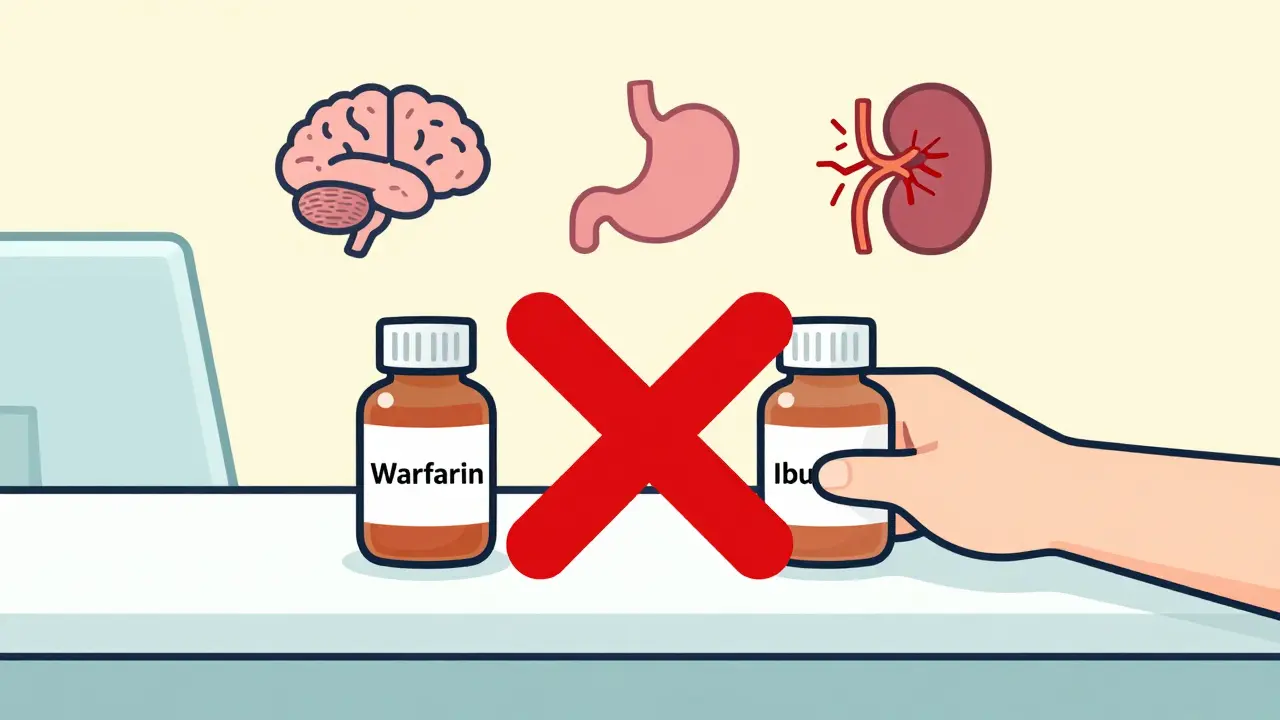
- Gastrointestinal bleeding: 2.24 times more likely
- Intracranial bleeding (brain bleed): 3.22 times more likely
- Urinary tract bleeding: 1.57 times more likely
- Pulmonary bleeding: 1.36 times more likely
Even selective COX-2 inhibitors - once thought to be safer because they don’t affect the stomach as much - carry the same risk. Celecoxib and rofecoxib don’t protect you. When paired with warfarin, they still double the chance of GI bleeding.
It’s Not Just Warfarin - All Blood Thinners Are Affected
Many people assume newer blood thinners like apixaban, dabigatran, or rivaroxaban are safer. That’s true in some ways - they have fewer drug interactions overall. But they are not safe with NSAIDs.
A 2019 study in Circulation found that NSAID use increased major bleeding risk in patients on any oral anticoagulant, whether it was warfarin or one of the newer drugs. The ARISTOTLE trial showed apixaban had slightly lower bleeding rates than warfarin in NSAID users - but the risk was still significantly higher than when NSAIDs were avoided entirely.
And here’s the dangerous myth: because NOACs (non-vitamin K oral anticoagulants) don’t interact with as many medications, some doctors and patients assume NSAIDs are okay. A 2023 study found that while warfarin-NSAID co-prescribing dropped 27% between 2015 and 2022, NSAID use with NOACs increased by 35%. People are trading one risky combo for another.
Who’s at Highest Risk?
Not everyone who takes both drugs will bleed. But certain factors make it much more likely:
- High warfarin dose (over 40 mg per week)
- Low baseline INR (below 2.0)
- Other medications like antibiotics, antifungals, or SSRIs
- Age over 75 - this group has 3.7 times higher bleeding risk
- History of ulcers or GI bleeding
A 2010 study of 98 warfarin patients found that nearly 40% had a dangerous spike in INR after starting an NSAID. The risk wasn’t random - it was predictable based on these factors.
Real Stories - ER Visits and Hospital Stays
The FDA’s adverse event database recorded over 1,800 bleeding events linked to warfarin-NSAID use between 2015 and 2020. Sixty-two percent of those were gastrointestinal.
On patient forums, the stories are heartbreaking:
"I took ibuprofen for a headache. 24 hours later, my hemoglobin dropped from 14 to 8. I was in the ER, hooked up to an IV, and spent three days in the hospital. I didn’t even know this was a risk." - Reddit user, r/BloodThinners, March 2023
A 2021 analysis of 5,237 warfarin patients found that those who bled while on NSAIDs were hospitalized 78% of the time - and stayed an average of 5.2 days. That’s 1.4 extra days compared to other bleeding causes.
On Drugs.com, 1,452 users rated the warfarin-NSAID combo. The average safety score? 2.1 out of 10. Eighty-seven percent of reviews explicitly warned others not to do it.
What Should You Do Instead?
The American College of Cardiology and the American Heart Association both give a Class I recommendation: avoid NSAIDs completely if you’re on warfarin. That’s the strongest possible warning.
So what can you take for pain?
- Acetaminophen (Tylenol): This is the top alternative. It doesn’t affect platelets or the stomach lining. It’s safe with warfarin - as long as you don’t exceed 3,000 mg per day.
- Topical pain relievers: Gels and patches with diclofenac, menthol, or capsaicin deliver relief without systemic absorption. They’re growing in popularity among warfarin users.
- Physical therapy or heat/cold therapy: For chronic joint or muscle pain, these non-drug options reduce reliance on pills entirely.
- Low-dose aspirin: Don’t assume this is safe. Aspirin is an NSAID. It’s just as risky.
If you absolutely must take an NSAID - say, for a short-term flare-up - follow these steps:
- Use the lowest effective dose for the shortest time possible.
- Avoid naproxen and meloxicam - they’re the riskiest.
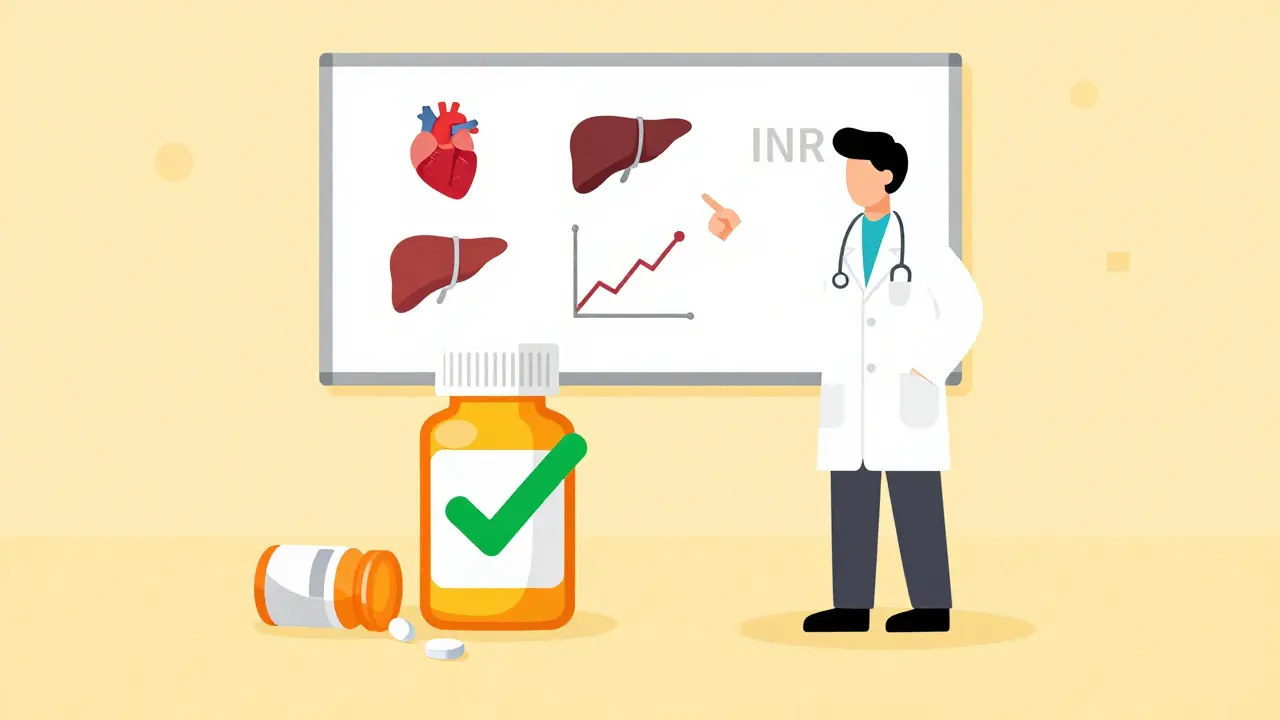
- Get your INR checked 3 to 5 days after starting the NSAID.
- Check it again weekly while you’re taking it.
- Take a proton pump inhibitor (like omeprazole) to protect your stomach.
- Tell your doctor every medication you’re taking - including OTCs and supplements.
Why This Keeps Happening - And How to Stop It
Even with all this evidence, the problem persists. Why?
- Patients don’t tell doctors: A 2021 University of Michigan study found 68% of warfarin-related bleeds happened because patients didn’t mention they were taking OTC painkillers.
- Electronic health records don’t flag it: Over 40% of U.S. hospitals’ systems fail to alert doctors when warfarin and NSAIDs are prescribed together.
- Package inserts are vague: Many NSAID labels mention "risk of bleeding" but don’t specify warfarin. Warfarin guides are clearer - but not everyone reads them.
The economic cost is staggering: $1.87 billion a year in U.S. healthcare spending just from bleeding events caused by this combo.
And yet, in 2023, over 42% of warfarin users still received an NSAID prescription. That’s not ignorance - it’s systemic failure.
The Bottom Line
If you’re on warfarin, NSAIDs are not a harmless choice. They’re a gamble with your life. The data is clear: the risk isn’t just higher - it’s dangerously high. There is no "safe" amount. No "occasional" use that doesn’t carry risk. Even a single dose can trigger a bleed.
Acetaminophen works for most pain. Topical treatments help with joints. Physical therapy addresses root causes. There are alternatives - and they’re safer.
Don’t assume your doctor knows you’re taking ibuprofen. Don’t assume OTC means safe. Don’t assume newer blood thinners protect you. This interaction is real, predictable, and deadly. The best choice? Avoid NSAIDs entirely. Your life depends on it.
Can I take ibuprofen if I’m on warfarin?
No, you should not take ibuprofen while on warfarin. Even though it’s available over the counter, ibuprofen increases your risk of bleeding by nearly 80% compared to warfarin alone. It affects platelets and irritates the stomach lining, which, when combined with warfarin’s blood-thinning effect, can lead to serious or fatal bleeding. Always use acetaminophen (Tylenol) instead for pain relief.
Is naproxen worse than ibuprofen with warfarin?
Yes, naproxen is significantly riskier than ibuprofen when taken with warfarin. Studies show naproxen increases bleeding risk by over 4 times, while ibuprofen increases it by about 1.8 times. Naproxen also has a longer half-life, meaning it stays in your system longer and creates a more prolonged effect on platelets. If you must use an NSAID at all, ibuprofen is the least risky - but even then, it’s still dangerous. Avoid both if possible.
Do newer blood thinners like Eliquis or Xarelto interact with NSAIDs?
Yes, they do. While newer anticoagulants like apixaban (Eliquis) and rivaroxaban (Xarelto) have fewer drug interactions overall, combining them with NSAIDs still significantly raises bleeding risk. Studies show the risk of major bleeding, especially gastrointestinal, increases by 2 to 3 times when NSAIDs are used with any oral anticoagulant - including NOACs. There is no safe NSAID for anyone on a blood thinner.
What should I do if I accidentally took NSAIDs while on warfarin?
If you took one dose of an NSAID by accident, monitor yourself closely for signs of bleeding: unusual bruising, dark or tarry stools, blood in urine, dizziness, or headaches. Contact your doctor immediately. They’ll likely check your INR within 24 to 48 hours. Do not take another dose. Going forward, keep a list of all medications and share it with every provider you see - including pharmacists.
Are there any NSAIDs that are safe with warfarin?
There are no NSAIDs considered safe with warfarin. This includes aspirin, celecoxib, diclofenac, meloxicam, and even topical NSAID gels - all can increase bleeding risk. The idea that some NSAIDs are "safer" is a myth. Even COX-2 inhibitors, once thought to be safer for the stomach, carry the same bleeding risk when combined with warfarin. The only safe approach is complete avoidance.
How often should my INR be checked if I must take an NSAID?
If your doctor approves NSAID use in rare cases, your INR should be checked within 3 to 5 days after starting the NSAID, then weekly until it stabilizes. After that, continue monitoring every 2 to 4 weeks. But even with frequent testing, the risk remains elevated. This is not a long-term solution - it’s a temporary measure with serious risks.


12 Comments
Honestly, I had no idea ibuprofen could be this dangerous with warfarin. I've been taking it for years for my knee pain. Guess I'm switching to Tylenol. Simple swap, maybe saves my life.
This is why you always tell your pharmacist everything you're taking. I had a patient last week who didn't mention her nightly Advil. She ended up in the ER. Don't assume it's 'just OTC'.
lol so basically every time I take a painkiller I'm playing russian roulette with my insides 😅
its funny how we trust big pharma to tell us whats safe but when it comes to otc stuff we think its harmless like its some kind of magic fairy dust 🤡
I think about how fragile our bodies really are. One little pill you grab without thinking, and suddenly your internal balance is shattered. We live in a world of invisible risks. Warfarin makes you hyper-aware of it. I used to take naproxen for my arthritis, now I do yoga and ice packs. It’s not glamorous, but I’m still here. And that’s the goal, right? Not to feel amazing today, but to be alive tomorrow.
I switched to Tylenol and my pain didn't get worse. My INR stayed stable. Why do people still risk it? 🤦♂️
I'm not convinced this isn't a pharmaceutical industry scare tactic. Who benefits from making people avoid NSAIDs? The makers of Tylenol? The hospitals? The doctors who get paid for ER visits? I've been on warfarin for 8 years and I've never bled. Maybe the numbers are skewed.
As someone from India where OTC meds are often taken without prescription, this post opened my eyes. We think 'natural' or 'over-the-counter' means safe. But biology doesn't care about labels. The fact that even topical NSAIDs carry risk? That’s terrifying. I’ll be sharing this with my father who’s on warfarin. Knowledge is the only real shield here.
You're not just risking your life. You're risking your family's peace. One stupid decision. One ER trip. One funeral. Stop being lazy.
The data is clear. The risks are documented. The alternatives exist. So why do people still do it? Because convenience trumps caution. And that's not bravery. That's negligence.
Let me break this down for the people still scrolling past this like it’s a TikTok ad. You think 'I only take it once a month.' That's like saying 'I only drive drunk once a month.' One time is all it takes. One headache. One dose. One bleed. You don't get a second chance. Acetaminophen works. Topicals work. Physical therapy works. You're not 'tough' for ignoring this. You're just unlucky. And you're about to be.
I was skeptical too - until my dad had a GI bleed after taking naproxen for his back. He’s 78, on warfarin, and now he’s got a new rule: 'No pills for pain unless I check with my doc.' We started using heat wraps and stretching. It’s slower, sure. But he’s home, not in the hospital. I get it - pain sucks. But so does losing your independence. This isn’t about being perfect. It’s about choosing the path that keeps you alive. Small changes. Big results.