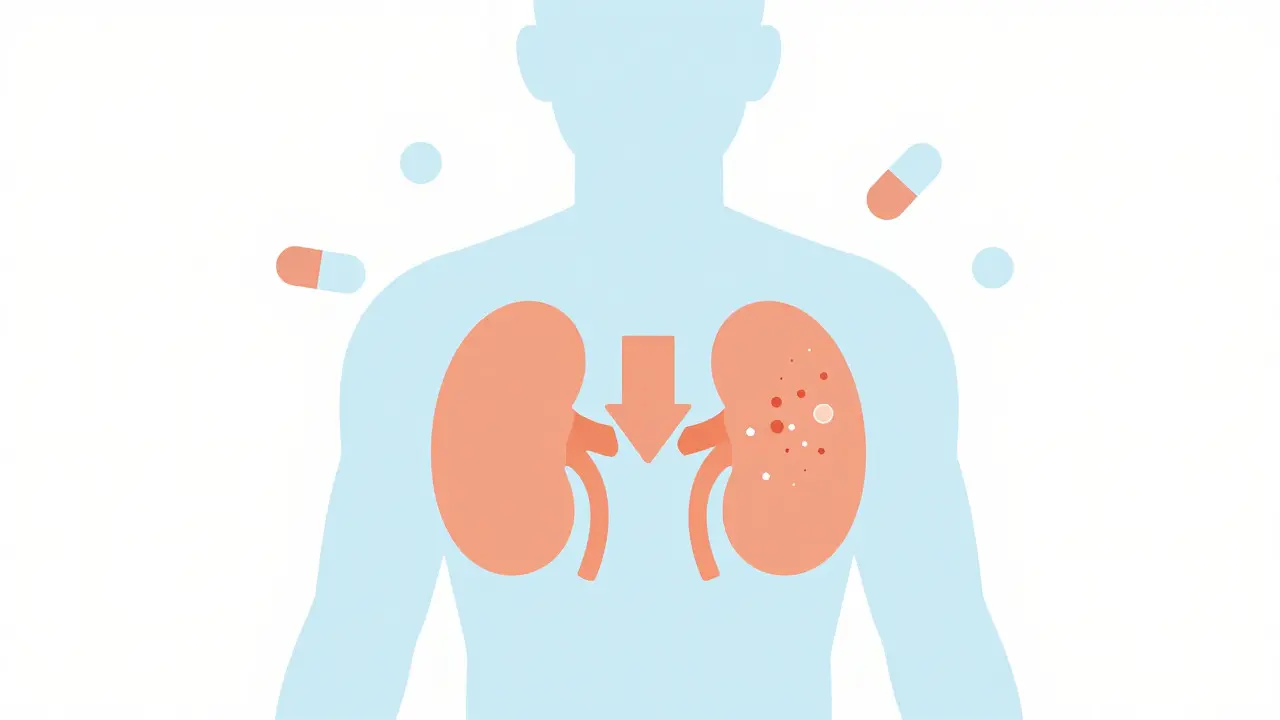
You’re 75. You take five pills a day. Your doctor says they’re safe. But your kidneys aren’t what they were at 40, and your liver doesn’t process drugs the way it used to. That’s why medication dosage adjustments are critical for aging bodies. Standard adult doses can become toxic as organs age. The goal isn’t just to keep you alive; it’s to keep you functioning without side effects that land you in the hospital.
| Organ/System | Age-Related Change | Impact on Medication |
|---|---|---|
| Kidneys | Glomerular filtration rate (GFR) declines ~8 mL/min per decade after age 30 | Drugs stay in the body longer, increasing toxicity risk |
| Liver | Hepatic blood flow decreases by 40%; enzyme activity drops | Slower breakdown of drugs like warfarin and benzodiazepines |
| Body Composition | Increased body fat, decreased lean muscle mass | Fat-soluble drugs (e.g., diazepam) linger longer; water-soluble drugs concentrate more |
| Gut | Reduced gastric acid and slower motility | Absorption rates change for certain oral medications |
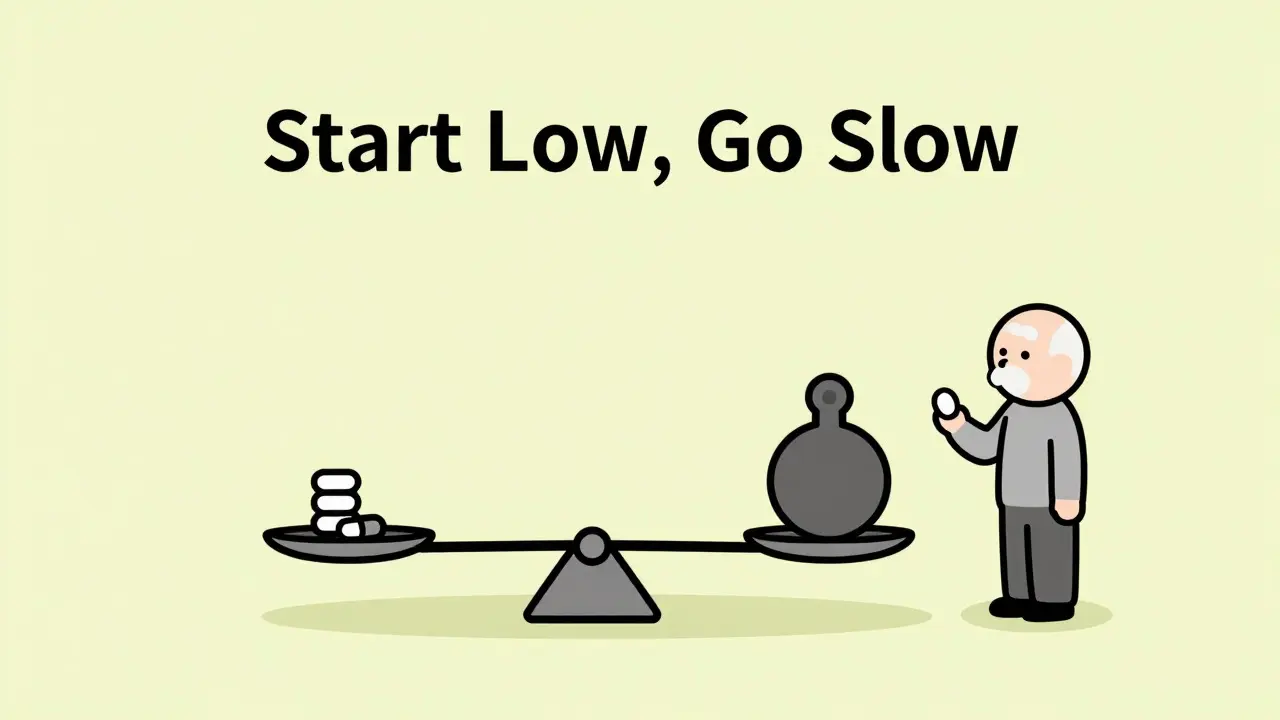
Why "Start Low, Go Slow" Is Non-Negotiable
The phrase "start low, go slow" isn’t just advice; it’s a clinical mandate derived from decades of geriatric research. When you’re young, your organs have reserve capacity. If you take a standard dose, your body handles it easily. As you age, that buffer disappears. A dose that was fine at 60 might cause dizziness or confusion at 80 because your clearance mechanisms are weaker.
Consider gabapentin, often prescribed for nerve pain. In younger adults, a starting dose might be 300mg. For an older adult with reduced kidney function, that same dose could lead to excessive sedation or falls. Guidelines suggest starting at 100-150mg instead. This isn’t about being cautious for no reason; it’s about matching the drug exposure to your actual organ function.
The Kidney Factor: Calculating Real Clearance
Your serum creatinine level is a common marker for kidney health, but it’s misleading if you don’t adjust for age and muscle mass. Muscle produces creatinine. Since older adults typically have less muscle, their creatinine levels might look "normal" even when kidney function is significantly impaired. Relying solely on creatinine can result in overdosing.
Clinicians use equations like Cockcroft-Gault to estimate creatinine clearance (CrCl). This formula accounts for age, weight, and sex. If CrCl drops below 50 mL/min, many drugs require dose reduction. Below 30 mL/min, some must be avoided entirely. For example, metformin, a common diabetes drug, is contraindicated when estimated glomerular filtration rate (eGFR) is under 30 mL/min/1.73m² because of the risk of lactic acidosis.
- Check your eGFR: Ask your doctor for this number, not just creatinine.
- Review renally cleared drugs: Antibiotics, ACE inhibitors, and diuretics often need adjustment.
- Monitor hydration: Dehydration worsens kidney function temporarily, requiring short-term dose tweaks.
Liver Function and Drug Interaction Risks
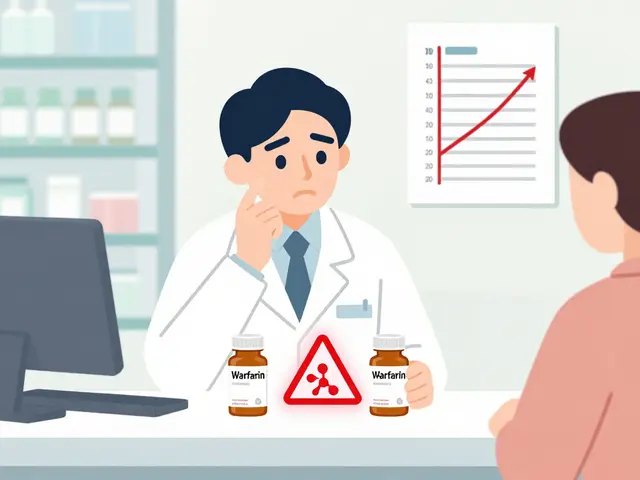
Your liver acts as the body’s chemical processing plant. It breaks down drugs so they can be excreted. With age, blood flow to the liver decreases, and the efficiency of metabolic enzymes drops. This means drugs stay active in your system longer. Warfarin, a blood thinner, is highly sensitive to these changes. Older adults often require 20-30% lower doses than younger patients to maintain the same therapeutic effect without causing bleeding.
The problem compounds when you take multiple medications. Polypharmacy-taking five or more drugs-is common among seniors. Each additional drug increases the chance of interactions. Some drugs inhibit liver enzymes, slowing the breakdown of others. Others induce enzymes, making them less effective. Without careful monitoring, this leads to unpredictable effects.
Beers Criteria®, updated regularly by the American Geriatrics Society, lists medications that pose high risks for older adults. Benzodiazepines, for instance, increase fall risk by 50% due to prolonged sedation. NSAIDs like ibuprofen raise gastrointestinal bleeding risk by threefold. Knowing which drugs to avoid-or adjust-is part of managing your medication list effectively.

Practical Steps for Safer Dosing
You don’t need to be a pharmacist to manage this, but you do need to be proactive. Here’s how to ensure your doses match your current physiology.
- Bring everything to appointments: Use the "brown bag review." Put all prescription bottles, over-the-counter meds, vitamins, and supplements in a bag and bring them to your doctor. This gives a complete picture of your intake.
- Ask about renal dosing: Explicitly ask, "Does my kidney function require any dose changes?" Don’t assume the standard dose applies.
- Use blister packs: If you take many pills, pre-packed blister strips reduce errors. Studies show this improves adherence by nearly 90% in some programs.
- Monitor for subtle changes: New symptoms like confusion, fatigue, or unsteadiness can signal drug toxicity, not just aging. Report these immediately.
The Role of Pharmacists and Technology
Pharmacists are increasingly central to geriatric care. They spot interaction risks that busy doctors might miss. Programs led by pharmacists have been shown to reduce hospitalizations by over 20% through targeted dose optimization. They also help deprescribe-removing medications that are no longer necessary or are doing more harm than good.
Technology is catching up too. Electronic health records now include alerts for renal dosing, reducing errors by half in some settings. AI tools are emerging that analyze patient data to suggest personalized doses based on real-world outcomes rather than generic guidelines. While not perfect, these tools add a layer of safety.
Why do I need lower doses as I get older?
Your body’s ability to absorb, distribute, metabolize, and excrete drugs changes with age. Reduced kidney and liver function means drugs stay in your system longer, potentially reaching toxic levels at standard doses. Adjusting doses helps maintain therapeutic benefits while minimizing side effects.
How often should my medication doses be reviewed?
At least once a year, or whenever there’s a significant change in health status, such as a new diagnosis, hospitalization, or noticeable decline in kidney or liver function. Regular reviews ensure doses remain appropriate as your physiological state evolves.
What is the Beers Criteria?
The Beers Criteria is a guideline published by the American Geriatrics Society that lists medications considered potentially inappropriate for older adults. It highlights drugs with high risks of adverse events, such as falls or confusion, and suggests safer alternatives or dose adjustments.
Can over-the-counter medications affect my prescriptions?
Yes. OTC drugs like NSAIDs (ibuprofen, naproxen) can interact with blood thinners and blood pressure medications. Supplements like St. John’s Wort can alter how your liver processes various prescriptions. Always disclose all non-prescription products to your healthcare provider.
What signs indicate a dose might be too high?
Common signs include unexpected drowsiness, dizziness, confusion, nausea, or unusual bruising. These symptoms may appear gradually. If you notice new issues after starting or changing a medication, contact your doctor promptly rather than assuming it’s just aging.


11 Comments
omg yes the kidney thing is so underrated my grandma was on standard doses and kept falling over like a sack of potatoes until they finally checked her gfr 🤯
this is exactly what i tell my mom but she thinks i'm being dramatic about the pills
the brown bag review tip is gold though honestly doctors never ask to see the whole shelf unless you force them to
The pharmaceutical industry relies on this ignorance. They push standard dosing because it's profitable, not because it's physiologically sound for every individual. If you don't demand your eGFR numbers, they will happily prescribe you into an early grave while billing insurance for the 'standard of care.' It's a systemic failure disguised as medical protocol.
Look, the data supports this but lets be real its mostly marketing fluff around complex biochemistry. Most docs dont have time to calc cockcroft-gault in their head so they just guess. Its not a conspiracy its laziness mixed with bad system design. The tech alerts help but garbage in garbage out still applies if the input data is stale from last years blood work.
This touches on a profound aspect of aging: the loss of physiological reserve. We often view our bodies as static machines that simply wear out, but in reality, they are dynamic systems where the margin for error shrinks exponentially.
When we discuss "start low, go slow," we are acknowledging that the therapeutic window narrows significantly. A young body can tolerate a spike in drug concentration because its homeostatic mechanisms are robust. An older body cannot. This isn't just about avoiding side effects; it's about respecting the changing nature of biological identity. The self at 75 is chemically distinct from the self at 35. To treat them identically is a philosophical error as much as a clinical one. We must adapt our approach to honor the new reality of the aging organism, prioritizing quality of life and cognitive clarity over aggressive symptom suppression. The goal is harmony with the body's current state, not forcing it back to a youthful baseline that no longer exists.
I love how clear this is! My dad has been struggling with confusion lately and I had no idea it could be his meds. I am going to print this out and take it to his next appointment. Thank you for sharing such helpful info!
Oh my goodness, reading this made me feel so anxious yet validated all at once because I have been worrying about my aunt's medication list for months now and feeling totally ignored by her primary care physician who just keeps refilling the same prescriptions without really looking at the big picture or considering how her weight has changed or how her kidneys might be quietly failing in the background while everyone acts like everything is perfectly fine and normal which is just insane when you consider the risks involved with polypharmacy in elderly patients who are already vulnerable to falls and hospitalizations that could completely ruin their independence and dignity in their final years of life.
Bro this is spot on 🔥💊 Stop letting doctors play Russian roulette with your liver!! You gotta fight for your dose adjustments or else you end up in the ER 🚑🏥 Don't be shy ask for the numbers!! 💪😤
Absolutely brilliant post! It’s so refreshing to see someone explain the physiology behind the advice rather than just giving a generic warning. I’ve always felt that doctors rush through these appointments, but knowing *why* the creatinine level is misleading gives us the ammunition to have a proper conversation. The bit about the "brown bag review" is fantastic practical advice too. We need to empower patients to be active participants in their own care, not just passive recipients of prescriptions. Well done!
Yeah I think the pharmacist angle is key here since they actually have the time to look at interactions. Also hydration is huge but people forget that until they're dehydrated and dizzy.
Nice breakdown. Keep pushing for those reviews. Your body changes, your meds should too. Stay safe out there.