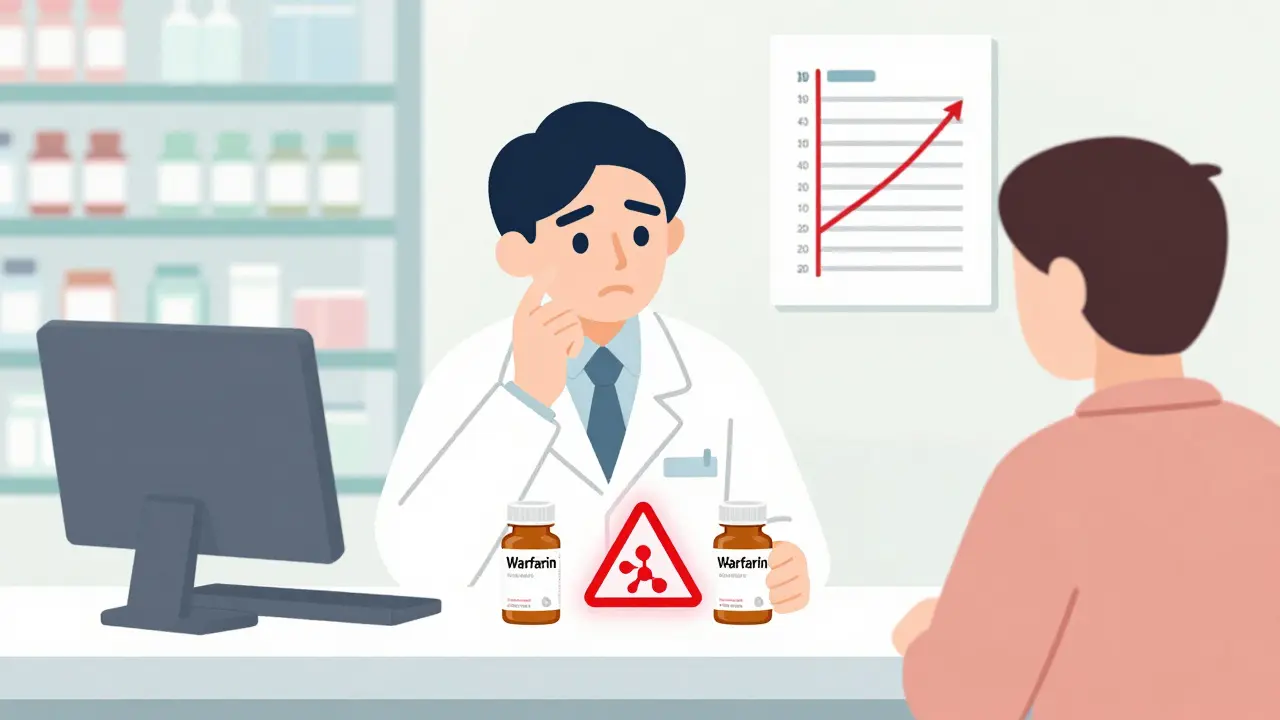
When a pharmacist fills a prescription for a medication like warfarin, levothyroxine, or phenytoin, they don’t just grab the cheapest generic off the shelf. In many states, they’re legally required to stop and think - because these are NTI drugs. Narrow Therapeutic Index drugs are a small but critical group of medications where even tiny changes in dose or blood levels can lead to serious harm - think blood clots, seizures, or even death. While the federal government says generic versions are just as safe, 27 states have passed laws that say otherwise. And those laws? They’re wildly different.
What Makes a Drug an NTI Drug?
NTI stands for Narrow Therapeutic Index. It’s not a fancy term - it just means the difference between a dose that works and a dose that’s dangerous is very small. Take warfarin, for example. A 5% change in blood concentration can turn a life-saving anticoagulant into a bleeding risk. Or levothyroxine, used for hypothyroidism. A slight shift in absorption can send thyroid-stimulating hormone (TSH) levels soaring or crashing, causing fatigue, weight gain, or heart problems. These aren’t theoretical risks. A 2023 meta-analysis of 17 studies found that over one-third of patients stabilized on brand-name levothyroxine needed dose adjustments after switching to a generic version.
The FDA doesn’t officially label any drugs as NTI. Their Orange Book, which rates drugs for therapeutic equivalence, only uses an "A" or "B" system. "A" means bioequivalent - meaning the generic absorbs into the body similarly to the brand. But here’s the catch: the FDA allows a 20% variation in absorption for generics. For most drugs, that’s fine. For NTI drugs? That’s like letting a pilot fly a plane with a gas gauge that’s off by a quarter tank.
State Laws Are All Over the Map
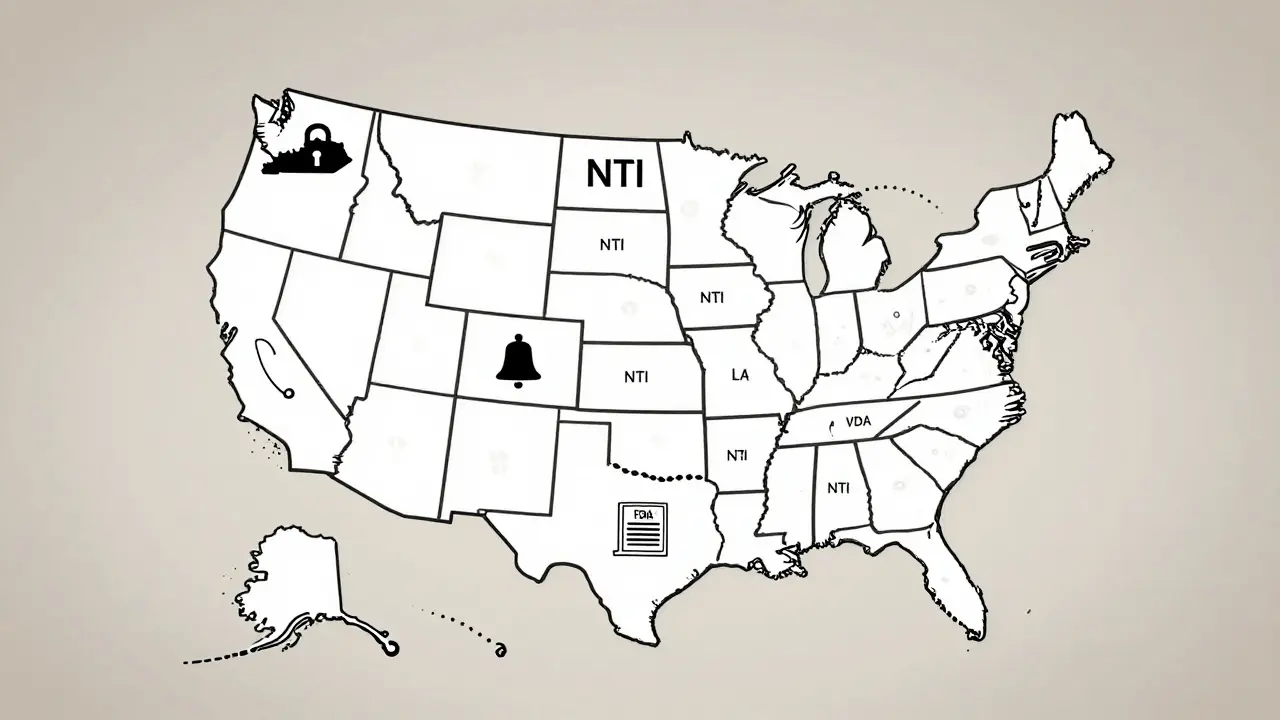
While the FDA takes a hands-off approach, states have stepped in - and they’re not all doing the same thing.
In Kentucky and Pennsylvania, pharmacists can’t substitute generics for certain NTI drugs without explicit permission from the prescriber. Their lists are specific: digitalis glycosides, antiepileptics, warfarin, and lithium are locked down. No exceptions.
South Carolina doesn’t ban substitution outright. Instead, it recommends against it for three categories: NTI drugs, brand-specific meds like Synthroid and Premarin, and "critical drugs" including insulin, anticoagulants, and time-release asthma inhalers. It’s advisory, not law - but most pharmacists treat it like a rule.
Tennessee lets pharmacists substitute A-rated generics - unless the patient has epilepsy or seizures. Then, no substitution. Period. That’s a targeted exception, not a blanket ban.
California goes further. Its law defines "critical dose drugs" as those where a 10% or less change in blood concentration could be dangerous. Pharmacists must notify the prescriber anytime they substitute one. That’s not just a warning - it’s a legal requirement.
And then there’s Iowa. They don’t make their own list. They tell pharmacists to just use the FDA’s Orange Book. No extra rules. No special lists. Simple.
Why the Chaos?
The inconsistency isn’t random. It’s a reaction to real patient harm. A 2022 study in the Journal of the American Pharmacists Association found that states with NTI substitution restrictions saw 18.7% fewer adverse events related to warfarin. That sounds big - until you realize it was only a 0.3% drop in total events. Still, for the patients who had a bleed or clot because of a switch? That 0.3% matters.
But the flip side? Pharmacy chaos. A 2023 survey by the National Community Pharmacists Association found that nearly 70% of pharmacists who work across state lines get confused by the rules. Over 40% admitted they accidentally broke substitution laws in the past year. One pharmacist in Tennessee described it like this: "In Knoxville, I can’t switch antiepileptics. In Chattanooga - same state - I have to check if the patient’s doctor has a different policy. It’s a mess."
Who’s Right? FDA or the States?
The FDA says the current bioequivalence standards are enough. Dr. John Jenkins, former head of the FDA’s drug evaluation office, called state restrictions "unnecessary." He argues that if a generic passes the 20% bioequivalence test, it’s safe.
But doctors like Dr. Jerry Avorn from Harvard say that’s dangerously naive. "For levothyroxine," he wrote in JAMA Internal Medicine, "a 5-10% variation can destabilize a patient who’s been stable for years." The American College of Clinical Pharmacy agrees. Their 2023 position statement backs state-level restrictions, citing evidence that switching generics often triggers thyroid level swings.
The FDA did create an NTI list in 1995 - but never made it official. That contradiction fuels the debate. If the FDA doesn’t classify these drugs, why do states? Because they’ve seen what happens when a patient’s dose changes without warning.
What’s Changing in 2025?
Things are starting to shift. In January 2024, the National Association of Boards of Pharmacy released a Model State NTI Substitution Act. It proposes a single, evidence-based list of NTI drugs - no more 50 different lists. Twelve states have already introduced it as legislation.
Meanwhile, the FDA is reconsidering its stance. In September 2024, they announced they’d review their position after the Senate Committee on Aging pointed to a Government Accountability Office report: 2,847 adverse events linked to NTI drug substitutions between 2019 and 2023. That’s not a small number.
And it’s not just about generics. Biosimilar substitution rules are now in place in 48 states. Pharmacists are juggling two sets of confusing rules - one for small-molecule NTI drugs, another for biologics. It’s a regulatory tangle that’s costing pharmacies money. Express Scripts reported a 5.7% rise in administrative costs just from NTI-related restrictions.
What This Means for Patients
If you take warfarin, levothyroxine, or an antiepileptic - check your prescription label. Does it say "dispense as written"? If not, your pharmacist might switch you without telling you. In restrictive states, they can’t. In others, they can - and you might not know.
Ask your pharmacist: "Is this drug on my state’s NTI list?" If they hesitate, ask your doctor to write "do not substitute" on the prescription. It’s not a hassle - it’s a safety step.
And if you’ve ever had your thyroid levels go haywire after a generic switch, you’re not alone. You’re part of a growing group pushing for change - and that change is finally starting to move.
What’s Next?
By 2027, IQVIA predicts 38 states will adopt standardized NTI substitution rules. That means fewer errors, fewer hospital visits, and less confusion for pharmacists. But it also means fewer generic switches - which could mean higher costs for patients and insurers.
The bottom line? NTI drugs aren’t just another prescription. They’re precision medicine. And when the margin for error is this thin, one-size-fits-all doesn’t cut it.



14 Comments
Let me guess-this whole NTI thing is just Big Pharma’s way of keeping generics off the market so they can keep charging $500 for a 30-day supply of levothyroxine. 🤡 The FDA says it’s safe? Yeah, and the tobacco industry said smoking was harmless too. 27 states know better. The real story? Corporate greed disguised as science. I’ve seen my cousin’s TSH go nuclear after a switch. They didn’t even *tell* her. This isn’t regulation-it’s exploitation.
The state laws reflect a deeper fracture in how we understand medicine as a mechanical process versus a living system of balance and context
The FDA operates on a model of equivalence as mathematical identity but biology is not algebra
A 20 percent variation in absorption is acceptable for a drug that treats acne but not for one that regulates the electrical rhythm of your heart
When you reduce human physiology to a lab report you lose the patient
The pharmacist is not a vending machine
The body remembers
The body does not forget
And when it forgets you are dead
Or worse you are alive but not yourself
Let’s cut through the noise-this isn’t about generics being bad. It’s about precision matters. A 5% shift in warfarin? That’s the difference between preventing a stroke and causing one. And yes, the FDA’s 20% bioequivalence window is a relic from a time when we didn’t have the tools to measure subtle pharmacokinetic differences. We do now. We’ve got LC-MS/MS, therapeutic drug monitoring, real-world EHR data-so why are we still using 1980s standards?
States like California are ahead of the curve. Not because they’re anti-generic, but because they’re pro-patient. Pharmacists aren’t robots. They’re clinical gatekeepers. If you’re switching someone on levothyroxine, you need to know the patient’s history, their labs, their stability. That’s not bureaucracy-it’s clinical judgment.
And yeah, the chaos is real. I’ve worked in 3 states. One says ‘notify the prescriber,’ another says ‘get written consent,’ another says ‘do whatever.’ It’s a nightmare. We need a national NTI list. Not because the feds know best-but because consistency saves lives.
Bottom line: If your drug has a narrow window, treat it like insulin. Not like ibuprofen.
Hey everyone-just wanted to say I’ve been a pharmacist for 18 years and this whole debate hits home. I’ve had patients cry because their TSH spiked after a switch and they couldn’t sleep or work for months. I’ve also had patients save $40 a month because we switched them-and they stayed stable. So it’s not black and white.
But here’s the thing: communication is everything. If a pharmacist calls the prescriber before switching, and the doc says ‘go ahead,’ it’s fine. If they don’t? That’s where things go sideways.
My advice? Always ask. Always check. Always flag it. And if your doctor’s not sure? Tell them to look up the 2023 meta-analysis on levothyroxine. It’s eye-opening.
We’re all on the same team here-patients, docs, pharmacists. Let’s not turn this into a war. Let’s turn it into a conversation.
States acting independently is how democracy works
Not every problem needs a federal solution
California’s 10% threshold makes sense because they’ve got the data
Iowa trusting the FDA makes sense because they’re pragmatic
Why force uniformity when the science and the patient outcomes vary by region
The real issue isn’t the laws
It’s the lack of interoperable pharmacy systems
Pharmacists in Tennessee shouldn’t have to memorize 50 state rules
We need a national database
Not a national law
While the emotional appeal of state-level regulation is understandable, the absence of a standardized, evidence-based framework undermines the very objectives it seeks to achieve. The current patchwork of statutes introduces inefficiencies that compromise both patient safety and clinical workflow. A unified, scientifically vetted list of NTI drugs, endorsed by the FDA in collaboration with professional societies, would provide clarity, reduce liability, and enhance therapeutic continuity. The current system is not merely inconsistent-it is untenable.
My grandma switched to generic levothyroxine and started feeling like a zombie for 3 months
She didn’t even know it was switched
Now her doc writes DAW 1 on every script
And honestly
Good for her
And good for any state that protects people like her
Generic is great
Unless it’s not
LOL so the FDA is ‘naive’ but states are the heroes?? 😂
Meanwhile, 40% of pharmacists admit they broke the law last year because the rules are a joke
One state says ‘no substitution’
Another says ‘notify’
Another says ‘check if the doc has a note’
So we’re just supposed to guess?
Also-how many of these states even have pharmacists on their advisory boards? Nah.
It’s politicians making rules for people they’ve never met.
Also-my pharmacy got fined $12k last year for ‘wrongly substituting’ warfarin because the patient’s chart said ‘brand’ but the script didn’t. 🤦♂️
Someone please make this stop.
My aunt had a seizure after a generic switch and no one told her
She’s fine now
But she won’t take anything generic anymore
And honestly
She’s right to be scared
My pharmacist just shrugged when I asked
Like it’s normal
It’s not
Stop treating people like lab rats
Imagine if your car’s fuel gauge had a 20% error margin. You’d take it to the shop. But we let people take life-saving meds with a gas gauge that’s off by a quarter tank? That’s not science. That’s Russian roulette with a prescription.
The FDA’s ‘A’ rating is like giving a driver’s license to someone who passed the written test but can’t parallel park. For most cars? Fine. For a Formula 1? Nope.
NTI drugs aren’t ‘just generics.’ They’re precision instruments. You wouldn’t swap out a Rolex movement for a Timex knockoff and expect the same accuracy. So why do it with your thyroid?
We need a new category-not ‘A’ or ‘B.’ Maybe ‘P’ for Precision. And pharmacists? They should be the gatekeepers. Not the cashiers.
Let’s be honest-the real issue isn’t patient safety. It’s liability avoidance. States with restrictions are reacting to lawsuits, not science. The 2022 study cited? 0.3% reduction. That’s statistically meaningless. Meanwhile, the cost burden on patients and insurers is real. Generic substitution saves billions. This is regulatory theater dressed as medicine.
And let’s not pretend pharmacists are incapable of handling this. They’re trained professionals. If they can manage anticoagulant therapy, insulin dosing, and polypharmacy regimens, they can handle a 20% bioequivalence window.
The ‘evidence’ here is anecdotal. The fear is manufactured. And the solution? A federal override. Stop the chaos. Trust the science. Not the panic.
cool post
i live in india
we dont even have this problem
everyone just takes whatever is cheapest
and somehow we still live
maybe the usa overthinks things
My pharmacist just called me last week because my script for phenytoin said ‘brand only’
She said she almost switched it because the insurance said ‘generic preferred’
But she checked my history
And called my neurologist
And they said ‘don’t touch it’
So I got the brand
And I didn’t have a seizure this month
So yeah
Pharmacists are the real MVPs
Don’t take that for granted
I’ve been on warfarin for 12 years. Switched generics once. My INR went from 2.8 to 4.9 in two weeks. No symptoms until I started bruising everywhere. Took 3 weeks to stabilize. No one warned me. No one asked.
Since then, I always ask: ‘Is this the same as last time?’
And I write ‘DO NOT SUBSTITUTE’ on every script.
It’s not paranoia.
It’s survival.