For years, cancer treatment relied on a single, painful step: the tissue biopsy. A needle inserted into a tumor, sometimes through the chest or liver, to pull out a small piece of tissue. It was necessary-but risky. Complications happened in 1 to 5% of cases. And even then, it only showed you one spot in a tumor that could be wildly different elsewhere. Today, that’s changing. A simple blood draw is now giving doctors a real-time window into what’s happening inside a cancer patient’s body. This is liquid biopsy, and it’s built around circulating tumor DNA-or ctDNA.
What Is Circulating Tumor DNA?
When cancer cells die, they don’t just disappear. They break apart and release fragments of their DNA into the bloodstream. That’s ctDNA. It’s not whole cells. It’s tiny pieces of genetic material, usually 100 to 150 base pairs long, that carry the same mutations found in the original tumor. Unlike a tissue biopsy that gives you a snapshot from one location, ctDNA comes from all parts of the tumor, giving a more complete picture. It’s like reading the entire book instead of just one chapter.
This isn’t science fiction. Studies from 2022 and 2024 show ctDNA can detect cancer recurrence up to 11 months before scans show anything. In lung cancer, it’s found targetable mutations like EGFR in 92% of cases where tissue biopsies failed. In colorectal cancer, ctDNA levels drop sharply when treatment works-and rise again when the cancer comes back. That’s not guesswork. It’s measurable, repeatable data.
How Liquid Biopsy Works
A patient walks in, gets a standard blood draw-no needles into organs, no sedation, no recovery time. The blood is sent to a lab where technicians isolate the cell-free DNA. Then they use one of several powerful techniques to find the cancer signals hidden in all the normal DNA.
- Digital droplet PCR (ddPCR) can find one mutant DNA molecule in 10,000 healthy ones. It’s precise but only looks for known mutations.
- Next-generation sequencing (NGS) scans hundreds of genes at once. It’s broader, catching new mutations you didn’t know to look for.
- Methylation analysis looks at chemical tags on DNA. Cancer cells often have abnormal methylation patterns, even before mutations show up. This method boosts detection rates by 20-30% in early-stage cancers.
- Fragmentomics examines how long the DNA pieces are and how they’re shaped. Tumor DNA breaks differently than healthy DNA. AI is now being trained to recognize these patterns, improving accuracy even more.
Some labs even use nanopore sequencing, which reads DNA strands in real time. It’s faster, cheaper, and works with smaller samples. All of this means you can test not just once, but every few weeks. That’s impossible with tissue biopsies.
Why It’s Better Than Tissue Biopsy
Traditional biopsies have three big problems:
- They’re invasive. A lung biopsy can cause a collapsed lung. A liver biopsy can bleed. Not everyone can handle it.
- They’re one-time snapshots. A tumor in the lung might look different from a tumor in the liver. One biopsy misses up to 30% of mutations because tumors aren’t uniform.
- They’re slow. Waiting weeks for results means treatment decisions are delayed.
Liquid biopsy fixes all three. No risk. No delay. No blind spots. A 2023 study from MD Anderson found that using ctDNA reduced the need for repeat tissue biopsies by 25-30% in metastatic patients. That’s not just comfort-it’s safety. And it’s cost-effective. One tissue biopsy can cost over $5,000. A liquid biopsy? Often under $1,000.
But it’s not magic. Some cancers barely shed DNA. Brain tumors, early-stage prostate cancer, and some blood cancers like chronic lymphocytic leukemia often give weak signals. In those cases, liquid biopsy isn’t reliable yet. That’s why doctors still use imaging and tissue samples when needed.
Real-World Uses Today
Here’s what liquid biopsy is actually being used for right now:
- Monitoring treatment response. If ctDNA levels drop after chemo, the treatment is working. If they stay high or rise? Change the plan. No waiting for scans.
- Detecting resistance. In lung cancer, patients on EGFR inhibitors often develop a T790M mutation. Liquid biopsy finds it 3-6 months before tumors grow on scans. That’s time to switch to a next-gen drug before the cancer spreads.
- Checking for minimal residual disease. After surgery, if ctDNA is still present, the cancer is hiding. Studies show 85-90% of patients with detectable ctDNA after surgery will relapse. That’s a clear signal to start treatment early.
- Guiding therapy when tissue is gone. About 20-30% of patients don’t have enough tissue for testing. Liquid biopsy fills that gap. NCCN guidelines now say it’s acceptable for initial EGFR testing in lung cancer when tissue isn’t available.
- Screening high-risk people. People with strong family histories or genetic syndromes (like Lynch syndrome) are being tested annually with ctDNA. Early detection in stage I cancer can mean survival rates jump from 60% to over 90%.
One case from a UK hospital in late 2024 involved a 58-year-old woman with stage III colon cancer. After surgery, her ctDNA was negative. Six months later, it turned positive-no symptoms, no scan changes. She started a new targeted therapy. A year later, she’s still in remission. Without liquid biopsy, they wouldn’t have known until her liver showed tumors on a CT scan-too late.
The Challenges
Liquid biopsy isn’t perfect. There are three big hurdles:
- False positives. Not all DNA mutations come from cancer. As people age, their blood cells can develop harmless mutations called clonal hematopoiesis. These show up in 10-15% of people over 65. Labs now use special filters to remove them-but it’s not foolproof.
- Variants of unknown significance (VUS). About 15-20% of reports find mutations we don’t yet understand. Is this driving cancer? Or just noise? Doctors need more data to interpret these.
- Standardization. Different labs use different machines, different blood tubes, different processing times. A 2024 study found up to 25% of results vary between labs. That’s why the FDA and NCCN are pushing for uniform protocols.
And sensitivity? It’s still low for early cancers. Stage I tumors shed very little DNA. Detection rates are only 50-70%. For stage IV, it’s 80-90%. That’s why liquid biopsy isn’t yet used for mass screening in healthy people. But that’s changing fast.
The Future Is Multi-Analyte
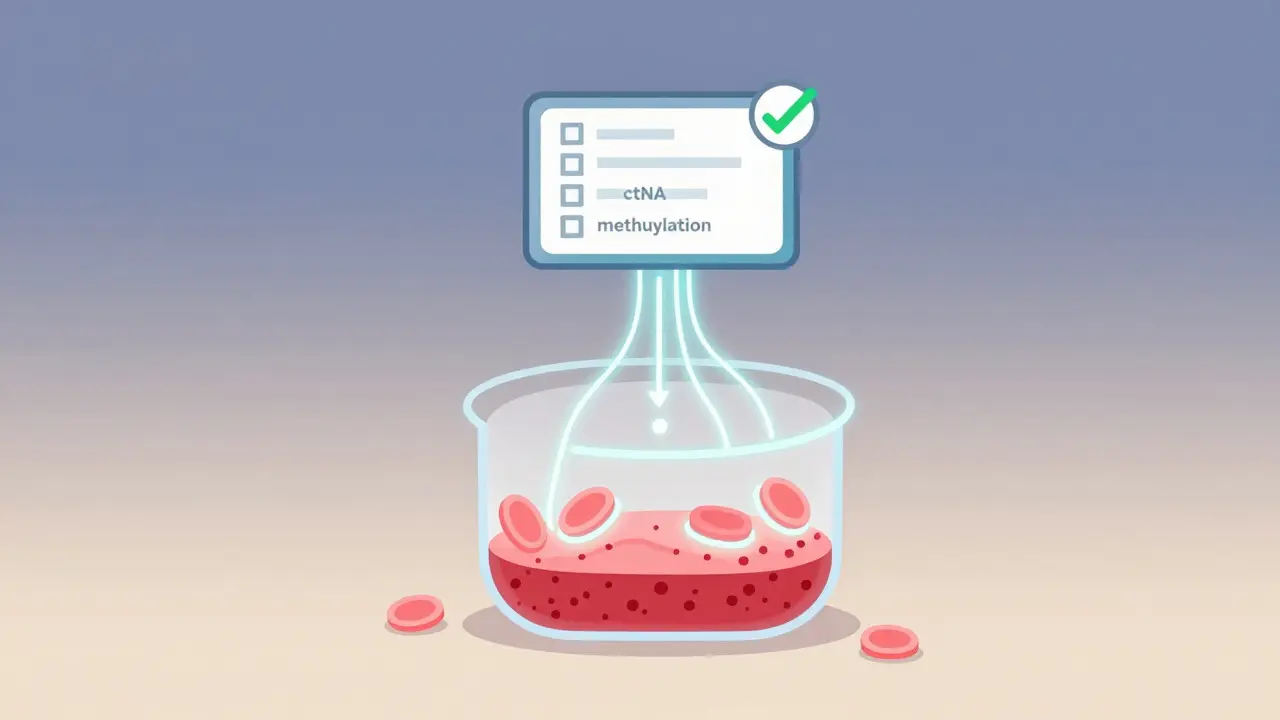
The next leap isn’t just ctDNA. It’s combining ctDNA with other signals from the same blood sample:
- Methylation patterns-epigenetic changes that happen early in cancer.
- Fragment size profiles-how DNA breaks tells you where it came from.
- Extracellular vesicles-tiny bubbles released by tumors that carry proteins and RNA.
- Tumor-educated platelets-blood cells that change their RNA when they touch cancer.
When you layer these together, detection sensitivity for stage I cancers jumps to over 95%. Companies are already testing multi-analyte panels. One test, currently in phase III trials, combines ctDNA, methylation, and fragmentomics to screen for five common cancers (lung, colon, liver, pancreatic, ovarian) in a single blood draw. If approved, it could be routine by 2028.
AI is also getting involved. At MD Anderson, algorithms now analyze ctDNA fragmentation patterns to predict which tumor type it came from-even before the mutation is identified. That’s huge for cancers with no clear genetic markers.
Who’s Using It Now?
It’s not just big hospitals. In the U.S., 60-70% of academic oncology centers offer liquid biopsy. Community clinics? Only 25-30%, mostly because of cost and training gaps. Insurance coverage is improving. Medicare now covers ctDNA testing for advanced non-small cell lung cancer. Private insurers are following.
Regulatory bodies are keeping up. The FDA has approved 12 liquid biopsy tests since 2020. Guardant360 CDx and FoundationOne Liquid CDx are now standard companion diagnostics-meaning they’re used to decide if a patient qualifies for specific drugs. In Europe, EMA approvals are growing fast. The UK’s NHS began pilot programs in 2024 to test ctDNA for monitoring metastatic breast and colorectal cancer.
The market? It was $4.4 billion in 2022. Experts predict it’ll hit $19.5 billion by 2030. That’s not hype. It’s demand. Patients want less invasive options. Doctors want better data. And science is delivering.
What’s Next?
In five years, liquid biopsy won’t be an alternative. It’ll be the first step.
Imagine this: A 55-year-old man with a family history of colon cancer gets a routine blood test. The ctDNA scan shows early methylation changes linked to precancerous polyps. He’s referred for a colonoscopy. They find and remove a polyp before it turns cancerous. No surgery. No chemo. Just prevention.
Or: A woman finishes chemotherapy for breast cancer. Her monthly ctDNA test stays negative for a year. No scans. No anxiety. Just peace of mind.
That’s the future. And it’s not far off. The technology is here. The data is solid. The only thing left is making it accessible to everyone-not just those in big cities or with top insurance.
For now, liquid biopsy is already saving lives. It’s reducing pain. It’s giving patients more control. And it’s turning cancer from a mystery into a measurable, trackable disease. That’s not just progress. It’s a revolution.

12 Comments
This is straight-up revolutionary. I had a cousin go through chemo last year, and the thought of another biopsy made her cry. Now? A simple blood draw tells the whole story. No more waiting weeks for results. No more invasive procedures. This isn’t just progress-it’s dignity restored for patients. I’m crying just thinking about it. 🙏
so like... this ctDNA thing is just like when your phone gets a software update and it tells you what's wrong? kinda? idk im not a doctor but it sounds like magic. also why is it so expensive if its just a blood test? they charging us for the vibes now?
It’s not magic. It’s biology. And it’s not perfect. False positives from clonal hematopoiesis? That’s a real problem. I’ve seen patients panic over a mutation that wasn’t even cancer. Labs are getting better, but we’re still playing whack-a-mole with noise. This tech needs more standardization-before it’s pushed as gospel in every clinic.
While the potential is immense, one cannot ignore the systemic disparities in access. The technology exists, yes-but it remains largely confined to academic centers in the United States. In rural communities, or in countries without robust healthcare infrastructure, this remains a luxury. Innovation without equity is not progress-it is exclusion dressed in lab coats.
Think of ctDNA like a smoke alarm for cancer. When the tumor dies, it leaks DNA into the blood. The test picks that up. No needles. No waiting. Just a vial of blood. It’s not perfect-early cancers don’t leak much-but for monitoring? It’s a game-changer. I’ve used it on patients. It’s saved time, money, and stress. Simple as that.
OMG I JUST CRIED. my mom had breast cancer and they did 3 biopsies. each one was worse than the last. i remember her shaking after the liver one. now? a blood test. i can’t even say how much this means. thank you scientists. 🥹💔
My sister’s oncologist started using liquid biopsy last year. She’s in remission now. No scans for 14 months. Just a blood test every 6 weeks. She says it’s the first time she’s felt like she has control. That’s not just medicine. That’s peace.
Oh great. Another billion-dollar scam disguised as science. They’re selling us a blood test so we’ll stop asking why cancer rates keep rising. Meanwhile, the real causes-pollution, processed food, corporate greed-are ignored. You think a $1000 blood test fixes that? Wake up.
The true significance of liquid biopsy lies not merely in its diagnostic utility, but in its ontological reconfiguration of disease itself. Where once cancer was a localized, static entity requiring physical excision, it is now understood as a systemic, dynamic process-constantly emitting molecular signatures into the bloodstream. This paradigm shift renders the notion of ‘tumor’ as a discrete object obsolete. We are no longer hunting a thing; we are interpreting a signal. And with signal comes the possibility of prediction, of preemptive intervention, of a future where disease is not treated, but anticipated. This is not medicine. This is epistemology made manifest.
Bro, this is Africa’s dream too! Imagine a village clinic in Zimbabwe with one machine that can tell if someone has cancer before they even feel sick. No more waiting 6 months for a doctor to come. Just a drop of blood and a phone call. This tech? It’s not just for rich countries. It’s for everyone. We need this here. NOW.
I work in oncology. I’ve seen the fear in patients’ eyes when they’re told they need another biopsy. The silence after they say yes. Liquid biopsy doesn’t just reduce pain-it reduces trauma. I had a 72-year-old patient who refused surgery because he was scared of the biopsy. We did a blood test. Found the mutation. Started targeted therapy. He’s hiking again. That’s what this is. Not tech. Not data. Humanity.
Wait-so you’re telling me the government, Big Pharma, and the FDA are all pushing this ‘liquid biopsy’ as if it’s a miracle? I’ve seen the patents. The labs are owned by three corporations. The blood tubes? They’re made by a company that also owns the sequencing machines. And the AI? Trained on data from patients who never consented. This isn’t science. It’s a surveillance system disguised as healthcare. They’re tracking your DNA, your habits, your future health risks-all so they can sell you drugs before you’re even sick. Wake up. This isn’t progress. It’s control.