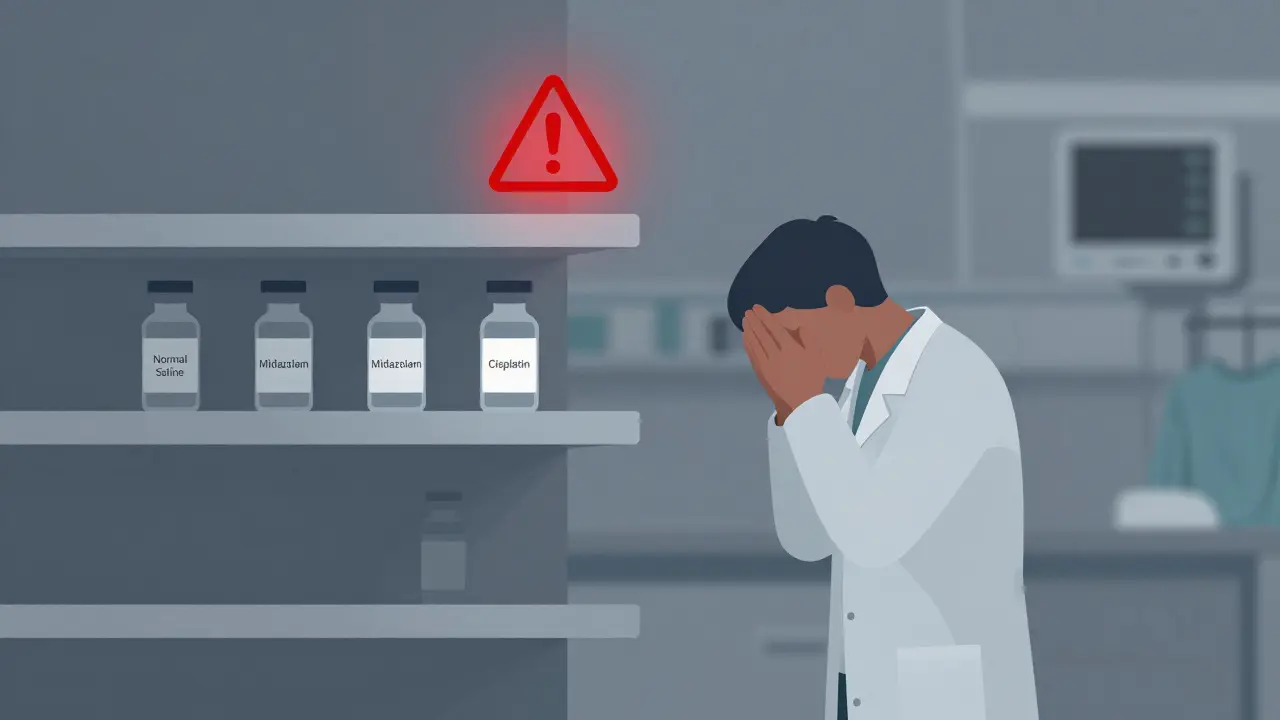
When a patient walks into a hospital for surgery, chemotherapy, or emergency care, they expect life-saving drugs to be available. But right now, injectable medication shortages are making that expectation harder to meet than ever. Hospital pharmacies aren’t just dealing with occasional out-of-stock items-they’re managing a systemic collapse in the supply of critical drugs. While retail pharmacies might see a few shortages, hospitals are facing a crisis that directly affects patient survival.
Why Injectables Are the Weakest Link
Not all drugs are created equal when it comes to supply chain fragility. Sterile injectables-medications given by IV, injection, or infusion-are the most vulnerable. Why? Because making them is hard. These drugs must be produced in clean-room environments, with zero contamination. One speck of dust, one faulty valve, one broken filter, and the entire batch gets tossed. The manufacturing process is slow, expensive, and unforgiving. That’s why 89% of drug shortages in 2024 carried over from 2023. These aren’t temporary glitches; they’re long-term failures. The numbers tell the story. As of July 2025, 226 drugs were in shortage across the U.S., and nearly 60% of them were sterile injectables. Think of drugs like normal saline, potassium chloride, midazolam, and cisplatin. These aren’t optional. They’re used daily in ICUs, ERs, and operating rooms. When they’re gone, there’s no easy substitute. Unlike oral pills, you can’t just switch a patient to a different brand or formulation. Injectables have precise bioavailability. Change the concentration, and you risk underdosing-or overdosing-a critically ill patient.Who Gets Hit the Hardest? Hospitals
Retail pharmacies might lose 15-20% of their inventory to shortages. Hospital pharmacies? They’re losing 35-40%. And of that, 60-65% are injectables. Why the gap? Because hospitals treat the sickest patients. A community pharmacy might run out of an antibiotic for a sinus infection. A hospital runs out of an anesthetic, and scheduled surgeries get canceled. It runs out of vasopressors, and a patient in septic shock dies. The stakes aren’t higher-they’re life-or-death. The most affected categories? Anesthetics (87% shortage rate), chemotherapeutics (76%), and cardiovascular drugs (68%). These aren’t niche medications. They’re the backbone of modern hospital care. In late 2024, a shortage of normal saline forced dozens of hospitals to use oral rehydration for post-op patients. That’s not ideal. It’s a workaround. And it’s becoming routine. Academic medical centers feel the pain even more. They handle complex cases-organ transplants, neonatal ICU patients, rare cancers-that rely on highly specialized injectables. These facilities report 2.3 times more disruption than community hospitals. One nurse manager in Massachusetts documented 37 surgical delays in just three months because of anesthetic shortages. Patients waited. Anxiety rose. Staff burned out.
The Root Causes: Profit, Geography, and Risk
This isn’t random. It’s structural. Most injectable drugs are generics. That means low prices. Manufacturers make only 3-5% profit on them. When a factory in India gets shut down by an FDA inspection-or a tornado hits a plant in North Carolina-it’s not worth the cost to fix it fast. The math doesn’t add up. Add to that: 80% of the active ingredients for these drugs come from just two countries-China and India. Geopolitical tension, climate disasters, or even a labor strike can cut off supply. In February 2024, an FDA shutdown at an Indian facility halted production of cisplatin, a key chemo drug. Patients across the U.S. went without. No backup. No alternative. Just silence. Quality issues are the biggest driver of shortages-responsible for 55% of them. The FDA doesn’t have the power to force manufacturers to improve. They can inspect, warn, or shut down-but they can’t demand investment. Only 12% of sterile injectable makers have adopted modern continuous manufacturing, which could prevent these breakdowns. The rest are stuck with outdated, fragile systems.How Hospitals Are Coping (And Failing)
Hospital pharmacists are becoming crisis managers. The average pharmacist now spends over 11 hours a week tracking down alternatives, calling distributors, and coordinating with doctors. That’s 11 hours they’re not spending on patient care, reviewing meds, or preventing errors. Some hospitals have created shortage management teams. But only 32% of them feel properly funded. Others are making it up as they go. Only 45% have formal, updated protocols. The rest rely on word-of-mouth, last-minute emails, and guesswork. That’s dangerous. One wrong substitution can lead to a medication error-and a patient could die. Ethical dilemmas are rising. Two in five hospital pharmacists say they’ve had to use less effective alternatives because there was no other choice. One pharmacist on Reddit wrote: “Running out of normal saline for three weeks straight forced us to get creative with oral rehydration for post-op patients-never thought I’d see the day.” That’s not innovation. That’s desperation.
What’s Being Done? Not Enough
The government has tried. The FDA’s Drug Supply Chain Security Act requires better tracking. The Consolidated Appropriations Act of 2023 forced earlier shortage notifications. But the results? A 7% reduction in shortage duration. Barely a blip. The Biden administration pledged $1.2 billion to boost domestic manufacturing. That sounds good. But experts say it will take 3-5 years to see any real impact. By then, the damage will be deeper. The FDA’s 2025 Strategic Plan offers incentives for quality improvements-but no penalties for failure. The American Medical Association called it “insufficient.” Meanwhile, the market keeps consolidating. Just three manufacturers now control 65% of the market for basic injectables like sodium chloride and potassium chloride. One factory failure. One recall. And hundreds of hospitals are left scrambling.The Future: More of the Same
Without major changes, the situation won’t improve. Industry analysts predict 200-250 active shortages annually through 2027. Hospital pharmacies will keep bearing the burden. The same patterns will repeat: a tornado, a factory shutdown, a regulatory delay, a price that doesn’t cover risk. And patients will pay the price. Some hospitals are trying new strategies-consolidating stock, pre-approving therapeutic alternatives, building direct supplier relationships. These help. They reduce disruption by 15-20%. But they don’t solve the problem. They just soften the blow. The truth? We’ve been treating this like a temporary glitch. It’s not. It’s a broken system. And until manufacturers are paid fairly, supply chains are diversified, and production is modernized, hospital pharmacies will keep being the frontline of a crisis no one else sees.Why can’t hospitals just switch to oral medications instead of injectables?
Many injectable drugs can’t be replaced with pills. For example, patients in shock need fast-acting vasopressors delivered directly into the bloodstream. Oral drugs take too long to absorb. Patients with nausea, vomiting, or intestinal blockages can’t swallow pills. Others, like chemotherapy agents, have no oral equivalent. Bioavailability matters-what works in a pill won’t work the same way in an IV. Switching isn’t always possible.
Are drug shortages getting worse, or is it just more attention now?
They’re getting worse. The U.S. hit a record 323 active shortages in early 2024-the highest since tracking began in 2001. Even though the number dropped to 226 by mid-2025, the core problems haven’t changed. Low profits, manufacturing concentration, and outdated production methods are still in place. The drop is likely temporary, not structural. Most shortages last years, not months.
Why don’t manufacturers just make more of these drugs?
Because it doesn’t pay. Generic injectables have profit margins of just 3-5%. The cost to build and maintain sterile manufacturing facilities is millions. When a batch gets contaminated, the loss can be hundreds of thousands. With so little return and so much risk, companies avoid investing. Many only produce these drugs because they’re required to-because they’re sold alongside more profitable medications.
Can the FDA do more to prevent shortages?
The FDA can inspect and shut down facilities, but it can’t force manufacturers to invest in better equipment or increase production. Only 14% of shortage notifications lead to timely fixes. The agency lacks authority to mandate quality improvements, subsidize production, or penalize companies that repeatedly cause shortages. Without legislative changes giving it real power, the FDA is stuck playing catch-up.
What can patients do if their hospital runs out of a critical injectable?
Patients should ask their care team about alternatives and risks. But they shouldn’t expect to find a solution on their own. Hospitals have limited options. In some cases, treatment may be delayed or modified. In others, patients may be transferred to a facility with better supply. Communication is key-ask questions, document what’s being used, and ensure your care team knows your history. But the responsibility lies with the system, not the patient.

9 Comments
Holy hell, this post hit me right in the gut. I work in a rural ER and we’ve been rationing normal saline like it’s gold. Last week, we had to use Gatorade for a dehydrated kid because we ran out of IV fluids. No joke. It’s not a joke. These aren’t ‘inconveniences’-they’re death sentences wrapped in bureaucracy. And don’t even get me started on how pharmacists are working 14-hour days just to patch holes in a sinking ship. We’re not broken. We’re just running out of bandages.
This is what happens when America lets everything go overseas. China and India control 80% of active ingredients? Pathetic. We used to make everything here. We had factories. We had standards. Now? We beg for pills like beggars. Why not build new plants? Why not nationalize production? Why not punish the lazy manufacturers who let batches go bad? This isn’t a shortage-it’s a surrender. And we are losing because we stopped being tough.
I’ve been a pharmacist for 27 years. I’ve seen shortages come and go. But this? This is different. It’s not just about money. It’s about dignity. These drugs aren’t widgets. They’re lifelines. And yet, we treat them like commodities. We’ve forgotten that behind every vial is a child, a parent, a veteran, someone who trusted that the system wouldn’t fail them. Maybe we need to stop measuring success by profit margins and start measuring it by survival rates. Maybe we need to ask: what kind of society lets its most vulnerable people wait because a factory in Gujarat had a power outage?
I’m sick of hearing about ‘systemic collapse’ like it’s some tragic opera. It’s not tragic-it’s predictable. It’s corporate greed dressed up in white coats. Three companies control 65% of the market? That’s not capitalism. That’s a cartel. And the FDA? They’re playing whack-a-mole with a rubber hammer. They inspect. They warn. They do NOTHING. They’re not regulators-they’re glorified tour guides. And don’t even get me started on the ‘ethical dilemmas’ pharmacists face. You don’t get to feel noble when you’re choosing who lives and who dies because someone’s quarterly earnings report was too thin.
Why dont they just make more? Simple. Because its too hard. And too expensive. And too risky. And too many lawsuits. We need to stop being soft. We need to build factories here. We need to pay people to make these drugs. We need to make it illegal to shut down a plant for a speck of dust. If you cant handle it, dont make it. We dont need imports. We need American made. America First. Always.
I live in India and I see this from both sides. We make most of the ingredients, but we don’t get paid enough. Factories here get shut down for tiny things. But the U.S. doesn’t pay enough to fix them. So we’re stuck. No one wins. The patients suffer. The workers get fired. The companies leave. It’s not about blame. It’s about broken economics. Maybe we need a global fund? Not charity. A fair price. Just enough to keep the lights on. That’s all.
I’m a nurse in a trauma center. I’ve held a mother’s hand while she waited for an anesthetic that never came. I’ve watched a patient code because we had to use a less potent vasopressor. I’ve seen nurses cry in the supply closet. This isn’t policy. This is trauma. And we’re being asked to be heroes while the system starves us. The answer isn’t more meetings. It’s not more reports. It’s funding. It’s enforcement. It’s accountability. And if you’re reading this and thinking ‘it’s not my problem’-you’re wrong. One day, it will be.
I’ve been reviewing the data on this for months. The 7% reduction in shortage duration? That’s not progress-that’s noise. The real problem is the structural decay in manufacturing infrastructure. We’ve outsourced not just labor, but expertise. We’ve abandoned continuous manufacturing because it requires upfront investment, and nobody wants to pay for it until after the crisis hits. And then we panic. We don’t build resilience-we build panic responses. We need to treat this like climate change: invest now, or pay exponentially later. But we don’t. We wait. Again. And again. And again.
One sentence: We are failing our sick because we value profit over people. That’s it. No fluff. No politics. Just truth.