
You probably think you're using your inhaler right. You shake it, press it, breathe in, and feel better. But here is the hard truth: roughly 7 out of 10 people get it wrong. That means when you take your morning puff, most of that medicine ends up stuck in your throat or on your tongue, not deep in your lungs where your airways actually need it. It’s frustrating, expensive, and leaves you vulnerable to flare-ups.
We’re going to fix that today. Proper Metered-Dose Inhaler technique isn’t just about following a pamphlet; it’s about timing, breath control, and understanding exactly how the device works. With correct technique, you can move from getting 10% of the dose to getting nearly 80%. That difference saves money on rescue visits and keeps your breathing clear.
Why Most Inhalers Fail Without Training
The problem usually isn't the medicine itself; it’s the physics involved. A metered-dose inhaler (MDI) releases medication as a fine mist or particles ranging from 50 to 150 microns. If those particles hit the back of your throat too fast, they bounce off and fall down the drain. For the drug to land in the smaller airways of the lung, you have to inhale slowly and steadily at around 30 liters per minute. That sounds technical, but it essentially means taking a slow, deep breath-like you are smelling a flower through your nose.
Research from the American Lung Association highlights a startling reality: even doctors sometimes teach incorrect methods. In a review published in the Pharmaceutical Journal, nearly 60% of patients missed critical steps. One common error involves the breath hold. After you release the puff, holding your breath for just 5 seconds cuts off the medicine's chance to settle. Experts recommend waiting a full 10 seconds. It sounds like an eternity when you're wheezing, but those extra seconds allow gravity to pull the medication down further.
Another major culprit is coordination. Newer hydrofluoroalkane propellants used in modern inhalers create a faster burst of spray than older models. This means the gap between pressing the canister and breathing in must be almost zero. If you wait until you've already started inhaling to press the button, you’ll miss the first puff entirely. Studies show 68% of users activate the canister too late in their breathing cycle. The fix? Exhale fully, start breathing in slowly, then press the canister in one smooth motion.
The Step-by-Step Guide to Perfect Delivery
Getting this right requires practice, especially if you haven't been trained by a specialist recently. Here is the exact sequence used by respiratory therapists to maximize lung deposition.
- Prepare the Device: If it’s a new inhaler or hasn't been used in two weeks, you need to prime it. Shake the canister vigorously. For most devices, 5 to 10 test sprays (aimed away from you) ensure the mechanism is ready. Note that some formulations like Alvesco require 2 sprays while others like QVAR require 4. Always check the leaflet.
- Shake Before Each Dose: Don't skip this step. Shaking mixes the propellant and the medication so they come out as one uniform mixture. Skip it, and you might get mostly propellant instead of medicine.
- Breathe Out Completely: Before you put the mouthpiece in, exhale all the air from your lungs. You want to empty the tank completely so you have maximum room for the fresh medicine. Breathe out naturally, not sharply.
- Seal and Activate: Place the mouthpiece in your mouth and close your lips tight. Do not clamp your teeth on it. Press down firmly on the canister at the exact moment you begin to breathe in. Imagine pressing the button and drawing breath together.
- Hold and Recover: Continue breathing in slowly for about 3 to 5 seconds. Once done, remove the inhaler, hold your breath for 10 seconds (count 'mississippi'), then breathe out normally.
- Rinse Your Mouth: If you are using a steroid inhaler (like Flovent or Fluticasone), rinse your mouth with water and spit it out. This prevents oral thrush, a fungal infection common among inhaler users who don't clean up after dosing.
If you use this sequence consistently, you will notice your symptoms stabilizing. Many patients report fewer rescue puffs needed later in the day just by correcting these basic mechanics.
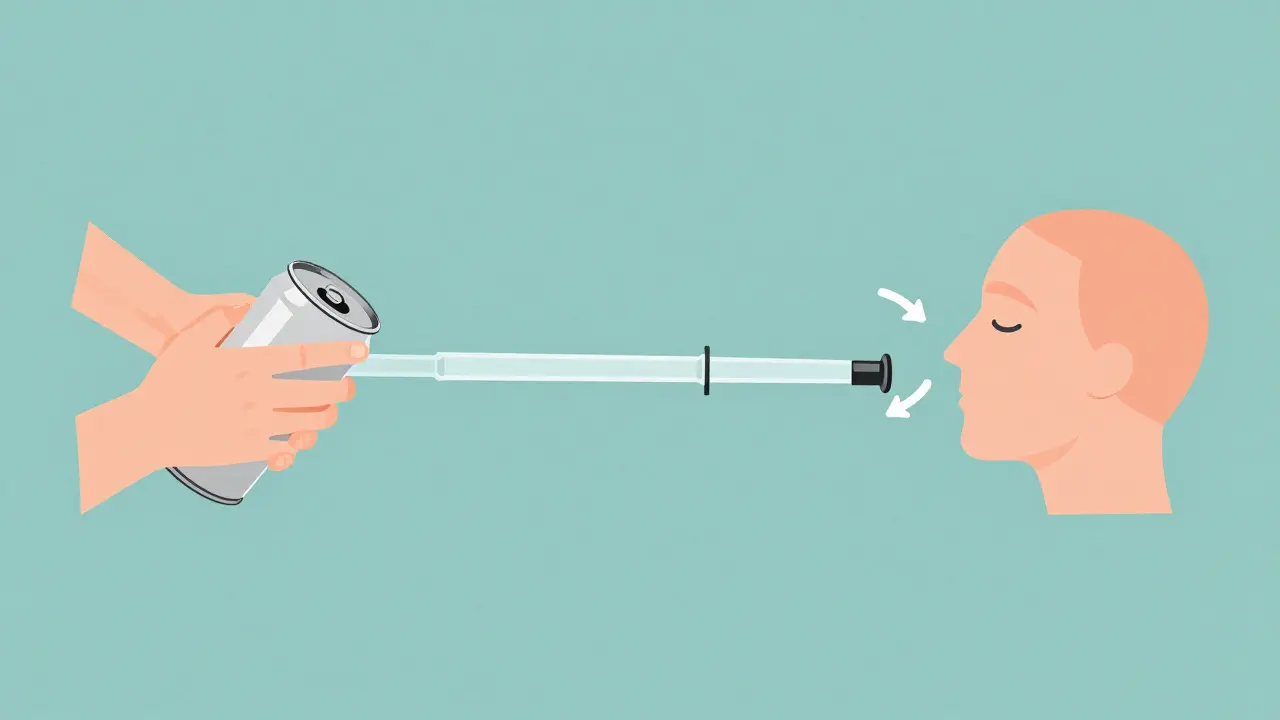
When to Use a Spacer: The Game Changer
A spacer is a plastic tube that attaches to the end of your inhaler. Think of it as a safety net. When you push the button on an MDI without a spacer, the medicine flies out fast. Without the spacer, you have to time your breath perfectly to catch it. With a spacer, the medication sits in the chamber long enough for you to inhale it at your own pace.
| Feature | Inhaler Alone | With Spacer |
|---|---|---|
| Medicine reaching Lungs | 10-20% | 70-80% |
| Coordination Required | High (Press & Breathe simultaneously) | Low (Breathe then Inhale) |
| Side Effects (Throat irritation) | Frequent | Rare |
Data shows that spacers increase the amount of medicine entering the lungs from roughly 10% to up to 80%. This is crucial for children, the elderly, or anyone struggling with hand-breath coordination. If you have an MDI prescription and aren't using a spacer yet, ask your pharmacist for one. They are inexpensive, durable, and washable.

Troubleshooting Common Issues
Sometimes the device behaves strangely. Knowing why helps you fix it before giving up on your treatment plan.
- The "Click" Sound: Some inhalers click when the counter reaches zero, others don't. If yours clicks every dose, ignore the clicks-they are counting puffs used. If it stops clicking but you still have puffs left, use the dose counter numbers instead of the mechanical click.
- Clogged Nozzles: If the mist is weak, the nozzle might be clogged with dried residue. Clean the plastic cap and mouthpiece regularly with warm water. Do not soak the metal canister itself.
- Cold Sensation: Feeling a cold spray in your mouth is normal for HFA propellants. However, if you taste a lot of bitter medicine, you likely didn't inhale deeply enough. The medicine hit your palate instead of passing through your glottis.
- Dryness: If you wake up with a dry cough after night-time doses, your head positioning might be wrong. Tilt your chin slightly forward during inhalation to bypass the sensitive nerves in the throat.
Smart Tech and Future Tools
By 2026, technology in respiratory care has evolved. While traditional plastic inhalers remain the standard, many patients now track their usage with sensors like Propeller Health. These clip onto the top of your inhaler and record how often you use it and whether you held your breath long enough. This data helps your doctor adjust prescriptions accurately rather than guessing based on memory.
Virtual reality training is also making a comeback in clinics. A 2023 study showed VR improves technique retention by 70%. It allows you to see exactly what happens to the invisible particles when you breathe, creating a visual link between your action and the result. Even if you can't access VR, asking for a demonstration with a placebo trainer kit during your next visit is a proven way to spot your personal errors.
Finally, consistency matters more than perfection. If you forget the 10-second hold one morning, don't worry. Just reset for the next dose. Over time, muscle memory will handle the steps automatically, ensuring your medication does the job it was designed to do.
Do I need to shake my inhaler every single time?
Yes, you should shake the canister for 5 to 10 seconds before each use. Shaking ensures the liquid medicine and the propellant mix properly so the spray is consistent. Some newer formulas claim not to require shaking, but unless your instructions explicitly say otherwise, always shake to be safe.
Can I drink water immediately after using my inhaler?
For bronchodilators (rescue inhalers), yes. For steroid inhalers (controller meds), you should rinse your mouth with water and spit it out to prevent oral thrush. Swallowing the water is okay, but avoid eating or drinking heavily immediately after to ensure absorption.
How do I know if I am using the inhaler correctly?
Good signs include feeling the medicine reach the deep lungs without a heavy taste in your mouth, and seeing visible mist if the weather is cold. However, the best way is to have a healthcare professional watch you use it. Ask for a technique check-up at every visit, as habits slip over time.
Is a spacer necessary for adults?
It is highly recommended. While adults often find coordination easier than children, studies show spacers significantly reduce throat irritation and increase the percentage of medicine that reaches the lower airways. It simplifies the process by removing the need for perfect timing.
How many puffs can I take?
Follow your prescription label. Usually, if two puffs are prescribed, wait 1 to 2 minutes between puffs. This gives your mouth and airways time to recover and clears any leftover droplets. Taking them back-to-back can reduce effectiveness.



15 Comments
Most people ignore this stuff until their lungs give out completely
While I understand your frustration regarding human nature it is important to realize that breathing mechanics are physically demanding tasks. Many individuals suffer from anxiety which complicates the coordination required for proper metered dose delivery. When the throat muscles tighten due to stress the medication fails to reach the alveoli efficiently. This creates a vicious cycle where the patient feels unmedicated and continues to panic during administration sessions. Patience is absolutely vital in this process. You cannot rush the ten second hold because gravity needs time to work its magic on the particles. Think of the medicine like dust settling on a shelf rather than water pouring into a bucket. If you move too fast the dust flies away into the air instead of landing where it belongs. Furthermore the psychological aspect of self treatment plays a massive role in overall outcomes. People often want immediate relief rather than sustained health improvements over a period of days or weeks. We must educate ourselves on why the steps matter beyond just following orders blindly. Understanding the physics helps us trust the procedure more deeply. I recall learning this during my own training years ago how critical the timing actually is. Without that knowledge patients lose hope when symptoms persist despite using the device daily. Please take a moment to consider the physical laws at play here. It might change your perspective on why the instructions seem so tedious initially. Ultimately consistency outweighs intensity in almost every respiratory care scenario.
You really need that spacer device honestly It makes everything so much simpler for the kids too My son used to struggle badly before we got one
It is morally imperative that every citizen takes full responsibility for their own healthcare adherence levels!
The masses clearly lack the discipline to follow basic mechanical protocols regarding pulmonary administration
The article misses key details regarding hydrofluoroalkane propellant velocities and their effect on particle size distribution but the basics are fine enough for most laypeople who struggle with coordination
We should support each other through the learning curve and avoid judgment on mistakes
Oh wow this is a total game changer!!! Your lungs will thank you big time!!! So many puffs wasted before I knew this trick!!! Definitely trying the flower sniff method tomorrow!!!
In our region we face similar challenges with humidity affecting the device performance sometimes
I remember back in school we never learned this properly. Just get handed the canister and told to fix yourself
How tragic that society allows such preventable inefficiencies to linger unnoticed. Truly heartbreaking to witness the decline of standards. I feel quite sad knowing many waste their precious dosage. Life is fragile without proper medical alignment.
Please ensure you consult your licensed physician prior to making any alterations to your current respiratory management regimen.
Peak expiratory flow rates often indicate better compliance when spacer technology is introduced into the clinical protocol.
You gotta do this now or you will never recover! Stop making excuses and start shaking that canister right now! Health is wealth and you are wasting it!
The correlation between virtual reality retention studies and practical application remains underutilized in standard clinics