Switching from a brand-name drug to a generic version is supposed to be seamless. You pay less, and you get the same medicine. But for Narrow Therapeutic Index (NTI) drugs, which are medications where small changes in dose can lead to serious health risks or treatment failure, that promise feels shaky. These are drugs like warfarin, phenytoin, and levothyroxine, where the line between a helpful dose and a dangerous one is razor-thin.
If your blood levels of these drugs drift even slightly, you could face bleeding events, seizures, or organ rejection. So, what happens when you switch manufacturers? Does the "generic" label guarantee safety for these high-stakes medications? The answer isn't a simple yes or no. It depends on the specific drug, the regulatory standards applied, and how closely your doctor monitors your blood levels after the switch.
What Makes NTI Drugs Different?
To understand the risk, you first have to understand why NTI drugs are treated differently by regulators and doctors. Most drugs have a wide safety margin. If you take a bit more or less than prescribed, it’s usually fine. With NTI drugs, that margin doesn’t exist.
The FDA defines these drugs as those where "small differences in dose or blood concentration may lead to serious therapeutic failures or adverse drug reactions." Think of it like tuning a radio. For most stations, you can be a little off-frequency and still hear music. For NTI drugs, you have to hit the exact frequency, or you get static-or worse.
This narrow window is often defined as less than a two-fold difference between the minimum effective concentration and the minimum toxic concentration. Because of this, standard bioequivalence rules-which allow generic drugs to have absorption rates between 80% and 125% of the brand name-can feel too loose. A shift from 80% to 125% exposure represents a 56% increase in drug potency. For a blood thinner or an anti-seizure medication, that jump can be catastrophic.
Bioequivalence Standards: The Global Divide
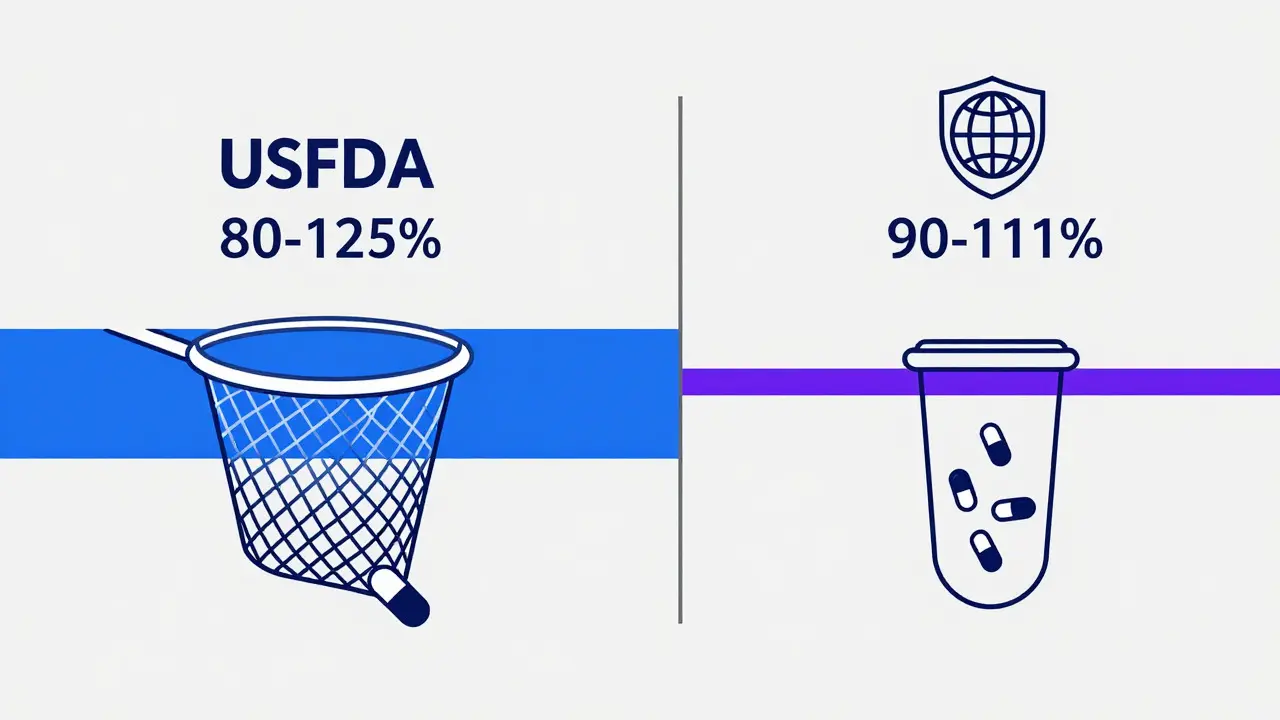
Not all countries agree on how tight the net should be for approving generics. This discrepancy creates confusion for patients and prescribers alike.
| Regulatory Body | Standard BE Range | NTI-Specific Range | Implication |
|---|---|---|---|
| FDA (USA) | 80-125% | 80-125% (Standard) | Allows wider variation; relies on post-market monitoring. |
| EMA (Europe) & Health Canada | 80-125% | 90-111% | Tighter limits reduce variability risk for sensitive patients. |
In Europe and Canada, regulators require a tighter confidence interval of 90-111% for NTI drugs. This means the generic must perform much closer to the brand name to get approved. In the US, the FDA generally applies the standard 80-125% rule but acknowledges the need for caution. They recommend maintaining patients on the same manufacturer whenever possible to avoid unnecessary fluctuations.
Clinical Outcomes by Drug Class
Research shows that the impact of switching varies significantly depending on which NTI drug you are taking. It’s not a monolith; warfarin behaves differently than phenytoin, which behaves differently than cyclosporine.
Warfarin: The Mixed Bag
Warfarin is the most commonly prescribed NTI drug. Observational studies paint a concerning picture. One study found that only 28% of patients maintained stable International Normalized Ratio (INR) control within 10% after switching to a generic. Another 38.9% saw their control worsen, requiring more frequent blood tests and dose adjustments.
However, randomized controlled trials (RCTs)-the gold standard of evidence-often show no significant difference in bleeding or clotting events between brand and generic warfarin. The disconnect suggests that while major events might not skyrocket, the *instability* does. Patients spend more time out of range, increasing anxiety and clinic visits.
Antiepileptics: High Stakes for Seizure Control
For patients with epilepsy, stability is everything. Breakthrough seizures can be life-threatening. Evidence here is more alarming. A retrospective review of 760 epileptic patients found that many required switching back to brand-name levetiracetam due to increased seizure frequency and side effects like mood swings and memory loss.
Phenytoin, another common antiepileptic, showed even sharper drops in efficacy. Substitution to generic phenytoin was associated with 22-31% lower plasma drug levels compared to the brand name. Lower levels mean less protection against seizures. In a survey of physicians, nearly half of the breakthrough seizures reported occurred at lower serum drug levels, pointing directly to formulation issues.
Immunosuppressants: Protecting the Transplant
Transplant patients rely on drugs like cyclosporine and tacrolimus to keep their bodies from rejecting new organs. A study on cyclosporine found that 17.8% of patients needed dosage adjustments after switching from the brand Neoral to a generic. Their trough concentrations spiked, raising the risk of kidney toxicity.
Tacrolimus data is more nuanced. Some studies show bioequivalence between brand and generic products using tighter NTI limits. However, manufacturing quality can vary wildly between different generic makers. One analysis showed active ingredient percentages ranging from 86% to 120% across different generic brands. That’s a massive variance for a drug that keeps an organ alive.
What Do Experts Say?
The medical community is divided, largely because the data is mixed. On one side, you have pharmacists who see generics working well day in and day out. A national survey found that 87% of pharmacists perceive generic NTI drugs as equally effective and safe as brand names. Eighty-two percent would substitute them without hesitation.
On the other side, specialists are more cautious. Neurologists often avoid generic substitution in patients with well-controlled seizures. Seventy-three percent of US states have laws restricting the automatic substitution of antiepileptic NTI drugs. Why? Because the cost savings don’t outweigh the risk of a seizure-related injury or death.
Dr. Jennifer Schneider, leading an FDA pharmacist survey, noted that skepticism was higher among pharmacists in non-chain settings. This might reflect deeper patient relationships where they see the long-term consequences of instability firsthand.
Real-World Patient Experiences
Statistics tell one story; patient forums tell another. Online communities for transplant recipients and epilepsy patients are filled with reports of trouble after switches.
- Transplant Patients: Reddit threads document cases of rejection episodes after switching from brand-name cyclosporine to generics. While some report five years of issue-free use, others describe immediate complications.
- Epilepsy Patients: The Epilepsy Foundation forums contain dozens of accounts of breakthrough seizures following generic switches. One thread documented 37 cases of increased seizure frequency after switching to generic levetiracetam.
- Warfarin Users: Data from PatientsLikeMe shows that 42% of users experienced INR instability requiring dose adjustments after a generic switch. The remaining 58% reported no significant changes.
These anecdotes highlight a critical point: individual biology interacts with drug formulations in unpredictable ways. A generic that works for 90% of people might fail catastrophically for the other 10%.

Monitoring Protocols After a Switch
If you or your loved one is on an NTI drug and faces a generic switch, passive acceptance isn’t enough. Active monitoring is key. Here is what experts recommend based on current evidence:
- Warfarin: Check INR levels within days and weeks after the switch. Do not wait for your next scheduled appointment if you suspect a change.
- Transplant Medications: Monitor trough levels at 2 and 4 weeks post-substitution. Be prepared for potential dosage adjustments.
- Antiepileptics: Keep a detailed seizure diary. Note any new side effects like dizziness, vision changes, or mood shifts. Report these immediately to your neurologist.
- Levothyroxine: Recheck TSH levels 6-8 weeks after switching. Thyroid hormone levels change slowly, so patience is required, but verification is essential.
The FDA recommends maintaining patients on the same formulation when possible. If a switch is necessary due to supply chain issues or insurance mandates, communicate clearly with your healthcare provider about the change.
Future Directions: Precision and Regulation
The landscape is shifting. The FDA has launched initiatives to address complex generics, including NTI drugs. There is a move toward product-specific bioequivalence recommendations rather than a one-size-fits-all approach. This means future regulations might require tighter controls for specific high-risk drugs like phenytoin or tacrolimus.
Additionally, pharmacogenomics-the study of how genes affect drug response-is emerging as a tool to personalize NTI dosing. Clinical trials are underway to see if genetic testing can predict who will struggle with generic substitutions. Industry analysts predict a 15-20% increase in therapeutic drug monitoring tests over the next five years as awareness grows.
Until then, the burden falls on patients and providers to stay vigilant. Generic NTI drugs offer vital cost savings, but they demand respect for their complexity. Knowing the signs of instability and advocating for proper monitoring can make the difference between a smooth transition and a medical crisis.
Are generic NTI drugs safer than brand-name versions?
Generic NTI drugs are not inherently safer or more dangerous than brand-name versions. They are designed to be bioequivalent. However, because NTI drugs have a narrow safety margin, small variations in absorption between manufacturers can lead to clinical differences in some patients. For most, generics work well, but for a subset, they may cause instability.
Should I refuse a generic prescription for my NTI drug?
Not necessarily. Refusing a generic can lead to higher costs or lack of access. Instead, discuss your concerns with your doctor. If you have been stable on a specific brand, ask if you can stay on it. If you must switch, agree on a strict monitoring plan to check blood levels shortly after the change.
Why do European standards for NTI generics differ from US standards?
European Medicines Agency (EMA) and Health Canada require a tighter bioequivalence range (90-111%) for NTI drugs compared to the FDA's standard (80-125%). This stricter limit aims to minimize variability in drug exposure, reducing the risk of therapeutic failure for sensitive patients. The FDA is reviewing its own guidelines to potentially adopt similar product-specific standards.
Which NTI drugs carry the highest risk during generic switching?
Antiepileptics (like phenytoin and levetiracetam) and immunosuppressants (like cyclosporine) carry high risks due to the severe consequences of under-dosing (seizures, organ rejection). Warfarin also carries significant risk due to INR instability, though major bleeding events are less frequently linked to switching in RCTs. Levothyroxine requires careful monitoring due to slow metabolic adjustments.
How soon should I test my blood levels after switching to a generic NTI drug?
Timing depends on the drug. For warfarin, check INR within a few days to a week. For thyroid medication (levothyroxine), wait 6-8 weeks as levels change slowly. For transplant drugs like cyclosporine, monitor trough levels at 2 and 4 weeks. Always follow your doctor’s specific instructions, as individual metabolism varies.