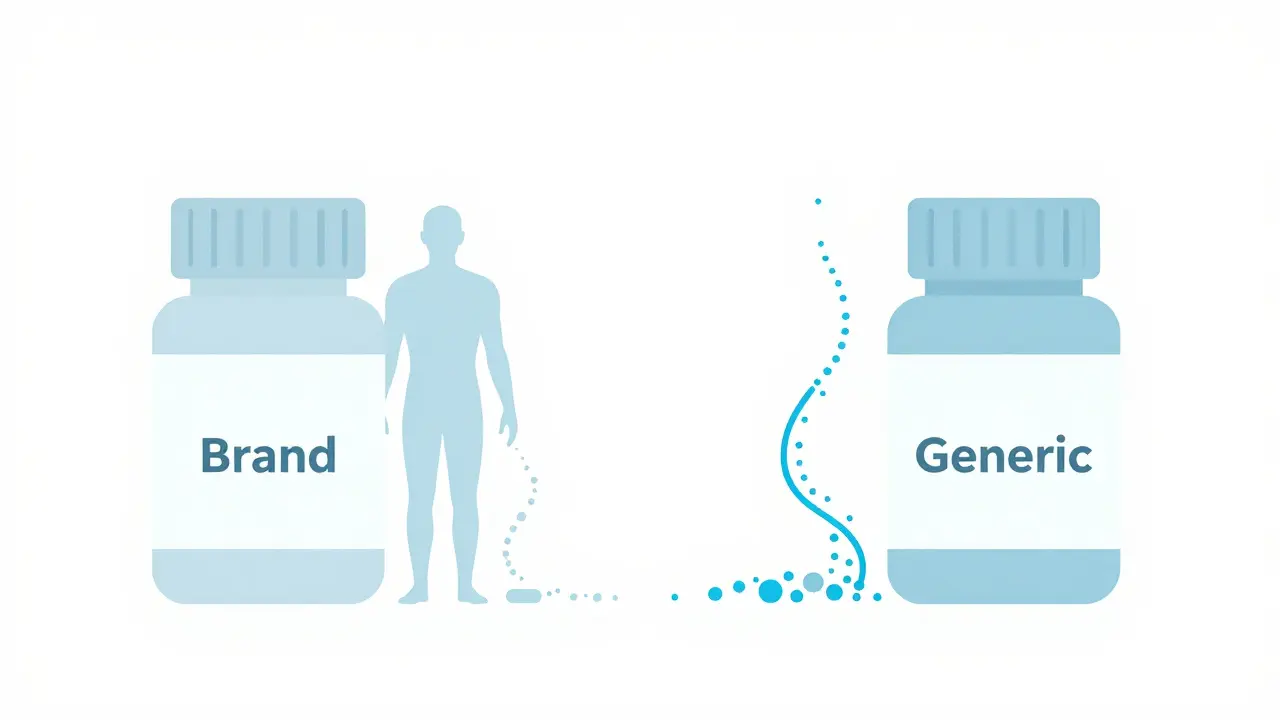
When you pick up a prescription at the pharmacy, it’s likely a generic. In fact, nearly 90% of prescriptions filled in the U.S. are generics. But have you ever wondered why these cheaper alternatives are considered safe and effective without going through the same massive clinical trials as brand-name drugs? The answer lies in bioavailability studies. These scientific tests don’t measure whether the drug cures your condition directly; instead, they measure how your body absorbs the medicine. If the generic behaves the same way in your bloodstream as the brand name, regulators approve it.
This process isn’t just about saving money-it’s about ensuring safety. Since the Hatch-Waxman Act of 1984, the U.S. Food and Drug Administration (FDA) has allowed generic manufacturers to skip full clinical efficacy trials if they can prove their product is "bioequivalent" to the original. This article breaks down exactly what those studies test, the math behind the approval, and why this system works for most drugs but faces challenges with others.
What Is Bioavailability?
Bioavailability is the rate and extent to which a therapeutically active chemical is absorbed from a drug product into the systemic circulation and becomes available at the site of action. Think of it this way: swallowing a pill is just the start. The real question is how much of that pill actually makes it into your blood and how fast it gets there. If a drug sits in your stomach undissolved or passes through your gut without being absorbed, it won’t work.
To measure this, scientists look at two main factors:
- Extent of Absorption: How much of the drug enters your system overall?
- Rate of Absorption: How quickly does it reach peak levels in your blood?
If a generic drug has different bioavailability than the brand name, it could mean you get too little medicine (ineffective treatment) or too much (increased side effects). That’s why these studies are the gatekeepers of generic drug approval.
The Three Key Metrics: AUC, Cmax, and Tmax
During a bioavailability study, researchers take blood samples from volunteers at multiple time points after they take the medication. From this data, they calculate three critical pharmacokinetic parameters. Understanding these helps explain why some generics pass and others fail.
| Parameter | Full Name | What It Measures | Why It Matters |
|---|---|---|---|
| AUC | Area Under the Curve | Total drug exposure over time | Shows the extent of absorption. Did your body get enough of the drug? |
| Cmax | Maximum Concentration | Peak drug level in the blood | Shows the rate of absorption. Does it hit hard too fast or too slow? |
| Tmax | Time to Maximum Concentration | When the peak concentration occurs | Indicates how quickly the drug starts working. |
For example, if a generic has a lower AUC than the brand name, your body might not be getting enough of the active ingredient to treat your condition. If the Cmax is too high, you might experience sudden side effects because the drug hits your system all at once. Regulators require both AUC and Cmax to fall within strict limits compared to the reference brand-name drug.
How Bioequivalence Is Determined
The goal of these studies is to establish Bioequivalence, which means the test (generic) and reference (brand) products have similar rates and extents of absorption. It doesn’t mean they are identical molecule-for-molecule in every respect, but that they behave similarly in the human body.
Here is the rule of thumb used by the FDA and other global regulators like the European Medicines Agency (EMA):
- The 90% confidence interval for the ratio of geometric means of AUC and Cmax must fall between 80% and 125%.
- This range ensures that any difference in absorption is unlikely to be clinically significant.
Let’s break down an example. Imagine a study compares Generic X to Brand Y. If the average AUC for the generic is 95% of the brand’s AUC, that’s well within the 80-125% window. However, statistics also look at variability. If the upper bound of the 95% confidence interval goes above 125%, the generic fails. For instance, one documented case showed a generic with an AUC ratio of 1.16 (16% higher), but because the confidence interval stretched to 1.30, it was rejected. This strict statistical hurdle protects patients from unpredictable dosing.

Study Design: How the Tests Are Run
Bioavailability studies aren’t random guesswork. They follow rigorous protocols designed to eliminate variables. Most standard oral solid-dose generics use a two-period, two-sequence crossover design.
- Recruitment: Typically 24-36 healthy volunteers are enrolled. Using healthy subjects removes the confounding factor of disease on drug metabolism.
- Period 1: Half the group takes the generic first, while the other half takes the brand name.
- Washout Period: Participants wait for at least five half-lives of the drug (often several days) to ensure the first dose is completely out of their system.
- Period 2: Groups switch. Those who took the generic now take the brand, and vice versa.
- Blood Sampling: Researchers draw blood at 12-18 specific time points over 24-72 hours, depending on the drug’s half-life.
This crossover method allows each participant to serve as their own control, making the comparison highly sensitive to differences in absorption. The blood samples are analyzed using validated methods that must be accurate within 85-115% of nominal values to ensure reliability.
Exceptions and Complex Cases
While the 80-125% rule works for most pills, some drugs pose unique challenges. Not all medications fit neatly into standard bioequivalence boxes.
Narrow Therapeutic Index (NTI) Drugs
Some drugs, like warfarin (blood thinner) or levothyroxine (thyroid hormone), have a very small margin between a therapeutic dose and a toxic dose. For these, the FDA requires tighter equivalence ranges, often 90-111%. A slight deviation here could lead to serious health consequences, so regulators are more cautious.
Highly Variable Drugs
Some drugs show high natural variability in how people absorb them. If the within-subject coefficient of variation (CV) exceeds 30%, standard studies might fail even if the drugs are equivalent. To address this, the FDA uses Reference-Scaled Average Bioequivalence (RSABE). This approach widens the acceptance criteria slightly based on the drug’s inherent variability, allowing approvals for generics of complex compounds like tacrolimus.
BCS Waivers
Not every generic needs a human trial. Under the Biopharmaceutics Classification System (BCS), drugs classified as Class 1 (high solubility, high permeability) may qualify for a waiver. If the generic formulation is chemically identical to the brand, regulators may accept in vitro dissolution tests instead of expensive and time-consuming human studies.

Why This System Works (And When It Doesn’t)
The fundamental assumption behind generic approval is that relative bioavailability predicts clinical outcomes. Over the past four decades, this model has proven remarkably successful. According to a comprehensive review in the Journal of Clinical Psychiatry, there have been no documented therapeutic failures attributable solely to bioequivalence limits for conventional drugs.
However, skepticism remains, particularly among specialists treating complex conditions. Dr. Randall Stafford from Stanford University has noted that for modified-release formulations or hormones like levothyroxine, standard BE criteria might not fully capture therapeutic equivalence. Patient reports occasionally highlight issues-such as increased seizure frequency after switching generic anticonvulsants-but investigations often attribute these to adherence issues or placebo/nocebo effects rather than true bioequivalence failure.
Despite these edge cases, the economic impact is undeniable. Generics represent 89% of market volume but only 26% of pharmaceutical spending. This savings allows healthcare systems to cover more patients. The trade-off is a reliance on surrogate markers (AUC/Cmax) rather than direct clinical outcome trials, a balance that regulators continuously refine.
Future Trends in Bioequivalence
As drug development evolves, so do testing methods. The FDA’s 2023 draft guidance on Model-Informed Drug Development (MIDD) suggests that advanced pharmacokinetic modeling could reduce the need for certain clinical studies. Additionally, collaborations with institutions like MIT are exploring machine learning algorithms to predict AUC ratios from formulation characteristics, achieving high accuracy in early trials.
For complex generics-like inhalers or topical creams-the agency is issuing product-specific guidances. Instead of relying solely on blood levels, these may use pharmacodynamic endpoints (e.g., measuring vasoconstriction for topical creams) to demonstrate equivalence. This shift acknowledges that for some drugs, "where it goes" matters less than "what it does" locally.
Do bioavailability studies prove a generic is safer than the brand name?
No, they prove the generic is equivalent in terms of absorption rate and extent. Safety is inferred from the fact that the active ingredient is identical and the exposure in the body is statistically similar. They do not claim the generic is superior, just that it performs comparably.
Why is the 80-125% range asymmetric around 100%?
It appears asymmetric, but it is symmetric on a logarithmic scale. Because pharmacokinetic data follows a log-normal distribution, the geometric mean ratio is used. An 80% lower bound and 125% upper bound represent equal proportional distances from the ideal ratio of 1.0 (since 1/0.8 = 1.25).
Can I request my doctor not to substitute my brand-name drug with a generic?
Yes, especially for narrow therapeutic index drugs like levothyroxine or phenytoin. While insurance plans often prefer generics due to cost, physicians can specify "Dispense As Written" if they believe consistency in manufacturer is critical for your specific health management.
Are bioavailability studies done on patients with the disease?
Typically, no. Standard bioequivalence studies use healthy volunteers to isolate the drug's pharmacokinetic properties from the variable effects of disease pathology. This provides a cleaner signal of how the body handles the drug itself.
What happens if a generic fails a bioavailability study?
The manufacturer cannot receive FDA approval for that specific formulation. They must reformulate the drug-changing excipients, particle size, or manufacturing processes-and conduct new studies until the product meets the 80-125% bioequivalence criteria.



8 Comments
I really appreciate how this breaks down the science without being overly dense. It’s fascinating to see the actual metrics like AUC and Cmax in action rather than just hearing vague assurances about safety. The crossover study design is brilliant because it controls for individual variability so effectively. I always wondered why they use healthy volunteers instead of patients, and the explanation about isolating pharmacokinetic properties makes total sense. It gives me a lot more confidence in the system when I understand the rigorous statistical hurdles involved. The mention of narrow therapeutic index drugs is also crucial context that often gets overlooked in general discussions.
Western regulators are too lenient with these generic approvals while our local pharmaceutical industry struggles to meet such arbitrary standards set by foreign bodies. The 80-125% rule is clearly designed to protect big pharma interests rather than ensure true therapeutic equivalence for patients who rely on consistent medication outcomes daily.
Oh please 🙄 like any of you actually read the FDA guidelines before commenting. The BCS waiver system is pure genius for high solubility drugs and saving millions in unnecessary human trials. Most people here don’t understand the nuance of log-normal distributions or why geometric means matter so much in pharmacokinetics. It’s not just about ‘saving money’ as the article simplistically puts it; it’s about sophisticated regulatory science that separates the wheat from the chaff. Stop pretending you know better than the experts who design these protocols 😒
It is truly remarkable how the Hatch-Waxman Act has transformed healthcare accessibility while maintaining rigorous safety standards through bioequivalence studies. The concept of using healthy volunteers to eliminate disease-related confounding variables demonstrates a profound understanding of experimental design principles. I find the discussion around Reference-Scaled Average Bioequivalence particularly enlightening, as it shows regulators adapting to complex biological realities rather than sticking rigidly to outdated rules. This balance between scientific precision and practical application deserves more recognition in public discourse.
hey guys i think we should all be super grateful for generics but also keep an eye out for those weird cases where switching meds feels off. its wild how much blood they draw from volunteers tho! like 12-18 times?? poor souls. but yeah the math checks out mostly and if u have thyroid issues maybe stick w one brand since levothyroxine is tricky af. dont let the haters fool u into thinking brands are magically better lol.
The entire premise is flawed. Surrogate markers never equal clinical outcomes. Patients suffer silent failures that statistics ignore. Trust your body over corporate algorithms.
This article is completely ignoring the elephant in the room: nocebo effects are real and devastating for patients switching generics unnecessarily. The psychological impact of believing your medicine is 'inferior' creates measurable physiological changes that ruin treatment efficacy regardless of what the AUC says. We need to stop treating patients like test tubes and start acknowledging the mind-body connection in drug therapy.
yeah i totally agree with the last few comments about the nocebo effect being huge. my cousin switched his anticonvulsant generic and had seizures again even tho the lab tests said it was fine. doctors just shrugged it off but it was clearly a problem for him. maybe the 80-125 range is too wide for sensitive folks?