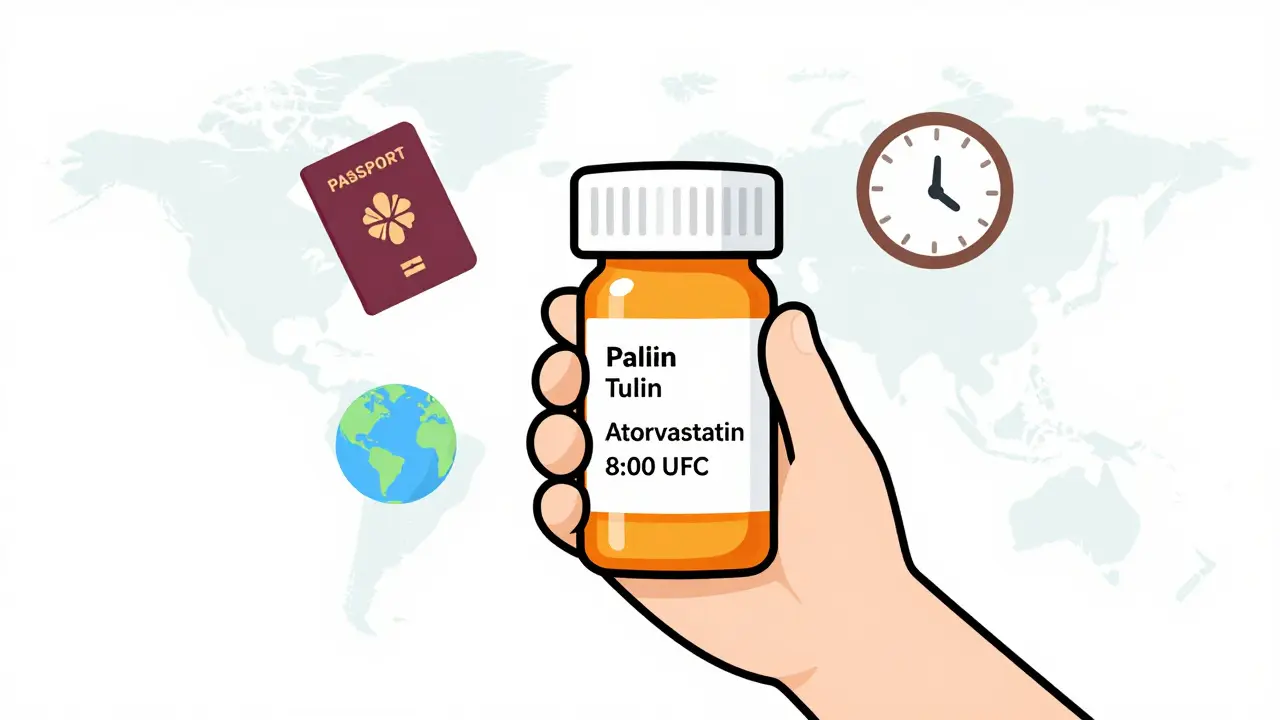
When you’re flying across time zones with prescription meds, a simple label can mean the difference between staying healthy and ending up in a foreign hospital. You’ve packed your clothes, booked your hotel, and checked your passport. But have you checked your pill bottle? Most travelers don’t realize that prescription labels aren’t just instructions-they’re legal documents, safety tools, and customs clearance forms all rolled into one. And if you miss the details, you could be denied entry, fined, or worse-take the wrong dose at the wrong time.
What’s Actually on Your Prescription Label?
Your prescription label isn’t just a reminder to take your pills. It’s packed with critical info that changes how you use them abroad. Look for these seven parts before you leave:- Patient name-This must match your passport exactly. No nicknames, no initials. If it says “J. Smith” and your passport says “Jennifer Smith,” customs might flag it.
- Medication name-Both brand and generic names should be listed. In countries like Japan or Saudi Arabia, the generic name is what officials use to verify your meds. If your label says “Lipitor” but not “atorvastatin,” you could be turned away.
- Dosage strength-Look for numbers like “10 mg” or “500 IU.” Don’t assume all pills are the same. A 5 mg tablet isn’t interchangeable with a 10 mg one, even if they look alike.
- Directions for use-This is the most dangerous part when crossing time zones. Look for phrases like “q24h” (every 24 hours) or “q12h” (every 12 hours). Avoid AM/PM-those are useless when your clock changes.
- Prescriber info-Your doctor’s name and contact details. Some countries require this to verify the prescription is real.
- Pharmacy details-Address and license number. This proves the med came from a licensed source.
- Prescription number-Used to track the fill. Keep this handy if you need a refill abroad.
Many U.S. labels skip the generic name or don’t include the pharmacy’s license number. That’s not enough for international travel. Ask your pharmacist to add these details before you leave.
Time Zones Are the Silent Killer
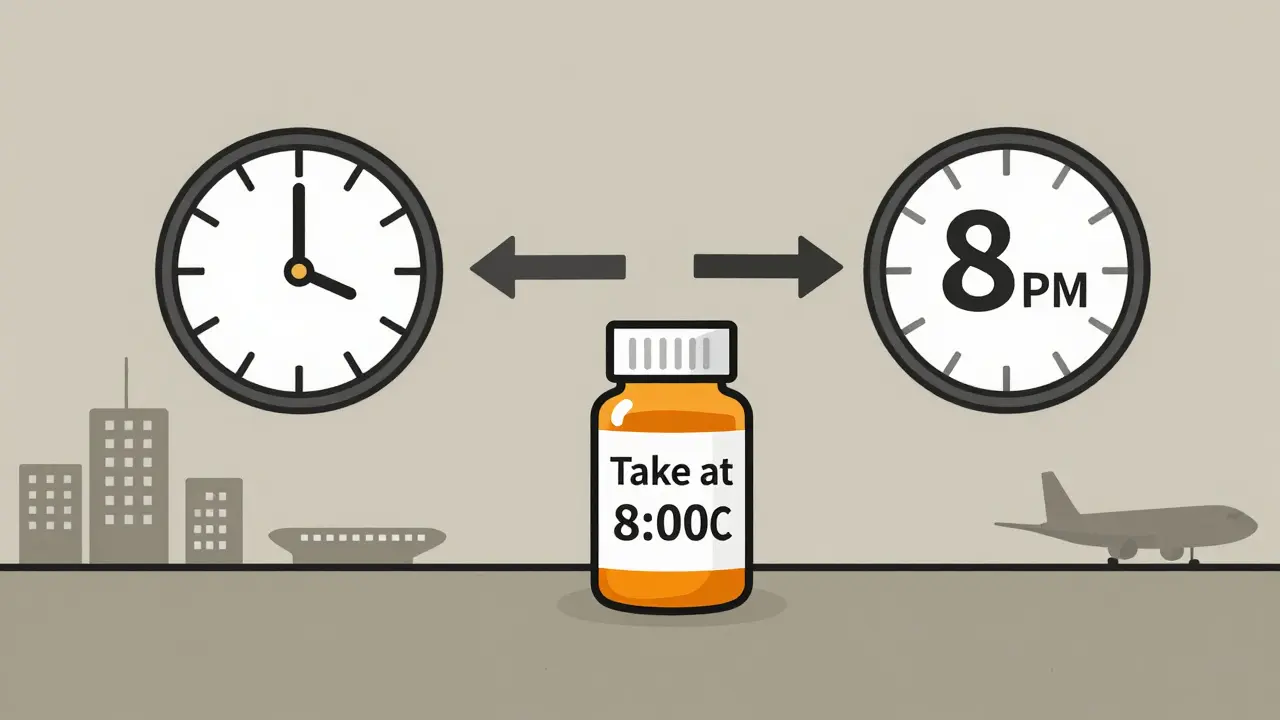
You think you’re just adjusting your sleep schedule. But your body’s clock isn’t the only thing that needs resetting. Your meds have one too.Take insulin, warfarin, or antibiotics. These aren’t like painkillers you can take when you feel like it. They need precise timing. If you’re on a 12-hour schedule and you fly from New York to Tokyo, you’ve just jumped 12 hours ahead. If you take your pill at 8 AM New York time, that’s 8 PM in Tokyo. But your body thinks it’s 8 AM. You might skip the next dose because you think you just took it. Or worse-you take it twice.
The fix? Convert everything to Coordinated Universal Time (UTC). It’s the global standard. No daylight saving confusion. No local time tricks. If your label says “take one tablet at 8:00 UTC,” you know exactly when to take it-whether you’re in London, Dubai, or Sydney.
Most pharmacies in the U.S. will add UTC times to your label if you ask. A 2023 audit found 78% of major chains now do it. Don’t assume they will. Say it clearly: “Can you add the UTC time for each dose?”
For time-sensitive meds like levothyroxine or bisphosphonates, timing matters even more. Levothyroxine must be taken on an empty stomach, 30-60 minutes before food. If you land in Rome at 6 AM and eat breakfast at 7 AM local time, but your body still thinks it’s 1 AM, you might wait too long-or take it too soon. Work with your doctor or a travel clinic to build a 2-3 day transition plan. Don’t guess.
Country Rules Vary-Big Time
Not every country treats your meds the same. What’s legal in the U.S. might be banned-or require special paperwork-in another.- Japan requires kanji characters for all medication names. If your label only says “ibuprofen,” you’ll be detained at Narita Airport. The 2022 Journal of Travel Medicine found 43% of American travelers faced delays because their labels didn’t include Japanese text.
- Saudi Arabia now requires the Arabic name of the active ingredient. In early 2023, 22% of seized medications at Riyadh Airport had English-only labels.
- Thailand demands both English and Thai on the label. They don’t care about your doctor’s note. If the bottle doesn’t say “ไอบูโพรเฟน,” you’re at risk.
- European Union follows standardized rules, but your name must be in the local language of the country you’re entering. A German pharmacy label might say “Anna Müller,” but if your passport says “Anna Muller,” that’s still fine-just make sure the spelling matches.
- Caribbean nations like Jamaica and Barbados require English and Spanish. Only 37% of U.S. prescriptions meet this standard, according to a 2022 University of Miami study.
Don’t rely on airport security or airline staff to know the rules. They often don’t. If you’re flying to a country with strict rules, print out the official government requirements and carry them with your meds.
What to Do Before You Fly
Don’t wait until the airport to figure this out. Start 4-6 weeks before departure.- Call your pharmacy and ask them to print a travel-ready label with: generic name, UTC timing, pharmacy license number, and prescriber info.
- Request a doctor’s letter on letterhead explaining your condition and meds. It helps if customs questions you. Include your diagnosis and dosage.
- Use the WHO Medication Time Zone Converter app-downloaded over 287,000 times since 2022. It lets you input your meds and auto-converts doses to local time.
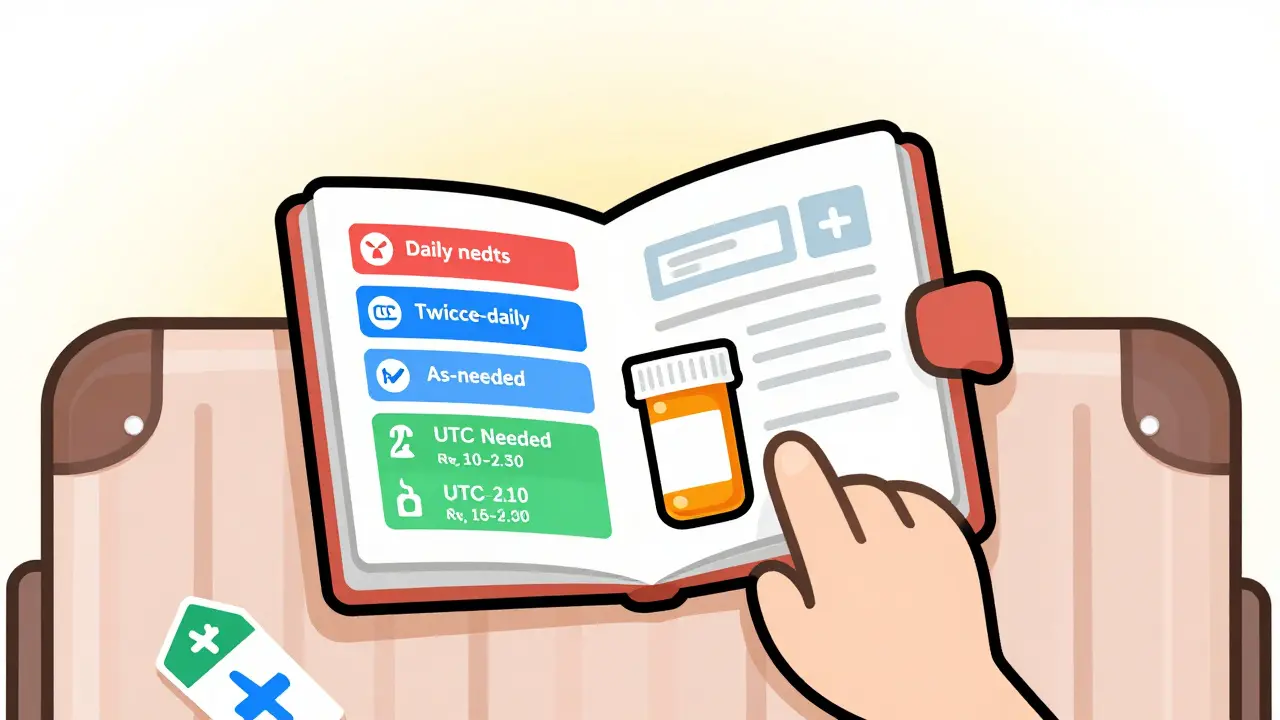
- Create a color-coded chart. Write your meds, doses, and UTC times on a sheet of paper. Use red for daily, blue for twice a day, green for as-needed. Keep it in your wallet.
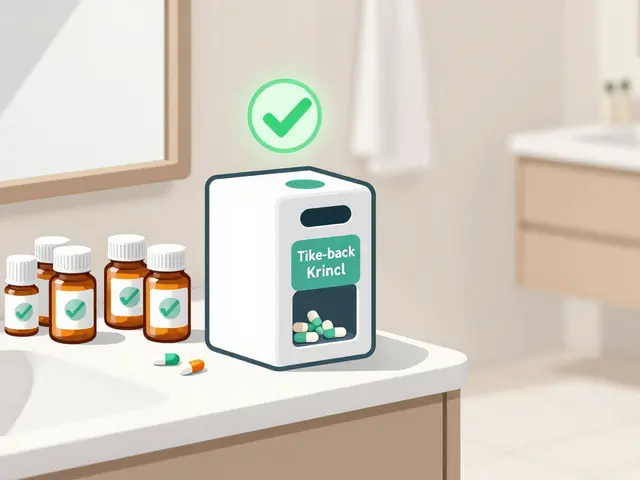
- Carry meds in original bottles. Even though TSA says you don’t have to, many countries do. If you split pills into a pill organizer, keep the original bottle in your checked luggage as backup.
- Check your destination’s rules. Search “[Country] import prescription medication 2026” on their government health site. Don’t trust travel blogs.
One traveler on Reddit took double doses of levothyroxine after misreading “take on empty stomach” in Prague. She ended up in the ER. She didn’t have a doctor’s letter. Her label didn’t have UTC time. She didn’t know the local name for the drug. All preventable.
What to Do If You Get Stopped
If customs asks about your meds:- Stay calm. Don’t argue.
- Hand them your original bottle, doctor’s letter, and travel label.
- Point to the UTC time and generic name.
- If they’re confused, say: “This is a standard international travel label. The WHO recommends this format.”
Some countries still don’t recognize the WHO guidelines. If they insist on confiscating your meds, ask for a receipt and contact your embassy. Don’t panic-most cases are resolved within hours.
The Future Is Here-But You Still Need to Act
New tech is coming. IATA and WHO launched the Universal Medication Travel Card in March 2024. It’s a digital card linked to your prescription that auto-checks country rules when you scan it. Forty-seven airlines now support it. But it’s not mandatory yet. You still need a physical label.Augmented reality labels are being tested in Singapore and Dubai. They’ll show you the correct time based on your GPS. But that’s still a pilot program. Don’t wait for tech to save you. Do the work now.
By 2025, all international prescriptions must include a “travel supplement” with UTC timing and multilingual names. That’s the law. But it’s not in effect yet. So if you’re traveling in 2026, you’re still in the old system. Be prepared.
Medication errors during travel cause over 15,000 hospitalizations a year, according to Dr. Robert Steffen of the International Society of Travel Medicine. Most are avoidable. You don’t need to be a pharmacist to get it right. Just read the label. Convert to UTC. Know the rules. And never assume anything.
Do I need to keep my pills in the original bottle when flying?
Yes, for international travel. While TSA in the U.S. allows meds in pill organizers, many countries require original containers with your name and prescription info. Customs agents may not recognize a pill in a plastic case-even if it’s labeled. Keep your meds in original bottles. Use a pill organizer only as a backup, and store the original bottles in your checked luggage.
What if my prescription doesn’t have a generic name?
Ask your pharmacist to add it. Generic names are required in over 60 countries. For example, “Lipitor” becomes “atorvastatin.” If your label only has the brand name, you risk being denied entry or having your meds confiscated. Pharmacies in the U.S. are legally required to provide this info-you just have to request it.
How do I adjust my insulin schedule across time zones?
Insulin requires careful planning. For trips under 8 hours, keep your home schedule. For longer trips, work with your doctor to create a transition plan. For example, if you’re flying east and lose 6 hours, you might delay your evening dose by 2 hours and advance your morning dose by 4 hours over two days. Never skip a dose. Use the WHO app to calculate exact UTC times. Always carry extra insulin and syringes in your carry-on.
Can I bring liquid medications on a plane?
Yes. Liquid meds are exempt from the 3.4-ounce rule, but you must declare them at security. Keep them in their original bottles with clear labels showing your name and dosage. Bring a doctor’s note. Some countries require the concentration per milliliter (e.g., “5 mg/mL”) to be printed-check your destination’s rules.
What’s the biggest mistake travelers make?
Assuming their label is enough. Most people look at the pill count and the name. They ignore the directions, the generic name, the UTC timing, and country rules. The biggest error? Taking meds based on local time instead of UTC. That’s how people end up double-dosing or missing doses. Always convert to UTC. Always check the country’s requirements. Always carry backup documentation.

14 Comments
Just got back from Tokyo and I can’t believe how much stress this could’ve saved me. My label said ‘ibuprofen’-no kanji, no UTC, nothing. Got pulled aside at Narita for 45 minutes while they called their pharmacy to verify. Turned out they had a guy who spoke English and recognized the brand, but holy hell, don’t be that guy. Ask your pharmacist to print a travel version. It’s literally 2 minutes of your time.
Also, the WHO app? Lifesaver. I used it to convert my blood pressure meds and didn’t miss a single dose. Seriously, download it now.
And yes-original bottles. Even if TSA doesn’t care, Bangkok customs does. I saw someone get their entire supply confiscated because they put everything in a Ziplock. Don’t be that person.
While I appreciate the practical advice, I must emphasize that this article’s tone risks inducing unnecessary panic among travelers who are already managing chronic conditions. The emphasis on ‘legal documents’ and ‘customs clearance’ may lead individuals to perceive routine medication as high-risk contraband. While vigilance is warranted, it should not be framed as a potential criminal liability. A more balanced approach-focusing on preparation rather than peril-would better serve the audience.
Wow. This is such a mess. You’re telling people to ask their pharmacist to add UTC times and generic names like it’s some kind of luxury service? Newsflash: most pharmacies in the U.S. are understaffed and overworked. They’re not printing custom travel labels. And if they do, they charge $30 for it. Also, ‘UTC’? That’s not a word most people know. Most patients don’t even know what ‘q24h’ means. You’re writing this like your audience has a pharmacy degree.
And don’t even get me started on ‘Japan requires kanji.’ That’s not the pharmacy’s job. That’s the traveler’s. If you can’t Google ‘ibuprofen kanji’ before you leave, maybe you shouldn’t be flying internationally. This whole post reads like a guilt-trip disguised as advice.
Okay, let’s be real. You’re telling people to use UTC for meds? That’s cute. But you’re ignoring the fact that most people don’t know what UTC is. I’ve seen patients try to convert their insulin doses using ‘UTC’ and end up taking it at 3 AM local time because they thought it meant ‘universal time’ and assumed that meant ‘your time zone.’
Also, the WHO app? It’s garbage. I used it last year in Germany and it told me to take my pill at 11:47 PM UTC, which was 1:47 AM local. My endocrinologist laughed and said, ‘Just take it when you wake up.’
Bottom line: stop overcomplicating it. Take your meds when you wake up. Take them with food if it says so. Don’t stress about UTC. Your body’s clock will adjust faster than your phone will.
Let me be blunt: this isn’t advice. It’s fearmongering dressed up as public service. You’re scaring people into thinking their meds are weapons. ‘You could be denied entry’? Yes. But only if you’re dumb enough to not read the label. ‘You could end up in a foreign hospital’? Only if you’re too lazy to ask your pharmacist for basic info. This isn’t rocket science. It’s responsibility. And if you can’t handle that, maybe you shouldn’t be traveling. The real problem isn’t the label-it’s the people who treat their health like an afterthought.
OMG I JUST REALIZED I DID ALL THIS WRONG 😭😭😭
I flew to Mexico last month with my levothyroxine in a pill organizer and my label only said ‘Synthroid’ and ‘take daily.’ I didn’t even know what the generic name was. I just took it when I woke up. I thought that was fine. I even took it with coffee because I was tired. I’m lucky I didn’t have a stroke.
Also, I didn’t know Mexico required Spanish on the label. I just assumed English was universal. I’m so embarrassed. I’m going to call my pharmacy tomorrow and demand a travel label. I’m also downloading the WHO app. And yes-I’m printing out the country rules. I’m gonna make a color-coded chart. I’m gonna cry when I do it. But I’m gonna do it.
Thank you for this. I’m not proud of myself, but I’m learning.
As someone from India who travels to the U.S. for medical care, I’ve seen both sides. U.S. labels are useless abroad. I had to get my insulin label rewritten by a pharmacist in Chicago because my Indian doctor’s note didn’t have the generic name. I had to pay $75 for it. And guess what? The U.S. pharmacy didn’t even offer it unless I asked.
So stop acting like this is some new revelation. People in developing countries have been doing this for years. You’re just catching up. And yes-UTC is the only way. Local time is a lie when you’re crossing 10 time zones. I’ve been using UTC for my diabetes meds since 2020. No one taught me. I figured it out the hard way. Don’t wait to be detained to learn.
Just wanted to say thank you. I’ve been on warfarin for 12 years and I’ve never thought about UTC. I just took it at 7pm, wherever I was. Last year I was in Italy and accidentally took my dose at 10pm local time because I thought I was ‘on time.’ My INR spiked. I ended up in an ER in Florence with a nurse who spoke zero English and had to point at my pill bottle while crying. I didn’t even know the generic name was ‘coumadin’ until then.
I’m calling my pharmacy tomorrow. I’m getting the label updated. I’m printing the WHO app instructions. I’m putting my meds in the original bottles. I’m not taking any chances anymore. This changed everything.
There’s a deeper question here: why do we outsource our bodily autonomy to labels and institutions? We’re told to trust the bottle, the pharmacist, the doctor, the WHO-but what if they’re wrong? What if the label is outdated? What if the country’s rules change overnight? We’re not just managing medication-we’re managing uncertainty. The real skill isn’t reading the label. It’s learning to navigate systems that weren’t built for you. The label is a crutch. The real safety is in knowing your own body, your own rhythm, your own limits-even when the world tries to dictate them.
Y’ALL. I JUST DID THIS. I’M SO PROUD OF MYSELF. I SPENT AN HOUR LAST NIGHT CALLING MY PHARMACY, PRINTING OUT COUNTRY RULES FOR JAPAN AND THAILAND, AND MAKING A COLOR-CODED CHART WITH MY DOCTOR’S LETTER ATTACHED. I EVEN PUT THE UTC TIMES ON A STICKER ON MY BOTTLE. I’M TAKING MY MEDS AT 11:00 UTC EVERY DAY NOW. I DON’T CARE IF I’M IN TOKYO OR TALLINN-I’M CONSISTENT.
AND GUESS WHAT? I FEEL LIKE A SUPERHERO. I’M NOT JUST TRAVELING-I’M PREPARED. I’M NOT AFRAID. I’M NOT A VICTIM OF THE SYSTEM. I’M THE PERSON WHO READS THE LABEL.
TO EVERYONE WHO’S BEEN SCARED: YOU CAN DO THIS. IT’S NOT HARD. IT’S JUST IMPORTANT. AND YOU DESERVE TO BE SAFE OUT THERE.
Let’s be honest-this whole thing is a waste of time because Americans are lazy. You want a label with kanji? Then learn Japanese. You want UTC times? Then learn how to use a clock. You think the rest of the world cares that your pharmacy didn’t print the right info? No. They care that you showed up unprepared. This isn’t about ‘travel safety.’ It’s about personal responsibility. If you can’t take 10 minutes to Google your meds before you fly, you don’t deserve to leave the country. This article is just enabling entitlement.
Bro. I flew to Cancun with my Adderall in a pill organizer. Got stopped. They took it. Said it was ‘controlled substance without proper documentation.’ I had the prescription. But no original bottle. No generic name. No UTC. No doctor’s letter. Just a little white pill in a plastic case.
I cried in the airport. I called my mom. I had to fly back home without my meds for 3 weeks. My ADHD went full chaos mode. I forgot my own birthday.
Now I carry my meds in the original bottle. I have the label printed in Spanish. I have the UTC times written in Sharpie on the bottle. I have the WHO app on my lock screen. I’m not doing that again. If you’re not doing this, you’re one flight away from disaster. I’m not joking. This is real life.
Why is this even a thing? Why do we need a 1500-word essay to tell people to read the label? This isn’t a guide. It’s a parenting manual for adults who can’t follow basic instructions. If you can’t tell the difference between ‘Lipitor’ and ‘atorvastatin,’ maybe you shouldn’t be managing your own meds. This article treats people like children. It’s condescending. And honestly? A little insulting.
This is exactly why I started my travel-medication prep workshops. I’ve helped over 800 people-mostly seniors and new parents-create their own ‘Travel Med Kit.’ We do it together: print the label, write the UTC, make the color chart, print the country rules. One woman from Ohio said, ‘I didn’t know I was allowed to ask my pharmacist to do this.’ She cried when she realized she had rights.
You’re not a burden. You’re not a problem. You’re a person who deserves to be safe. This isn’t about being perfect. It’s about being prepared. And you? You can do this. One label. One step. One time zone at a time.